Dream Dictionary
Twenty-four symbols, chosen by what people search for rather than by alphabet. Every entry leads to a real page.
Showing 24 of 24
| Symbol | How it is usually read | On the page |
|---|---|---|
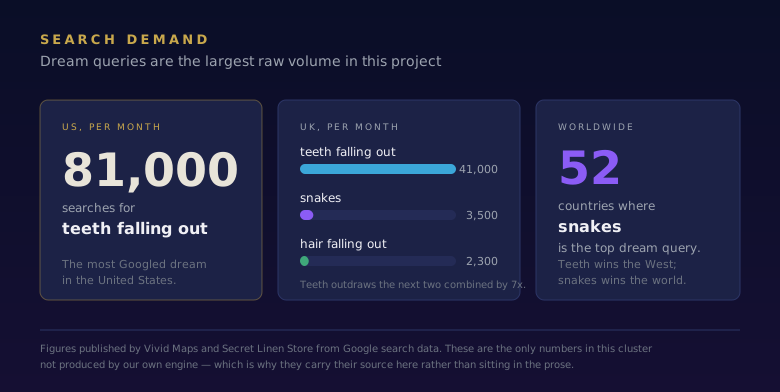
| Teeth falling out81,000 searches a month (United States) · Ahrefs US volume, Sep 2026 | Control slipping, or a change already underway that cannot be held back. | 6 variationsfolk traditionbody sensationoften recurs |
| Snakes3,500 searches a month (United Kingdom) · Google Trends UK, Sep 2026 | Something hidden, dangerous or transforming — read very differently across cultures. | 5 variationsfolk traditionoften recurs |
| Hair falling out2,300 searches a month (United Kingdom) · Google Trends UK, Sep 2026 | Exposure and ageing; the loss is public in a way tooth loss is not. | 4 variationsfolk traditionbody sensation |
| Being chased | Avoidance given a shape: the thing pursuing is usually the thing not faced. | 5 variationsfolk traditionbody sensationoften recurs |
| Falling | Support giving way, and the moment before impact rather than the impact. | 4 variationsfolk traditionbody sensationoften recurs |
| Flying | Freedom and the effort it costs — how easily you fly is the whole reading. | 4 variationsfolk traditionbody sensationoften recurs |
| Water | Feeling itself, with its clarity or murkiness doing most of the work. | 6 variationsfolk tradition |
| Death | An ending rather than a death; the oldest and most consistently misread symbol. | 5 variationsfolk tradition |
| Pregnancy | Something developing that is not ready to be seen yet. | 4 variationsfolk traditionbody sensation |
| Baby | A new responsibility, or a part of yourself that needs tending. | 5 variationsfolk tradition |
| An ex-partner | Unfinished business, more often with a version of yourself than with them. | 4 variationsmodern symboloften recurs |
| Spiders | Entanglement and patience — the web is usually the point, not the spider. | 5 variationsfolk traditionbody sensation |
| A house | The self as a building: rooms you know, rooms you forgot, rooms you never opened. | 5 variationsfolk traditionoften recurs |
| A car crash | Loss of control over direction, usually somewhere you are the driver. | 5 variationsmodern symbolbody sensation |
| Fire | Destruction and clearing at once, which is why it reads well and badly at the same time. | 5 variationsfolk tradition |
| Money | Worth rather than wealth — what you think you are owed or owe. | 5 variationsfolk tradition |
| An exam | Being measured, and the fear of being found unprepared for it. | 5 variationsfolk traditionoften recurs |
| Missing a flight | A window closing — the modern form of an old anxiety about timing. | 5 variationsmodern symboloften recurs |
| Naked in public | Exposure without the option of covering, and who notices matters. | 5 variationsfolk traditionbody sensation |
| Cats | Independence and instinct, read as fortune or warning depending on the tradition. | 5 variationsfolk tradition |
| Dogs | Loyalty, protection, and sometimes the threat that loyalty turns into. | 5 variationsfolk tradition |
| Blood | Vitality and cost in the same image: what something is taking out of you. | 5 variationsfolk traditionbody sensation |
| Drowning | Feeling past the point of managing it — water with the volume turned up. | 5 variationsfolk traditionbody sensation |
| A wedding | Commitment and its witnesses; who is present says more than the ceremony. | 5 variationsfolk tradition |
What a dream symbol actually is
A dream symbol is a recurring image that enough people report for its readings to have been written down. That is a weaker claim than most dictionaries make, and it is the accurate one.
It does not mean the image has a fixed meaning
It does not mean the image carries a fixed meaning. It means that when thousands of people dream about losing teeth, the readings that have accumulated around that image are worth knowing, because they are a record of what other people made of the same experience. Whether any of them fits your dream is a question only you can answer.
How to use a dream dictionary, then
This matters for how you use a dream dictionary. The useful move is to read several framings and notice which one produces a reaction — not to look for the one true answer and accept it. A reading that lands is telling you something about your own situation. A reading that does not is telling you nothing at all, and there is no obligation to make it fit.
Nothing here says "your dream means"
It is also why nothing in this dream dictionary says "your dream means". The entries say how a symbol is commonly read, which is a claim that can be true, rather than a claim about you, which cannot be checked by anyone.
Four ways to read the same symbol
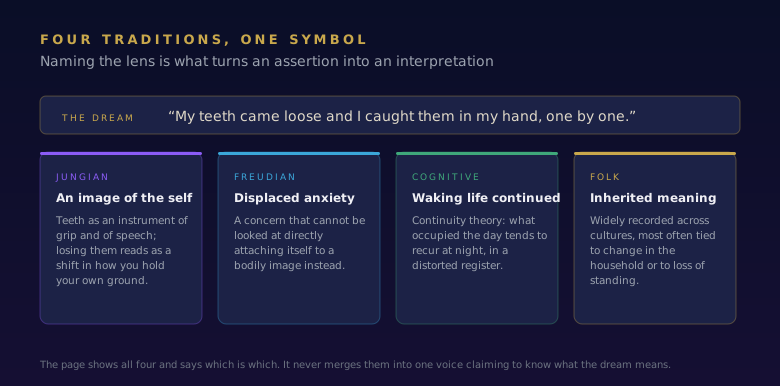
Dream dictionaries usually give one voice and do not say whose. Separating the traditions is both better content and a more honest structure, because it shows that the disagreements are real.
The Jungian reading
The Jungian reading treats the image as belonging to a shared vocabulary rather than a personal one. A snake is not your snake; it is the snake that appears in myth and ritual across cultures that never met, which is why the reading looks for what the image does rather than what it reminds you of.
The Freudian reading
The Freudian reading goes the other way: the image is a disguise, and the work is to see what it is standing in for. It is the tradition most often parodied and it produced the durable observation that the feeling in a dream is often attached to something other than the thing it appears to be about.
The cognitive or continuity reading
The cognitive or continuity reading is the one closest to current sleep science. It holds that dreams continue waking concerns rather than encoding messages — that you dream about an exam because being assessed is on your mind, not because the exam stands for something else. On this account the useful question is never "what does it mean" but "what in my week does this resemble".
The folk tradition
The folk tradition is the oldest layer and the one with the least explanation attached. It is where "a snake means betrayal" comes from, and its readings vary sharply by culture, which is itself informative: a symbol read the same way everywhere is behaving differently from one that is not. Three of the twenty-four dream symbols here have no folk tradition at all, because the thing in the dream did not exist before the twentieth century, and their pages say so rather than inventing one.
The feeling attached changes the symbol
The single most common mistake in using a dream dictionary is looking up the object and ignoring the tone. The same image with a different feeling is, for practical purposes, a different dream.
Flying is the clearest case
Flying is the clearest case. Flying easily and flying while struggling to stay above the rooftops are reported as entirely different experiences, and they read differently — the first around freedom, the second around effort that is only just sufficient. The object is identical. Nothing about "flight" as a symbol distinguishes them.
It runs through the whole list
It runs through the whole list. Losing teeth painlessly and losing them with blood; a house you know and a house you have never been inside; being chased and finally turning to face what is chasing you. Where a variation is common enough to have its own body of readings, it gets its own section on the dream symbol page instead of being flattened into the main entry.
Hold on to two things
So when you look something up here, hold on to two things: what was in the dream, and how it felt. The second is the one people forget by lunchtime, and it is the one doing most of the work.
Why the same dream comes back
Recurring dreams are common, and the recurrence is more informative than the content. A dream symbol that appears once is an image; a symbol that appears eleven times over two years is a pattern, and patterns can be checked against your life in a way single images cannot.
What the continuity account says
The continuity account explains it simply enough: an unresolved concern keeps generating similar material, so the dream repeats as long as the situation does. That predicts something checkable — recurring dreams tend to stop or change when the circumstance around them changes — and people who keep records do report exactly that.
The argument for keeping a record
Which is the argument for keeping a record. You cannot notice a pattern retrospectively if you did not write the entries down, and memory for dreams is famously bad: most are gone within minutes of waking and the rest are reshaped by the telling. Nine of the twenty-four symbols here are commonly reported as recurring, and those pages carry a section on what to do with that.
How this dictionary is different
The large dream dictionaries in this category run to five or twenty thousand entries. One competitor has 21,088. That is not an advantage; it is the shape of thin content, where most entries are two sentences that could apply to anything.
Twenty-four is a deliberate limit
Twenty-four is a deliberate limit, the same discipline that capped the moon calendar here at sixteen years rather than the 136 a competitor publishes. Each of these has enough written about it to be worth a page, and the ones people actually search for are a short list — the four with published search figures are marked in the table above, with the source next to the number.
And every entry carries the lunar context
The other difference is the lunar context. Every dream symbol page carries the moon phase, illumination and sign for a night you name, computed rather than asserted, and checkable against any almanac. It is the only thing on a page in this category that can be verified, which is precisely why it is there.
Questions people ask about dream symbols
- How were these twenty-four chosen?
- By measured search demand rather than alphabet. Teeth falling out is the most searched dream in several markets; snakes is the top dream query in a large number of countries. Where a published figure exists it is shown in the table with its source, and most symbols have no figure, which is left blank rather than estimated.
- Will you add more symbols?
- Possibly, after these have run long enough to measure. Adding hundreds of thin entries to match a competitor’s count is the failure this list is built to avoid.
- Where do the meanings come from?
- Four named traditions — Jungian, Freudian, cognitive-continuity and folk — set out separately on each page rather than blended into one anonymous voice. Where they disagree, the page says so.
- Does the moon phase affect what I dream?
- The published research is contested: a 2013 laboratory study found an effect on sleep, a much larger 2014 re-analysis found none, and a 2021 field study found a small effect on the nights before the full moon, attributed to moonlight after dusk. The lunar block on each page is context you can check, not a cause.
- Do I need an account?
- No. Every page here is free, ungated and free of AI. Nothing you enter is stored.
- What if my dream is not on the list?
- Look up the nearest dream symbol and read the variations, which is where most specific dreams actually live. A dream about a flood is a water dream; a dream about a burning house is on both the fire and the house page.
Check the sky over the night you dreamed it
One date gives you the phase, the illuminated fraction and the sign the Moon held in the small hours — anchored at 3am rather than midday, because that is when the dreaming happens.