Ask Your Chart
One question, answered from the placements it actually depends on — each shown with its degree, so you can check it.
Free. No signup. Nothing is stored unless you save your birth details.
Or start from one of these
What this actually does with your question
The interesting part is what it refuses to do. A chart has ten bodies, twelve houses, four angles and several dozen aspects between them. Handed all of that, anything can be made to support anything: there is always some placement that fits the answer you already had in mind. That is how astrology software ends up sounding convincing and saying nothing.
A fixed, short list per area
So each area of life has a fixed, short list of factors, decided in advance and not per question. A question about money is read from the second and eighth houses, their rulers, Venus, Jupiter and Saturn. Not from whatever happens to look supportive. The list is on the page, and it is the whole list.
Which is what makes the answer checkable
That constraint is also what makes the written answer checkable. The model that phrases it receives only those factors, and an answer naming anything else is rejected rather than shown — because the panel underneath would have no line to point at.
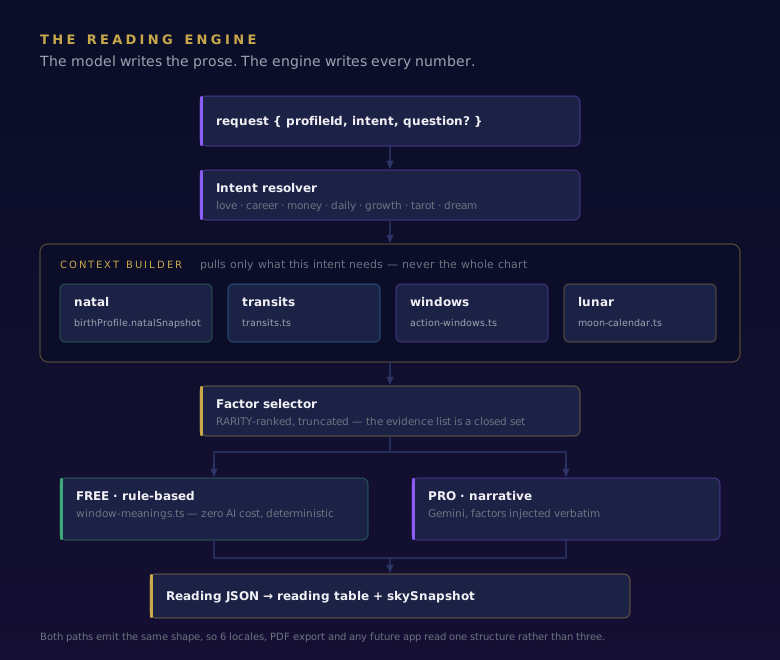
What each area is read from
These are the complete lists. They are fixed in advance, identical for every chart, and published here because a method nobody can inspect is a method nobody should trust.
- Love
- Venus, the Moon and Mars, the fifth and seventh houses, and the planets ruling those two cusps. Venus for what you are drawn to, the Moon for what settles you, Mars for how you pursue it.
- Career
- The Sun, Saturn and Jupiter, the Midheaven, and the tenth, sixth and second houses with their rulers. The Midheaven for direction, the sixth for the daily work, the second for what it pays.
- Money
- Venus, Jupiter and Saturn, plus the second and eighth houses and their rulers — what you earn and hold, and what you share or owe.
- Mind and communication
- Mercury and the Moon, with the third and ninth houses. The third for the near conversation, the ninth for the longer argument you are having with yourself.
- Home and feeling
- The Moon and Saturn, with the fourth and tenth houses. Those two are one axis, which is why a question about home so often turns out to be a question about work.
- Growth
- Saturn, Chiron and the North Node, with the ninth and twelfth houses. The slowest-moving set, and the one where a transit lasts years rather than weeks.
- Energy
- The Sun, Mars and the Ascendant, with the first and sixth houses — the body, its pace, and the habits that either hold it up or wear it down.
A question that matches none of them is read from your Sun, Moon and Ascendant instead. Notice that no list contains everything: that is the point, and it is why an answer here can be checked against a panel short enough to read.
How your question is sorted into an area
By matching words, not by a model. The resolved area is always shown as a control you can change, which is the point: a keyword matcher gets things wrong, and a wrong guess that you can see and correct in one click costs nothing. A wrong guess you cannot see would answer a question about money with a reading about relationships and give you no way to tell why.
When nothing matches
When nothing matches, it says so and falls back to your Sun, Moon and Ascendant rather than picking an area at random. That is the honest failure, and it is also usually the moment to pick an area yourself.
Matching runs in all six languages
Matching runs in all six languages the site speaks. Two things it learned the hard way: German compounds, so a question about a Jobwechsel has to match the stem inside the compound, and a Turkish question opening with İ lowercases to a letter plus a combining dot, which silently broke every Turkish keyword until it was normalised.
Why every answer shows its working
Because the alternative is unfalsifiable. An astrology answer with no placements attached cannot be wrong, which sounds like a strength and is the opposite: nothing that cannot be checked can be trusted either.
Every placement carries its degree
Every placement on this page carries its degree. Put your birth details into any ephemeris and the numbers should match to a fraction. If they do not, we are wrong, and you can see that we are — which is the only version of trust worth having in this category.
The same applies to the transits
The same applies to the transits. They are found by scanning the ephemeris and bisecting to the boundary where an aspect enters and leaves orb, not looked up in a table of pre-written dates.
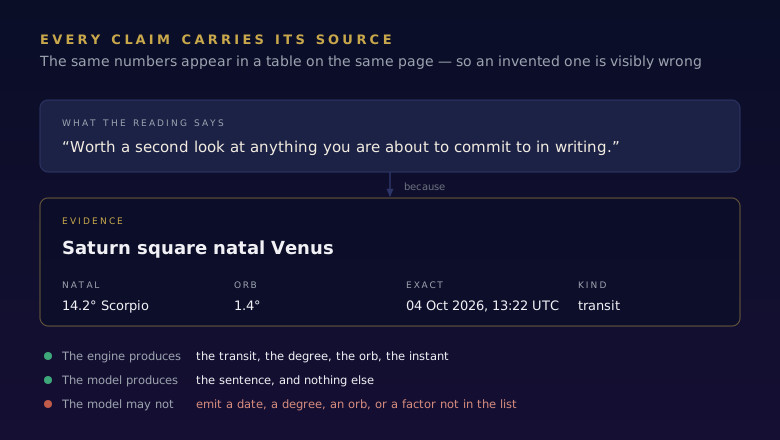
What it will not tell you
It will not predict events. The guidance attached to each transit is about the timing of your own actions — a period where a contract is worth reading twice, not a contract that will arrive on Thursday. The first is usable and you can check it against your own week; the second is neither.
No medical, legal or financial advice
It will not give medical, legal or financial advice, and the written answer is instructed not to tell you what to decide. It describes patterns and timing. The decision stays yours, which is also the only honest position a chart can take.
Without a birth time, houses and angles are dropped
And when your birth time is unknown, it drops houses and the angles entirely rather than deriving them from a noon guess. That removes about half of what some questions would otherwise draw on, and says so — which is better than a confident answer built on cusps that could be four hours out.
Your chart already knows the shape of the question
The calculation is free and stays free. Pro adds the written answer, unlimited questions, and the year-scale timing that goes with them.