Free tarot reading
Shuffle, pick three, and see where they fall. Each card rules ten degrees of the zodiac — we check whether anything in your chart, or in the sky right now, is standing there.
The topic frames what you hold in mind while you pick. It does not change the deck.
- Behind
- Now
- Ahead
Shuffled in your own browser with a cryptographic random source.
The correspondence, shown
Every Minor Arcana from Two to Ten rules one ten-degree slice of the zodiac. Here are four of the thirty-six, with the arc each one holds.
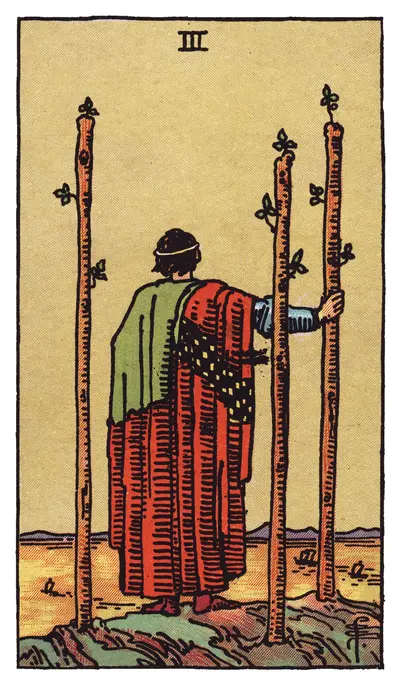
Three of Wands
Aries 2 · 10°–20°
Sun
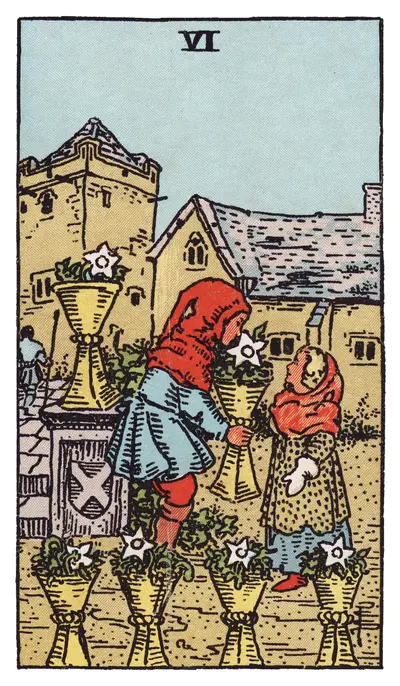
Six of Cups
Scorpio 2 · 220°–230°
Sun
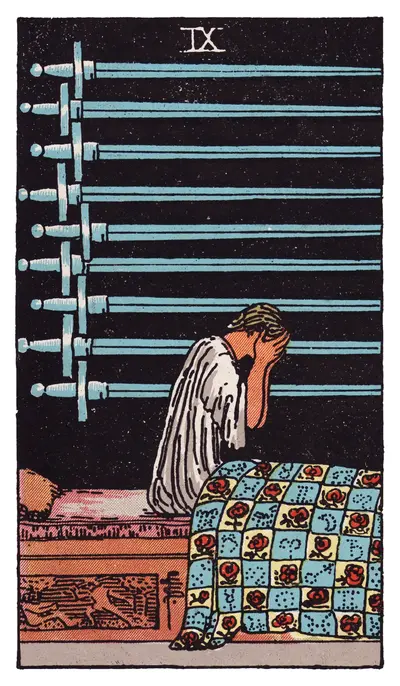
Nine of Swords
Gemini 2 · 70°–80°
Mars
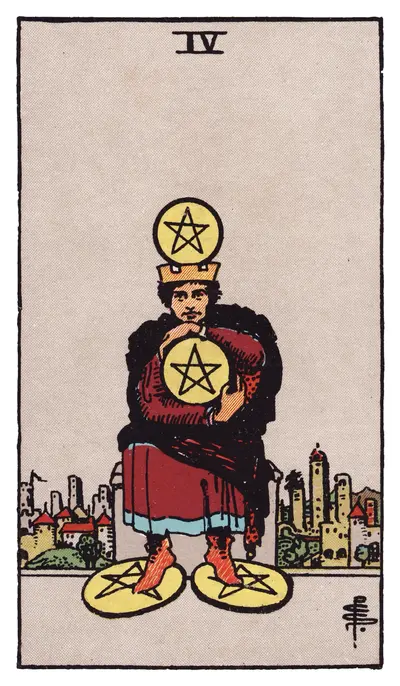
Four of Pentacles
Capricorn 3 · 290°–300°
Sun
The degrees come straight from the same table the draw uses, so what you read here is what the tool checks your chart against.
Why a tarot reading lands differently when it knows your chart
Here is the fact the rest of this page rests on. The thirty-six Minor Arcana from Two to Ten each rule one ten-degree slice of the zodiac, and those thirty-six slices cover the circle exactly once. Every degree of your birth chart therefore already has a card attached to it, and has had since you were born.
This is a correspondence, not an interpretation
That is not an interpretation. It is a correspondence the Hermetic Order of the Golden Dawn published in the 1890s, it has not moved since, and it is reproduced in every standard reference. What it means in practice is that your Venus, wherever it is, sits inside exactly one of those thirty-six cards, and so does everything else in your chart.
What a generic reading cannot do
A generic tarot reading cannot tell you that. It has no idea where anything of yours is, so the most it can do is describe the card. When you turn over the Six of Cups on a site that knows nothing about you, it can say what the Six of Cups means. It cannot say that the Six of Cups is the card your Venus has been standing in your whole life.
The one thing this page does
This page can, and that is the only thing it does that a thousand other tarot sites do not. It is also a small claim, deliberately: a coincidence between a card you happened to pick and a degree fixed at your birth is interesting, it is checkable, and it is not evidence of anything beyond itself.
What is a tarot reading?
In one sentence
A tarot reading is a set of cards drawn from a 78-card deck and interpreted in relation to a question, where each card’s position in the spread shapes what it is taken to mean.
The deck splits in two
The deck splits in two. Twenty-two Major Arcana, numbered zero to twenty-one and usually read as the large structural themes of a situation. Fifty-six Minor Arcana in four suits of fourteen — Wands, Cups, Swords and Pentacles, which are fire, water, air and earth — read as the texture and detail.
Upright, reversed, and a genuinely contested question
A card can come out upright or reversed, and what a reversal means is one of the few genuinely contested questions in tarot: it blocks the upright meaning, inverts it, or turns it inward. All three positions are defensible. This page draws upright only, for the reason given further down.
The spread, and what a position adds
A spread is the layout, and the positions carry meaning of their own. The three-card line above is the most common one there is: what is behind the question, what is present in it, and what is ahead. The same card in the first slot and the third slot is not making the same statement, which is why a keyword list read card by card flattens a reading.
How to get your tarot reading in four steps
- 1Choose a topic. Love, career, money, growth, or an open question. This frames what you are holding in mind while you pick — it does not filter the deck, and the page says so on the button rather than letting you assume it does something it does not.
- 2Focus the question. The most useful questions are about what you should do rather than about what will happen, and the difference is not a technicality: a reading can help with the first and has nothing to offer on the second. "How am I approaching this?" beats "will it work out?".
- 3Pick your own three cards. The deck is shuffled in your browser with a cryptographic random source, and you choose from the fan — nobody on our side decides which cards come up, and nothing about your question reaches the shuffle. The picking is the part that is yours.
- 4Read the cards, then the astrology layer. Each card comes back with the ten-degree arc it rules, and with anything of yours or anything in the sky that is standing inside that arc. Most spreads have no contacts at all; that is a normal result and the page says so rather than dressing it up.
What your reading actually shows you
Three layers, and they are different kinds of thing, so the page keeps them visually apart rather than blending them into one paragraph of prose.
Layer 1
The cards themselves
The first layer is the cards. Which three came up, in which positions, and what the tradition says about them. That layer is chance, exactly as a physical shuffle is, and it is presented as chance.
Layer 2
The arc each card rules
The second is the arc. Each numbered card from Two to Ten carries a decan — a sign, a decan number, a ruling planet and an exact degree range. That is a lookup, identical every time, and you can check any of it against any published correspondence table. Majors, Aces and Pages carry no arc, so those positions simply say so.
Layer 3
The contact, and it is the one worth waiting for
The third is the contact, and it is the one worth waiting for. If a body in your chart or a body in the sky right now happens to be standing inside one of those three arcs, the panel names it with its degree. Measured over thousands of draws against real charts, about two spreads in five produce at least one contact, so a spread with none is the more common outcome and not a failure.
Three questions this is actually good for
A spread is a thinking tool with a particular shape, and it fits some questions much better than others. These three are the ones it does well, and they have something in common: each is about what you are doing rather than about what will happen.
A question you keep coming back to.
The same worry about the same relationship, arriving every few weeks. Here the three positions do real work — the card behind is usually the part you already know and have stopped looking at, and seeing it named tends to be more useful than the card ahead. If the astrology layer lights up on a natal contact, that is worth a second look, because a fixed placement is exactly the kind of thing a recurring question tends to be built on.
A decision with a date on it.
An offer to accept or decline, a lease to sign, a conversation to have this week. Read the middle card hardest: it describes the position you are in now, which is the only part of a deadline you actually control. And if something is transiting one of the three arcs, the panel gives you its degree — a fast-moving body there is a matter of days, a slow one is the background to the whole decision.
A month with nothing particular in it.
No crisis, no deadline, just a stretch where you want a prompt. This is where an open question works better than a specific one, and where a spread with no contacts is perfectly fine — most are, and a reading that only felt worthwhile when the sky agreed would be training you to keep drawing until it did.
What the shape does not fit is a question with a factual answer. Whether someone is going to call, whether the job is yours, whether the test comes back clear — a spread has nothing to offer there, and a page that pretended otherwise would be selling certainty it cannot produce.
Tarot and astrology: the correspondence nobody computes
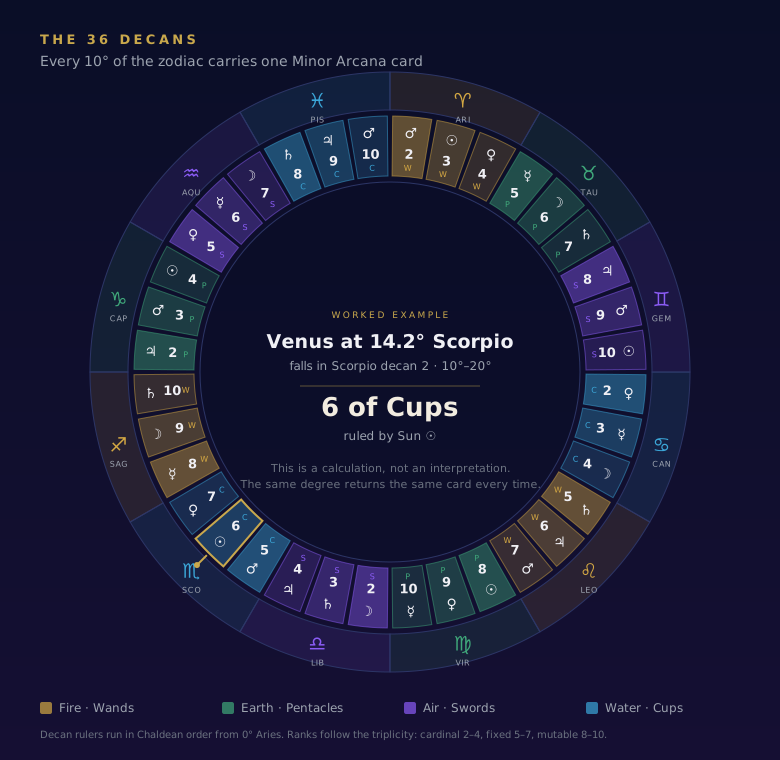
The link between the deck and the zodiac is not a modern invention and it is not vague. Each of the twelve signs divides into three arcs of ten degrees, thirty-six in all, an division far older than tarot that reached Western astrology through the Hellenistic tradition with a ruling planet attached to each arc.
Laid over an existing structure, not invented
The Golden Dawn laid the Minor Arcana over that existing structure rather than inventing a new one, and the fit is tight because it is constrained three ways at once. The suits follow the elements, so Cups take the water signs. The ranks follow the modalities, so Sixes take the fixed signs. And the rulers follow the Chaldean order of the classical planets by apparent speed.
A worked example, degree by degree
Take a worked example. A chart with Venus at 224.2 degrees of ecliptic longitude: divide by thirty and it is in Scorpio, with 14.2 degrees left over. That falls in Scorpio’s second decan, 220 to 230 degrees, which the Chaldean sequence gives to the Sun. Cups are water and Scorpio is water; Sixes are fixed and Scorpio is fixed. The Six of Cups. Nothing in that chain is a judgement call.
Why every card panel here carries a degree range
Which is why the fourth column of every card panel on this site carries a degree range, and why you are invited to check it. The correspondence is published, the degrees come from an ephemeris, and if the two disagree we have a bug. Almost nothing in the tarot category makes a claim that can fail that way, which is less a boast than an observation about how low the bar is.
Reading the cards yourself after the spread
Start with the shape rather than the cards. Which suits turned up, how many Majors, whether the ranks cluster low or high — that tells you what kind of question you are actually looking at, and it is visible before you have interpreted a single image. Three Majors in a three-card line is genuinely unusual; three Pentacles says the question is more practical than it felt.
Let the position do its work
Then let the position do its work. The card behind is context you may already know; the card now is what you are standing in; the card ahead is the direction of travel rather than a destination. A card that would read as a warning in the third slot often reads as a lesson already taken in the first.
Why reversals do not appear here
Reversals do not appear here, and the reason is structural rather than a preference. A reversal comes from the physical act of laying a card down the wrong way up. Nothing on this page is laid down — the cards are positions in a shuffled array — and a reversed decan would be a distinction the correspondence has no room for. The card meanings index covers upright and reversed in full for readings done with a physical deck, where the distinction is real.
When the same card keeps arriving
And if the same card keeps arriving, the useful response is not to look for a hidden mechanism. Seventy-eight cards and three slots means repeats across a handful of sessions are ordinary. What is worth noticing is the question you keep bringing, which is the part you control.
What this will not do
It will not predict events. The copy rules that govern every tool on this site apply here without exception: the timing of your own actions, never the prediction of what will happen, and nothing said that cannot be traced back to the card or the placement that produced it.
It will not tell you a draw mattered when it did not
It will not tell you the draw was meaningful when it was not. A spread with no contacts is reported as a spread with no contacts. A page that spoke up only on a hit would be a slot machine, and the honest version of this feature has to be willing to say that most of the time the cards are on their own.
It will not stand in for the chart
And it will not stand in for the chart. The astrology layer here checks three ten-degree arcs, which is under a thirtieth of the zodiac; it is a spotlight, not a reading of your chart. For that there is the birth chart calculator, which is free and gates nothing.
The cards that are yours do not change
The three above came from a shuffle. The ones fixed to your own degrees — your Sun, Moon, Venus and the rest, each standing in a decan — are the same today as the day you were born.