Missing a flight
A window closing — the modern form of an old anxiety about timing.
What dreaming about Missing a flight usually means
Missing a flight is the most purely modern symbol on this list — air travel did not exist before the twentieth century, so there is no folk tradition and the page says so rather than inventing one. What the missed-flight dream has instead is an unusually precise structure. A flight is a window that closes: it leaves at a fixed time, without you if necessary, and no amount of effort afterwards recovers it. That is a narrower idea than "anxiety" and it is what the accounts support. Reports of missing a flight cluster around opportunities with deadlines, around situations where preparation ran out of time, and around the specific feeling of watching something proceed without you. The detail that varies most and matters most is what caused it: arriving late, being in the wrong place, or being stopped by something procedural are three different complaints. There is one structural feature worth noticing before the variations: unlike almost every other symbol on this list, this dream has a clock in it. The deadline is part of the image rather than something a reader supplies, which is why the accounts are so consistent about the emotion and so varied about the cause. When you record one of these, the cause is the part that will identify the situation; the urgency will be the same every time.
Common variations
Arriving too late
The simplest version and the most common. Time ran out and nothing else went wrong, which makes it the cleanest statement of the flight symbol. It attaches to opportunities that had a deadline rather than to situations that went badly.
Losing your luggage
A distinct complaint: you reach the flight but without what you meant to bring. The accounts attach to moving into something new while having lost track of the preparation, and the detail people remember is what was in the bag.
Being at the wrong terminal
Effort correctly applied in the wrong place, which is a particular frustration and a recognisable one. It attaches to situations where the work was real and pointed somewhere that did not count.
Not having your passport
Procedural rather than temporal: everything is ready and you lack the one thing that permits it. The accounts attach to situations blocked by credentials, standing or permission rather than by capability.
The flight being cancelled
Not your fault, which changes the symbol entirely. The window closed and no effort on your part would have mattered, and the accounts attach to opportunities withdrawn rather than missed. The emotion reported is frustration without the self-reproach that runs through every other version on this page, and that absence is the most useful thing about it.
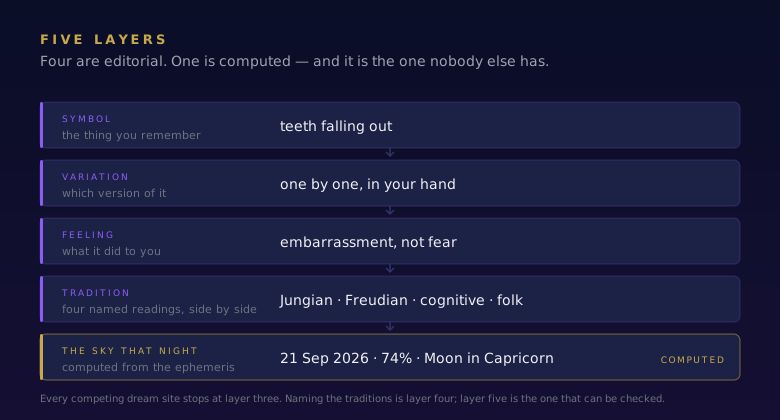
Four ways this is read
The Jungian reading
Treats the image as belonging to a shared vocabulary rather than a personal one, and asks what the image does rather than what it reminds you of. On this account the figures in a dream are closer to characters in a story everybody already knows than to coded references to your own week.
Would read the journey rather than the aeroplane — departure, threshold, the move from one state to another — and the missed flight as a transition not made. The tradition has no ancient material for this particular image and would not expect any: the structure is old, the vehicle is new.
The Freudian reading
Treats the image as a disguise and asks what it is standing in for. It is the most parodied of the four and it produced one durable observation worth keeping: the feeling in a dream is often attached to something other than the thing the dream appears to be about.
Predates air travel, so there is no direct reading. The general contribution applies and is worth stating: a dream about being prevented is frequently attached to ambivalence rather than to obstruction, and the part of the dreamer that arrived late is sometimes worth as much attention as the part that wanted to go.
The cognitive or continuity reading
The one closest to current sleep science. It holds that dreams continue waking concerns rather than encoding messages, so the useful question is never "what does it mean" but "what in my week does this resemble". It is also the reading that explains recurrence most simply: an unresolved situation keeps producing similar material.
Has the most to say and needs the least interpretation. The dream is substantially more common among frequent flyers and rises sharply before an actual flight, where it continues a real concern. Outside that it asks what currently has a deadline, and the answer is usually immediate.
There is no folk tradition for this one
The thing in this dream did not exist before the twentieth century, so no pre-modern dream literature has anything to say about it. That is worth stating plainly rather than filling the gap: a dictionary that offers you an ancient reading of a missed flight is inventing one. The other three framings above still apply, and the continuity reading applies especially well, because a modern anxiety is exactly what it is built to describe.
How this one is usually misread
The misreading that sends people here is predictive — having the dream before a flight and wondering whether to change the booking. Nothing supports it, and the continuity account explains the timing without any prediction: the dream is more common before travel precisely because travel is on the mind. The second error is structural and belongs to the dictionaries. A number of them give this symbol an ancient or traditional reading. There is not one to give, and an entry that offers you a centuries-old interpretation of a missed aeroplane has invented the centuries.
The feeling matters more than the image
The emotion is unusually uniform for a symbol on this list — a particular futile urgency that people describe in almost the same words — which means the tone separates instances less here than elsewhere. What does separate them is whether you were still trying. A dream spent running through the airport and a dream that begins after the flight has gone are reported differently and attach differently: the first to something still in play, the second to something already lost. That is the detail worth writing down, and it is the one that disappears fastest.
If it keeps coming back
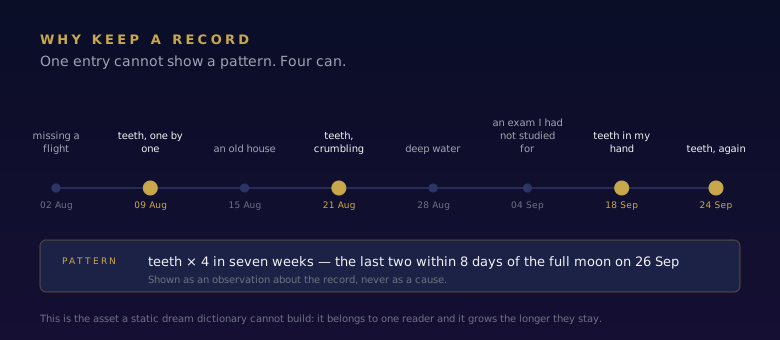
This is one of the symbols most often reported as recurring. The recurrence is more informative than the content: a single instance is an image, and eleven over two years is a pattern that can be checked against your life. The continuity account predicts something testable — recurring dreams tend to stop or change when the circumstances around them change — and people who keep records report exactly that.
The Moon on the night you dreamed it
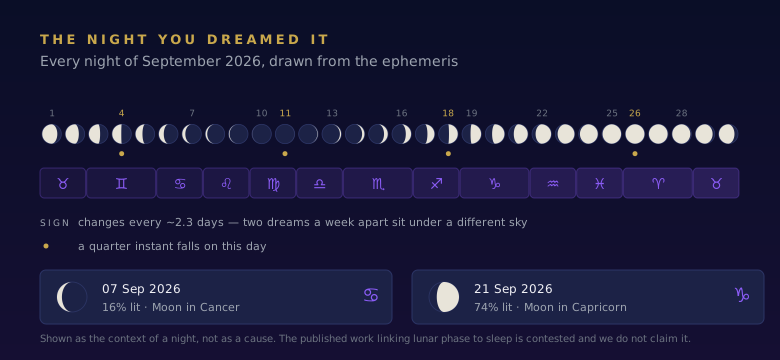
The one thing on this page that can be verified. Enter the night you went to sleep and you get the phase, the illuminated fraction and the sign the Moon held in the small hours, computed rather than asserted. It is context, not a cause — the published research on the Moon and sleep is contested, and the page on it says so.
Related symbols
These are descriptions of how a symbol is commonly read, never statements about you, and nothing here is medical or psychological advice.