Pregnancy
Something developing that is not ready to be seen yet.
What dreaming about Pregnancy usually means
Dreams of pregnancy are reported by people who are pregnant, people who are trying to be, people who emphatically are not, and men. That spread is the first thing to know about the symbol, because it means the dream cannot be primarily about pregnancy. The readings converge instead on something developing that is not ready to be seen: a project at the stage where talking about it would be premature, a decision being made slowly, a change underway internally with no external sign. What makes it distinctive among the symbols on this list is the time element. Almost nothing else in the vocabulary of dreams carries a built-in sense of a process with a duration and an arrival, and that is most of what the image contributes. Where the dreamer is actually pregnant the continuity reading applies flatly and needs no symbolism at all: the dream continues the largest thing currently on the mind.
Common variations
Dreaming you are pregnant when you are not
The commonest version and the one people find most startling. Accounts of it attach to early-stage work far more often than to anything about children, and the recurring detail is whether you had told anyone in the dream. Something being carried privately is usually the closer fit.
Dreaming someone else is pregnant
Shifts the whole reading onto that person and your relation to them. Reports of it cluster around situations where someone close is changing in a way you can see and they have not named. Occasionally it is read as envy, which the accounts support less often than the dictionaries suggest.
Giving birth
The arrival rather than the carrying, and reported with far more intensity — this is one of the more physically vivid dreams on the list. The readings attach to something finally becoming visible to others. What people remember is usually the effort rather than the outcome.
Finding you are already months along
A distinct and frequently reported version: the discovery that something has been developing much longer than you realised. It attaches to situations noticed late, and the emotion in the accounts is more often alarm at the timeline than anything about a child.
Four ways this is read
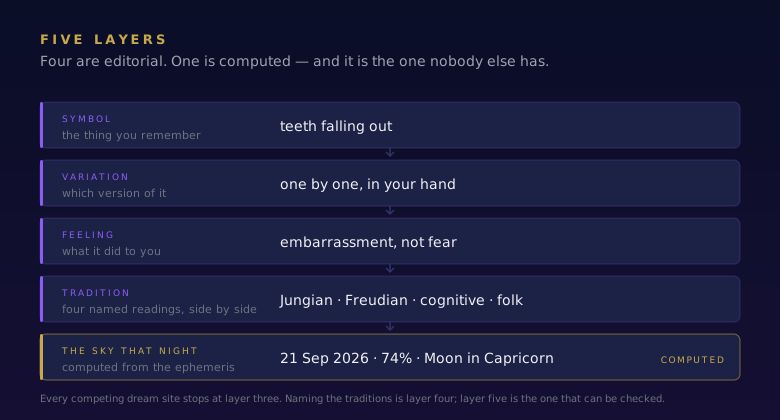
The Jungian reading
Treats the image as belonging to a shared vocabulary rather than a personal one, and asks what the image does rather than what it reminds you of. On this account the figures in a dream are closer to characters in a story everybody already knows than to coded references to your own week.
Reads pregnancy as the standing image for something forming below awareness before it can be expressed — and, unusually for this tradition, treats it as available to any dreamer rather than as belonging to women. The emphasis is on the interval, because on this account a thing that arrives fully formed was never the kind of change this symbol describes.
The Freudian reading
Treats the image as a disguise and asks what it is standing in for. It is the most parodied of the four and it produced one durable observation worth keeping: the feeling in a dream is often attached to something other than the thing the dream appears to be about.
Connected the image to wish and to the body in ways that were specific to a period and have aged poorly, particularly the readings applied to women. What survives is narrower: the dream is unusually common at points of transition, and a strong feeling attached to a future state can generate an image of that state already underway.
The cognitive or continuity reading
The one closest to current sleep science. It holds that dreams continue waking concerns rather than encoding messages, so the useful question is never "what does it mean" but "what in my week does this resemble". It is also the reading that explains recurrence most simply: an unresolved situation keeps producing similar material.
Points at the obvious first: the dream is most frequent among people who are pregnant, trying, or close to someone who is. Where none of those applies it asks the usual question, and the answer is usually something in development that has not been announced. It also notes that the physical sensations of the dream track ordinary bodily awareness during sleep.
The folk tradition
The oldest layer, and the one with the least explanation attached. Its readings vary sharply between cultures, which is itself informative — a symbol read the same way everywhere is behaving differently from one that is not.
Widely recorded and unusually inconsistent. Some traditions read a pregnancy dream as good fortune arriving, some as its opposite on the principle that dreams invert, and a number of European records tie it specifically to news travelling. The inconsistency is the informative part: a symbol read in opposite directions is one whose reading is cultural.
How this one is usually misread
The misreading in widest circulation is that a pregnancy dream is predictive, and it persists for a plain statistical reason: the dream is common, pregnancy is common, and nobody writes down the hundreds of instances where nothing followed. The same asymmetry keeps every predictive dream belief alive. The second and subtler error is treating the symbol as belonging to women. Men report this dream, the readings that matter apply to them identically, and a dictionary that frames the entry around female readers has narrowed a general symbol to part of its audience for no reason the traditions support.
The feeling matters more than the image
This symbol splits on tone more cleanly than most, and the split is not the one people expect. Delight and dread are both common, but the more informative distinction in the accounts is between dreams where the pregnancy is welcome and dreams where it is simply a fact being processed — the second is reported far more often and attaches to ordinary developments rather than to anything about children. The other detail worth recording is how far along it was. A dream at the beginning and a dream at the end of a pregnancy are reported as different experiences and map onto different stages of whatever the dream is actually tracking.
This one is felt, not only seen
People report this dream partly as a bodily sensation rather than an image — which is why it is remembered vividly and why it is hard to describe afterwards. The sensation is worth noting alongside the content when you write it down, because it is usually the part that changes between one instance and the next.
The Moon on the night you dreamed it
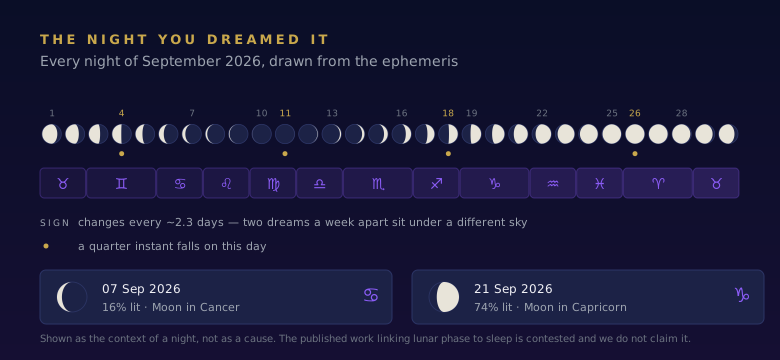
The one thing on this page that can be verified. Enter the night you went to sleep and you get the phase, the illuminated fraction and the sign the Moon held in the small hours, computed rather than asserted. It is context, not a cause — the published research on the Moon and sleep is contested, and the page on it says so.
Related symbols
These are descriptions of how a symbol is commonly read, never statements about you, and nothing here is medical or psychological advice.