Teeth falling out
Control slipping, or a change already underway that cannot be held back.
81,000 searches a month in United States, per Ahrefs US volume, Sep 2026.
What dreaming about Teeth falling out usually means
Losing teeth is the most searched dream in several countries, and the readings that have accumulated around it converge on one theme more than any other: something changing that cannot be held in place. Teeth are the part of the body that is both permanently fixed and, once gone, gone — which makes them an unusually exact image for a change that is irreversible and not chosen. The dream is commonly reported during periods of transition rather than crisis: a move, a job ending, a relationship shifting shape. It is also one of the dreams people describe as physical rather than visual, and that is worth separating from the content when you think about it. What the dream almost never turns out to be about, in the accounts people give afterwards, is teeth. Dentists do not report it more often than anyone else. The image borrows the body to say something about circumstances, which is why looking up "teeth" alone tends to produce a reading that sounds right and goes nowhere.
Common variations
Teeth falling out one by one
The slow version, and the one most often reported around a situation that is degrading gradually rather than ending at once. The sequence is usually what people remember — the sense of counting them, of it not stopping. Read against a circumstance that has been getting worse in increments small enough to keep absorbing.
Teeth crumbling rather than falling
Crumbling carries a different note from falling: the tooth does not leave cleanly, it breaks up in the mouth. The readings around it lean toward something that has lost its structure while still being in place — a role still held but no longer solid, an arrangement that technically continues.
Someone else's teeth falling out
Watching rather than experiencing shifts the whole dream. Accounts of this version usually attach to concern about another person, and the helplessness of watching is often the part that is remembered rather than the teeth. Worth noting who it was, because that detail does more work here than the symbol.
Teeth falling out with no pain
Frequently reported, and the absence is the striking part — something that should hurt does not. Read alongside a change that has not yet registered emotionally, or one that was expected long enough that its arrival is a relief rather than a shock.
Teeth falling out with blood
The version people wake from most abruptly. Blood adds cost to the image: the change is not only happening, it is taking something. Accounts of it cluster around circumstances where the loss is real rather than symbolic, and where there is nothing to be done about it.
Spitting teeth into your hand
The physical detail of holding them is the one people describe most vividly. It puts the loss in front of you as an object, which is a different experience from simply losing them. Often reported alongside a situation that has become undeniable after a period of not quite being looked at.
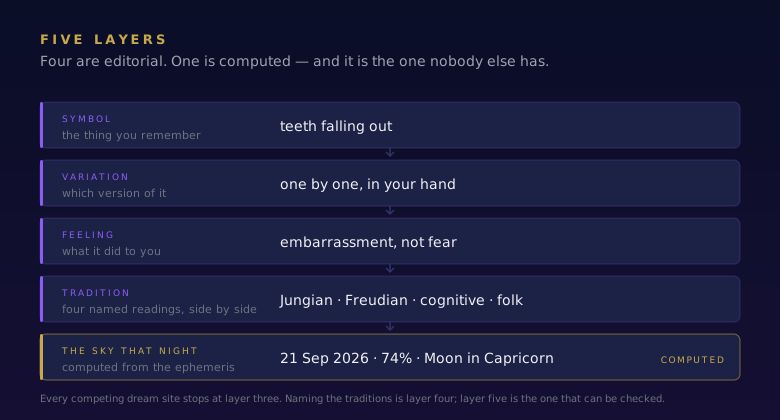
Four ways this is read
The Jungian reading
Treats the image as belonging to a shared vocabulary rather than a personal one, and asks what the image does rather than what it reminds you of. On this account the figures in a dream are closer to characters in a story everybody already knows than to coded references to your own week.
Reads the tooth as an archetypal image of vitality and capability rather than a personal reference — the thing you bite and hold with. Losing them appears in the same family as the loss-of-power images that recur in myth and folklore across unrelated cultures, which on this account is why the dream feels significant out of proportion to its content.
The Freudian reading
Treats the image as a disguise and asks what it is standing in for. It is the most parodied of the four and it produced one durable observation worth keeping: the feeling in a dream is often attached to something other than the thing the dream appears to be about.
Famously read it as displacement, with the anxiety attached to the mouth standing in for something else entirely. The specific readings that came out of this have not aged well, and the tradition is worth keeping here for the general observation rather than the particular one: the distress in the dream is real, and its object in the dream is usually not its object in waking life.
The cognitive or continuity reading
The one closest to current sleep science. It holds that dreams continue waking concerns rather than encoding messages, so the useful question is never "what does it mean" but "what in my week does this resemble". It is also the reading that explains recurrence most simply: an unresolved situation keeps producing similar material.
Points at the simplest explanation and has some support: the dream is unusually common during periods of change and among people under sustained pressure, and it does not require the image to stand for anything. There is also a plain physical account worth knowing — nocturnal tooth grinding produces exactly the jaw sensation the dream describes, and sensations during sleep get written into the narrative.
The folk tradition
The oldest layer, and the one with the least explanation attached. Its readings vary sharply between cultures, which is itself informative — a symbol read the same way everywhere is behaving differently from one that is not.
Widely recorded and strikingly consistent in its unpleasantness. Across a number of European and Asian traditions, a dream of losing teeth was read as a death in the family, sometimes with the specific tooth indicating who. That reading has no support of any kind, and it is included because people encounter it and are frightened by it, not because it is worth carrying.
How this one is usually misread
The reading people arrive carrying is that losing teeth foretells a death in the family. It is recorded across several European and Asian traditions, it is repeated in most of the large online dictionaries, and there is nothing behind it. It persists for a structural reason worth understanding: the dream is extremely common, deaths in extended families are not rare, and nobody writes down the hundreds of instances where nothing followed. That asymmetry is enough to keep a belief alive indefinitely without any connection existing. The second and gentler misreading is that the dream is about dental anxiety, which is testable and fails — people who fear the dentist do not report it more often. Both are worth knowing about mainly so that neither takes up space that the actual circumstances of the week could occupy.
The feeling matters more than the image
This is a symbol where the tone changes the reading more than the content does. Losing teeth with alarm and losing them with a flat, resigned calm are reported as different dreams, and they attach to different situations. Alarm tends to accompany a change that is arriving; calm more often accompanies one that has already happened and is being absorbed. The physical dimension matters too: people report this dream as felt in the mouth rather than seen, and that sensation often persists for a minute after waking. Worth writing down alongside the content, because it is usually the part that differs between one instance and the next and therefore the part that tracks what is actually going on.
This one is felt, not only seen
People report this dream partly as a bodily sensation rather than an image — which is why it is remembered vividly and why it is hard to describe afterwards. The sensation is worth noting alongside the content when you write it down, because it is usually the part that changes between one instance and the next.
If it keeps coming back
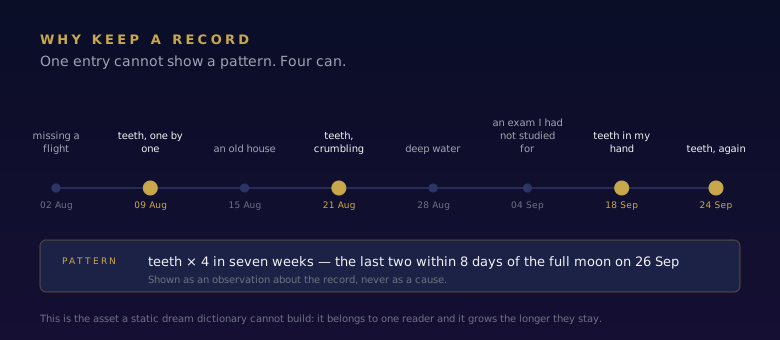
This is one of the symbols most often reported as recurring. The recurrence is more informative than the content: a single instance is an image, and eleven over two years is a pattern that can be checked against your life. The continuity account predicts something testable — recurring dreams tend to stop or change when the circumstances around them change — and people who keep records report exactly that.
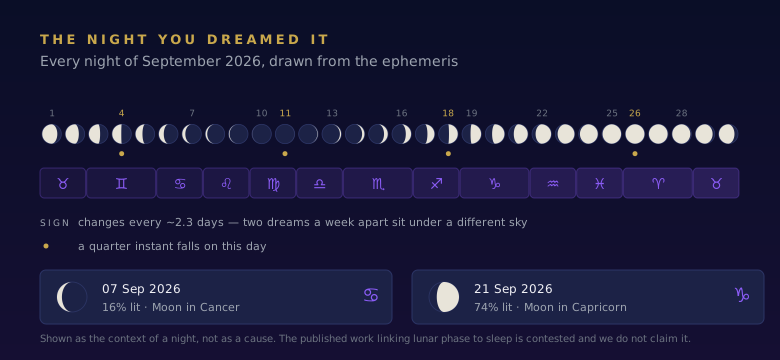
The Moon on the night you dreamed it
The one thing on this page that can be verified. Enter the night you went to sleep and you get the phase, the illuminated fraction and the sign the Moon held in the small hours, computed rather than asserted. It is context, not a cause — the published research on the Moon and sleep is contested, and the page on it says so.
Related symbols
These are descriptions of how a symbol is commonly read, never statements about you, and nothing here is medical or psychological advice.