A house
The self as a building: rooms you know, rooms you forgot, rooms you never opened.
What dreaming about A house usually means
The house is the most structurally interesting symbol on this list, because it is the one where the traditions agree on an architecture rather than a meaning: the building is the self, and its rooms are parts of it. That gives the symbol something almost none of the others have — an internal geography that makes the specific detail of a dream legible. A room you did not know about, a floor you never go to, a childhood home, a house falling apart: these are not variations on a theme but different statements in the same grammar. It is also the symbol that most often appears in combination, because a dream has to take place somewhere, and when it does the house is usually doing real work rather than acting as scenery. The question worth asking of any house dream is which part of the building you were in, and whether you had been there before.
Common variations
Finding rooms you did not know were there
The version people describe as the most interesting dream they have had, and one of the few on this list reported as pleasant more often than not. It reads as capacity discovered rather than acquired, and the accounts attach to periods after a change rather than before one.
A childhood home
Extremely common and usually read as a period rather than a place. The detail that carries information is what you were doing there, because the accounts divide sharply between visiting and being unable to leave.
A house falling apart
Damp, cracks, collapsing floors. The readings attach to something that has been neglected long enough to show, and the recurring detail is whether you were trying to repair it or watching. Reported more often during periods of overwork than during crises.
An empty house
Not derelict but unfurnished, which is a different image and reads differently: potential rather than decay. The accounts attach to beginnings and to periods after something has been cleared out, and the tone is more often neutral than sad.
Someone else in the house
An intruder or an unexplained presence, and the version that frightens people most. The readings attach to something in your own territory that you did not admit and cannot account for. Whether you saw them is the detail that most changes the accounts.
Four ways this is read
The Jungian reading
Treats the image as belonging to a shared vocabulary rather than a personal one, and asks what the image does rather than what it reminds you of. On this account the figures in a dream are closer to characters in a story everybody already knows than to coded references to your own week.
The tradition where this symbol does the most work. The house is read as the psyche laid out as architecture, with the upper floors as conscious life and the cellar as what is not looked at; the discovery of unknown rooms is one of the specific dream events this tradition treats as significant rather than incidental.
The Freudian reading
Treats the image as a disguise and asks what it is standing in for. It is the most parodied of the four and it produced one durable observation worth keeping: the feeling in a dream is often attached to something other than the thing the dream appears to be about.
Read the house as the body, with a set of specific correspondences that are now more quoted than used. The generalisable part: an enclosed space in a dream frequently carries a sense of what is inside and outside, and that distinction survives the particular readings built on it.
The cognitive or continuity reading
The one closest to current sleep science. It holds that dreams continue waking concerns rather than encoding messages, so the useful question is never "what does it mean" but "what in my week does this resemble". It is also the reading that explains recurrence most simply: an unresolved situation keeps producing similar material.
Points out that houses appear in dreams constantly because dreams need a setting and domestic interiors are the most rehearsed spaces anyone has. On this account many house dreams are scenery, and the symbol is only doing work when the building itself is doing something — changing, failing, revealing a room.
The folk tradition
The oldest layer, and the one with the least explanation attached. Its readings vary sharply between cultures, which is itself informative — a symbol read the same way everywhere is behaving differently from one that is not.
Reads the house as the household rather than the self: its condition is the family’s condition, and damage to it is read as difficulty for the people in it. That is a different architecture from the analytic one and a coherent one, and the two disagree about who the building is.
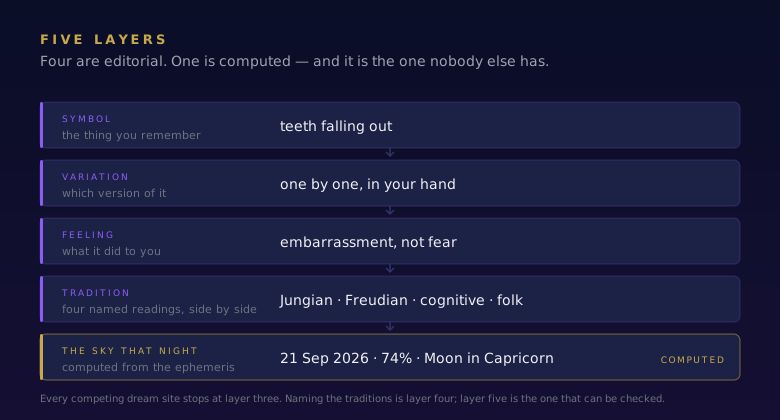
How this one is usually misread
The common error is treating the house as a place rather than a structure — reading the dream as being about somewhere you lived, when the traditions read the building itself. Under that reading a childhood home is nostalgia, when the accounts far more often make it a period of life; and unknown rooms become curiosities, when they are one of the specific events this symbol exists to describe. The second habit worth breaking is looking up the house and ignoring the room. A dream in a cellar and a dream on a top floor share a noun and almost nothing else, and an entry that gives them one reading has discarded the symbol’s only real advantage: that it has a geography.
The feeling matters more than the image
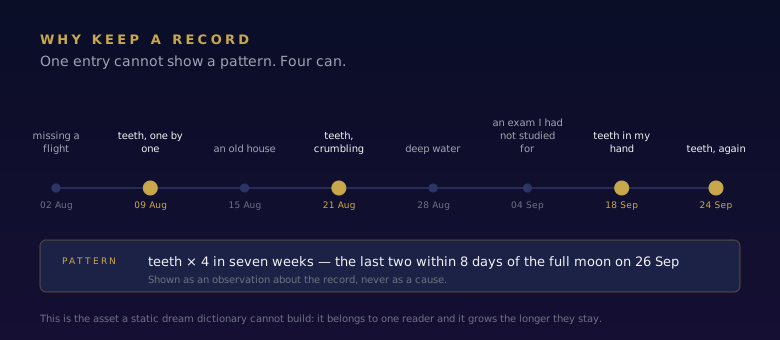
House dreams cover a wider emotional range than any other symbol here, from the delight of finding new rooms to the particular dread of an unexplained presence, and the tone is what identifies which kind of dream you had. The detail worth recording alongside it is orientation: which part of the building, and whether you were moving toward the unknown part or away from it. People who keep records often find that the same house recurs across years with the geography changing slowly, which is the sort of pattern that only becomes visible in writing and is completely invisible in a single entry.
If it keeps coming back
This is one of the symbols most often reported as recurring. The recurrence is more informative than the content: a single instance is an image, and eleven over two years is a pattern that can be checked against your life. The continuity account predicts something testable — recurring dreams tend to stop or change when the circumstances around them change — and people who keep records report exactly that.
The Moon on the night you dreamed it
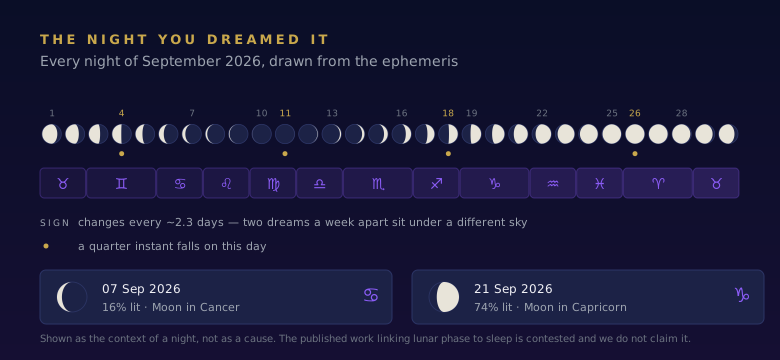
The one thing on this page that can be verified. Enter the night you went to sleep and you get the phase, the illuminated fraction and the sign the Moon held in the small hours, computed rather than asserted. It is context, not a cause — the published research on the Moon and sleep is contested, and the page on it says so.
Related symbols
These are descriptions of how a symbol is commonly read, never statements about you, and nothing here is medical or psychological advice.