Astrology calendar
Every sign change, station, exact aspect between planets, new and full moon and eclipse, month by month, timed to the minute in your own time zone.
Choose a year
- 2025 astrology calendar56 sign changes, 19 stations, 191 exact aspects and 24 new and full moons
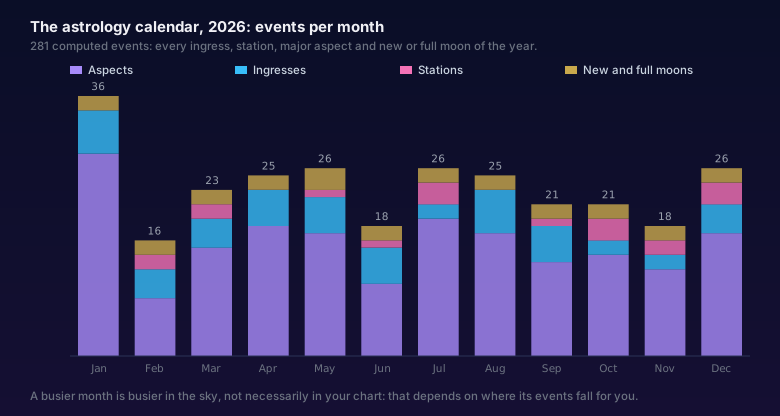
- 2026 astrology calendar50 sign changes, 18 stations, 188 exact aspects and 25 new and full moons
- 2027 astrology calendar52 sign changes, 17 stations, 188 exact aspects and 25 new and full moons
- 2028 astrology calendar47 sign changes, 17 stations, 198 exact aspects and 25 new and full moons
What is an astrology calendar?
Astrologers use it to time things. A Mercury station, a Jupiter ingress, a Sun–Saturn square or a full moon in a particular sign are all events that can be planned around, and the calendar says exactly when each one happens.
This one is computed rather than copied: every instant comes from the same ephemeris as the site's charts, found to the second and shown to the minute in the time zone your browser reports.
Four kinds of event
Each month's list mixes four kinds of entry. They differ in how long their influence is read as lasting.
Sign changes (ingresses)
The moment a planet crosses from one sign into the next. The Sun's ingresses into Aries, Cancer, Libra and Capricorn are the equinoxes and solstices. The Moon's, which come every two or three days, are on the moon calendar instead. A retrograde planet can back into the sign it just left, and that crossing is listed too.
Stations
The moment a planet appears to stop and turn: retrograde when it starts moving backwards against the stars, direct when it resumes. Mercury does it three or four times a year, the outer planets once. A planet moves very slowly near a station, which is why astrologers read the days around it as concentrated.
Exact aspects
The moment two planets are exactly 0°, 60°, 90°, 120° or 180° apart: conjunct, sextile, square, trine or opposite. The calendar lists every one between the Sun and the planets from Mercury to Pluto. Fast pairs are exact for a day or so; slow pairs like Uranus and Pluto stay close for months.
New and full moons, and eclipses
The moment the Moon is exactly conjunct the Sun (new) or opposite it (full), with the degree and sign. When a new moon is a solar eclipse or a full moon a lunar eclipse, the entry says so and gives its type.
How to read it
Start with the slow events, which shape months: stations of the outer planets, ingresses of Jupiter and Saturn, eclipses. Then the faster ones, which shape days: Mercury's stations and the Sun's aspects. The month pages open with where every planet stands on the first of the month, so you can see which slow configurations are already in play.
An event's exact moment is the peak, not the whole story: astrologers usually read an aspect from when it comes within a degree or so until it separates by the same amount. And what an event means for you depends on where it falls in your own chart, which the transit chart calculator shows.
How the calendar is computed
Ingresses are found by stepping a day at a time for a change of sign and narrowing it to the second; stations from the zero crossings of each planet's speed; aspects from the angle between every pair of planets; new and full moons from the same instants as the moon calendar, with eclipses matched to them. Tests check Mercury's 2026 stations against their published dates, the Sun's cardinal ingresses against the equinoxes and solstices, that every aspect is exact at the moment given, and a month of entries against astro-seek's calendar, which agrees to within two minutes.
What is on other calendars
The Moon's own sign changes and its daily phase are on the moon phase calendar, retrogrades are covered planet by planet on the retrograde calendar with their shadow periods, and eclipses with their visibility on the eclipse calendar.