Yes or no tarot
One card. If it carries a decan, you get its ruling planet’s lean and the degrees it rules. 42 of the 78 carry none — and you get told so, not a made-up verdict.
- Your card
Drawn in your own browser with a cryptographic random source.
Where the lean comes from
Not from a yes/no list. Those are in wide circulation, they disagree with each other, and shipping one would mean picking a variant and presenting it as the answer — inventing while looking like citing. Deriving a lean from the suit and number would be worse, because that rule would be ours and a rule we made up cannot be checked against anything.
10 cards
Favourable
Jupiter · Venus
11 cards
Constrained
Saturn · Mars
15 cards
Variable
Sun · Moon · Mercury
This question belongs to horary, not to tarot
Yes-or-no questions do not really belong to tarot. They belong to horary astrology, which has answered them the same way for two thousand years: by the benefic or malefic character of the ruling planet. Jupiter is the greater benefic and Venus the lesser; Saturn is the greater malefic and Mars the lesser; the Sun, Moon and Mercury are variable.
A lookup on top of a lookup
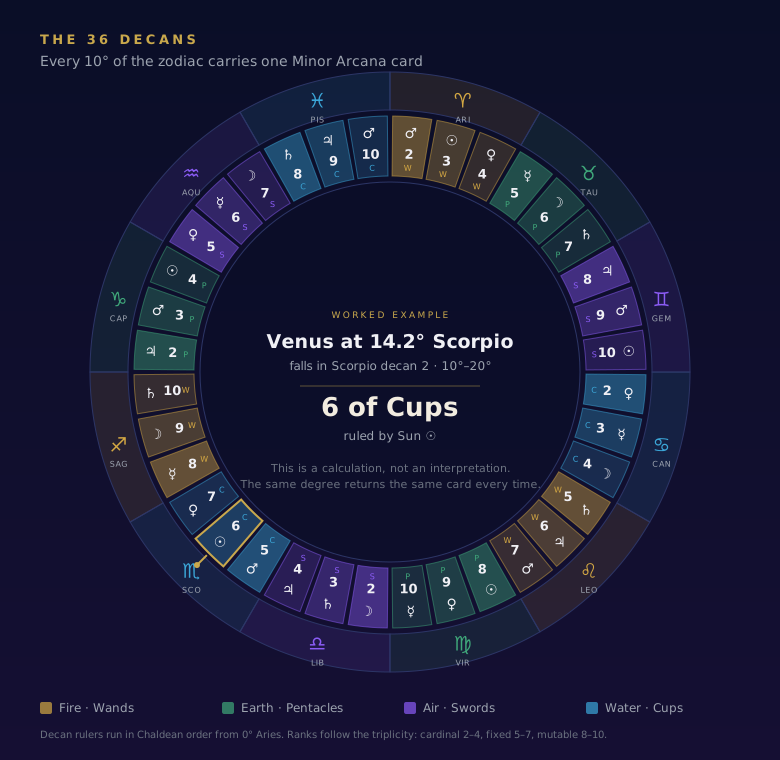
Every numbered card from Two to Ten already carries a decan ruler under the same Golden Dawn table the rest of this site runs on. So the lean here is a second lookup on top of a lookup — both published, both checkable against any standard reference, and identical every time you draw the same card.
Nobody balanced this
It also cannot be tilted. The Chaldean order distributes the seven rulers almost evenly across the thirty-six decans, so the deck comes out at 10 favourable, 11 constrained and 15 that genuinely do not lean. Nobody balanced that; it falls out of the arithmetic, and a test fails if a future edit makes "favourable" the common answer.
Why more than half the deck says nothing
42 of the seventy-eight cards carry no decan at all, so on more than half of all draws this tool has nothing to look up and says so.
22
The Majors
Each takes a planet, a sign or an element — never one ten-degree arc.
4
The Aces
An Ace is the root of its whole element, not a slice of it.
16
The courts
A court spans twenty degrees of one sign into twenty of the next.
Why there is no fallback
The obvious move would be a fallback: a second method for those cards, so that every draw produces something. That is exactly what this page will not do. A fallback invented to fill a gap is the one part of the answer that could not be looked up, dressed to look like the parts that could.
A tool that declines more often than it answers
So more than half the time this tool declines. That is an unusual thing for a page targeting this keyword to do, and it is the most useful thing on it — because it means that when a lean does come back, it came from somewhere.
What to do when the answer is "no answer"
Usually the question is the problem. "Will it work out" and "should I" are different shapes, and only the second is one a card can help with. The first asks about a world the deck has no access to; the second asks about you, which is the only thing any of this has ever been about.
Conversion 1
Ask what you would do either way
The reliable conversion is to ask what you would do in either case. If the answer is the same either way, the yes-or-no was never the question. If it differs, you have just named the actual decision — and that one takes a three-card spread rather than a verdict.
Conversion 2
Ask what would have to be true
The second conversion is to ask what would have to be true. "Should I take the job" becomes "what would make this obviously right, and is it there" — a question with an answer you can go and check, which is more than any single card can offer.
What this is not
It is not a prediction, and the copy above is written so it cannot be read as one. A favourable lean describes conditions, not permission; a constrained one names a cost, not a refusal. That is the same line every tool on this site is held to — the timing of your own actions, never the prediction of events — and this is the page where it is hardest to hold.
There is no redraw button
It is also not a second opinion. There is no redraw button while a result is showing, because a yes-no tool with one sitting next to an unwelcome answer is a machine for extracting the answer someone already wanted. You can reload the page; you just have to mean it.
Free, and no model anywhere on the path
And it is free, with no account and no model anywhere on the path. The draw is a shuffle in your browser and the lean is a table lookup, which between them cost nothing to serve and can both be checked by hand.
Most yes-or-no questions are a different question
If the draw came back with no lean, or with one you want to look at properly, three cards will do more than one. The three-card page has six layouts and says which fits which kind of question.