Progressed Chart Calculator
Your birth chart, moved forward one day for every year you have lived. Enter your birth details to see where your progressed planets, angles and Moon stand today, and how they touch the chart you were born with.
- The full progressed chart, free
- Checked against astro-seek to the minute
What is a progressed chart?
The method is called secondary progressions, and astrologers have used it since at least the seventeenth century. It is the most common of several ways to move a birth chart through time. Where transits compare your chart with the real sky of today, progressions let the birth chart unfold at its own slow pace, so the changes they describe are read as inner and gradual rather than as events arriving from outside.
Because a day of sky covers a whole year, the fast bodies are the ones that visibly move. The progressed Moon travels about a sign every two years and a few months, the progressed Sun about a degree a year, and the progressed Ascendant and Midheaven about a degree a year as well. The outer planets barely move in a lifetime: Pluto's progressed position is usually within a few degrees of its natal one at ninety.
How this calculator computes your progressions
There is more than one way to progress a chart, and two calculators can disagree simply because they chose different conventions. These are the ones used here, and they are astro-seek's defaults, so you can check every figure against it.
A year of life is a tropical year of 365.2422 days. Your progressed date is your birth moment plus as many days as you have lived tropical years: the chart for 3 November 2026 of someone born on 1 January 1970 is the sky of 27 February 1970.
The Midheaven advances by the Naibod rate, 0°59′08″ a year, measured in right ascension, and the Ascendant and house cusps are then cast for your birthplace. The other common choice, solar arc, moves the angles by the progressed Sun's actual motion and can differ by a degree or so by midlife.
The progressed planets are simply where the planets were on the progressed date, from the same ephemeris as your birth chart. That means a progressed planet can be retrograde, or turn direct, just as a real one does.
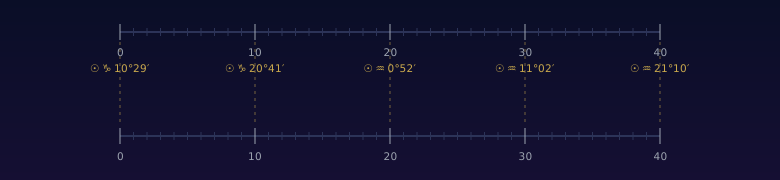
Degrees are shown as astro-seek shows them: whole minutes, truncated rather than rounded.
What to look at first
A progressed chart has as many placements as a birth chart, but they do not all carry the same weight. Most astrologers read them in roughly this order.
The progressed Moon
The fastest mover, and the one most astrologers read first. Its sign and house describe the emotional climate of a chapter of two years or so, and its aspects to your natal planets mark the months when a particular part of the chart is stirred.
The progressed Sun
It moves about a degree a year, so it changes sign roughly every thirty years. Most people see it change sign two or three times, and each change is read as a shift in where your sense of purpose is directed.
The progressed angles
The progressed Ascendant and Midheaven describe how you meet the world and the direction of your public life. Their sign changes, and their aspects to natal planets, are among the most precisely timed contacts a progressed chart offers, which is also why they depend on an accurate birth time.
Planets changing direction
If Mercury, Venus or Mars was close to a station when you were born, it may turn retrograde or direct by progression during your life. Astrologers read such a turn as a long change of orientation in what that planet stands for.
Exact progressed aspects
A progressed body coming within a degree of an aspect to a natal one is read as a period when the two are in conversation. With the slow bodies these contacts can last years; with the Moon, a month or two.
The progressed Moon through the signs
The progressed Moon spends a little over two years in each sign and completes the circle in about 27 years, so most people see each sign at least twice. Your result gives the reading for the sign it is in now and the dates of every change.
The progressed lunar phase
The angle between your progressed Sun and progressed Moon goes round the circle in about 29.5 years, the same cycle the real Moon completes in 29.5 days. Dane Rudhyar read this progressed lunation cycle as the large rhythm of a life, in eight phases of three to four years each. Your result shows which phase you are in and the dates of your progressed New and Full Moons.
New Moon
The progressed New Moon phase opens a cycle of about thirty years. Astrologers in Dane Rudhyar's tradition read it as a time of seeds: new directions felt before they can be explained, a self that is not yet visible to others. The sign of the progressed New Moon is read as the theme of the whole cycle ahead.
Waxing Crescent
The Crescent phase is read as the struggle to establish what the New Moon began. The new direction meets the weight of the old one, and effort is needed to keep it alive. It is described as a time of commitment more than of results.
First Quarter
The First Quarter phase is read as a crisis in action. What was begun now has to take form in the world, and the structures that no longer fit are tested. It is described as decisive, often outwardly busy, and a time of building.
Waxing Gibbous
The Gibbous phase is read as a time of refinement before the high point. The work is adjusting and perfecting what has been built, and learning what it needs to become whole. It is described as analytical and preparatory.
Full Moon
The progressed Full Moon, about fifteen years after the progressed New Moon, is read as the cycle's moment of illumination. What was seeded becomes visible, in relationships especially, and the meaning of the cycle can be seen. It is described as fulfilment and objectivity together.
Disseminating
The Disseminating phase is read as a time of sharing what the cycle produced: teaching, communicating, passing on what has been learned. It is described as outward and generous, the harvest being distributed.
Third Quarter
The Last Quarter phase is read as a crisis in consciousness. The forms of the cycle start to feel finished before they are, and the turn is inward: re-evaluating, letting structures go, keeping the meaning without the shell.
Balsamic
The Balsamic phase, the last before the next progressed New Moon, is read as release and preparation. What belongs to the old cycle completes, and the future is sensed before it arrives. It is described as quiet, inward and often visionary.
Progressions, transits and solar returns
Three techniques answer three different questions about time. They are often read together.
| Technique | What it compares | Pace | Read for |
|---|---|---|---|
| Secondary progressions | Your birth chart, unfolded one day per year | Slow: the Moon about 1° a month, everything else slower | Inner development across years and decades |
| Transits | Today's real sky against your birth chart | From the Moon's hours to Pluto's years | What the outside world brings, and when |
| Solar return | The chart for the moment the Sun returns to its birth degree | One chart per year of life | The themes of the year from one birthday to the next |
How much your birth time matters
For the progressed angles, a great deal. Four minutes of clock time move the Midheaven by about a degree, and a degree of progressed Midheaven is about a year of timing. A birth time rounded to the nearest quarter of an hour can put a progressed angle's contacts up to about two years early or late.
The progressed Moon is more forgiving. The Moon moves about half a degree an hour, so an hour's error moves the progressed Moon by half a degree, which it covers in about two weeks of life. Without a birth time this calculator uses noon, leaves out the angles and houses, and keeps the progressed Moon with a note on its uncertainty.
How to use the progressed chart calculator
- 1Enter your birth detailsYour date, time and place of birth. The time matters most for the progressed angles; without it the calculator still gives the progressed planets and Moon.
- 2Read your progressed chartThe bi-wheel puts your progressed chart around your birth chart. Below it are the progressed positions, angles, aspects to your natal planets, your progressed Moon and your progressed lunar phase.
- 3Move the dateProgressions are read over years. Step a year forward or back, or choose any date, to see when a progressed aspect becomes exact or the progressed Moon changes sign.
See your chart unfold
The full progressed chart is free, with every degree checkable against astro-seek. Pro adds Ask My Chart, written answers about your chart in your own words.