Three card tarot
The same three cards say different things depending on what you call the positions. Pick a layout, then shuffle and draw.
- Past
- Present
- Future
Shuffled in your own browser with a cryptographic random source.
Choose a layout
The layout changes what each position asks, and nothing else. The deck is shuffled in your browser either way, and the astrology lookup underneath is identical — a page that let the layout steer the draw would be choosing your cards while calling it a choice.
Why three cards is the spread worth learning
One card gives you an image and no structure. Ten cards give you more structure than most questions have, and the common result is that you read the two or three you recognise and quietly ignore the rest. Three is the smallest spread where the positions do real work, which is why it is the one that has survived.
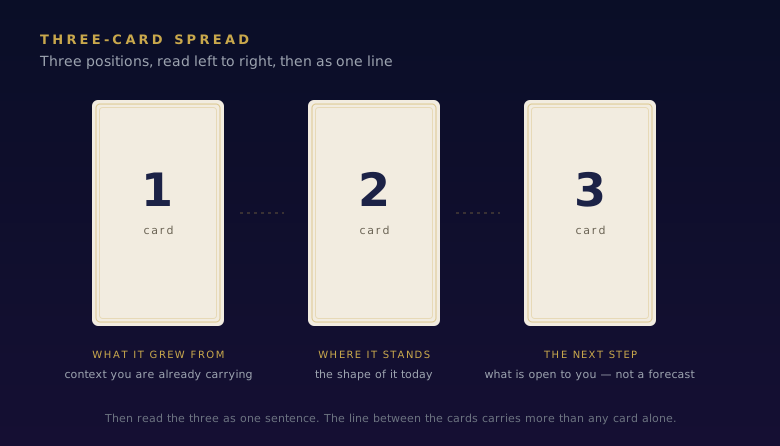
What the positions actually do
The work the positions do is the whole subject of this page. A card in isolation has a range of meaning; a card in a named position has that range pointed somewhere. The Five of Cups is a different statement in a slot called "past" and a slot called "what decides it" — same image, same keywords, and two readings that have almost nothing in common.
The layout is the decision; the shuffle is not
That is also why the layout is the real decision and the shuffle is not. You choose what the three positions ask before a single card turns over, and that choice does more to shape the reading than which cards arrive. Most people skip it, take the default, and then wonder why the third card felt like a fortune.
Why six layouts and not thirty
The six layouts below are the ones in common circulation. There are hundreds more in books and on blogs, and nearly all of them are one of these six with the slots renamed — which is why this list is short rather than exhaustive.
The six layouts and when each one fits
Pick the row whose third column describes the question you actually have. The tool at the top of the page uses whichever you choose.
The timeline
Past · Present · FutureThe default, and the one most people mean. Best when a situation has a history you can name and you want to see it laid out in order. Worst when you are hoping the third card will tell you how it ends — read that slot as direction of travel, not destination.
The next move
Situation · Action · OutcomeThe version that survives the prediction problem, because every slot is something you control. Use it when you already know the facts and are deciding what to do about them. The third card is the outcome of the action in the second — not of the world.
Two people
You · Them · BetweenTwo people and the space they make together. Use it for a relationship question of any kind, including a working one. The third card is the dynamic rather than the verdict, and it is the card that does the work.
The fork
Option A · Option B · What decides itA genuine fork with two named choices. The third card is not a recommendation — it names the criterion, the thing you will actually be weighing, which is usually the part that has stayed unspoken.
The review
Stop · Start · ContinueA review rather than a question. Use it at the end of something — a month, a project, a phase — when there is nothing to decide but plenty to notice. It is the only layout here that assumes you already have the answer.
The whole self
Mind · Body · SpiritAn open layout for when there is no specific question. Use it for a check-in rather than a problem. It reads badly against a concrete decision and well against a vague unease, which is the opposite of the first two layouts.
What a position actually does to a card
Three things, and they compound. The first is direction: a position tells you which way to read an image that could face several ways. "Past" points a card backwards into something already settled; "action" points the same card forwards into something not yet done.
The second
Ownership: whose side of the question
The second is ownership. In a You / Them / Between layout, the first slot is yours and the second is your picture of theirs — not theirs. That distinction is easy to lose and expensive to lose, because a reading that treats the second card as a report on another person has quietly stopped being about anything you can check.
The third
Weight: not every slot deserves equal attention
The third is weight. Not every position deserves equal attention, and the layouts differ on which one carries it. In Situation / Action / Outcome the middle card is the one that matters, because it is the only slot you act in. In You / Them / Between it is the third. In Past / Present / Future it is usually the first, which is the opposite of where people look.
Put together, the same cards read differently
Put those together and the same three cards produce genuinely different readings under different layouts. That is not a flaw in tarot; it is the mechanism. Choosing the layout is choosing what you are asking, and doing it deliberately is most of the skill.
The third card problem
Every three-card layout has a third slot, and in the default layout it is called "future". That single word does more damage than anything else in this spread, because it invites a reading no deck can support: a statement about what will happen, delivered with the same confidence as the other two cards.
The honest version: direction of travel
The honest version reads it as direction of travel. Where is this pointing if nothing changes — which is a sentence with a visible escape clause in it, and the escape clause is the useful part. A card that says "this is heading toward exhaustion if nothing changes" is actionable. A card that says "you will be exhausted" is not, and cannot be wrong, which is how you know it is saying nothing.
Three layouts avoid the trap structurally
The other layouts handle this by not offering the trap. Situation / Action / Outcome puts an action between you and the outcome, so the third card is contingent by construction. Option A / Option B / What decides it refuses to name a winner and names the criterion instead. Stop / Start / Continue has no future slot at all.
If you reach for the third card first
If you find yourself reaching for the third card first, that is worth noticing on its own. It usually means the question was really "will it be all right" — a question a spread cannot answer, and one the layouts above are all quietly designed to redirect.
The layer underneath, and what it is not
Once the cards are down, each numbered card from Two to Ten carries a fixed ten-degree arc of the zodiac under the Golden Dawn correspondences. The panel checks whether anything in your chart, or anything in the sky right now, is standing inside those three arcs, and prints the degree if so.
The lookup is identical whichever layout you picked
That half is a lookup and is identical whichever layout you picked. The layout frames the question; it does not touch the computation, and the page says so next to the chooser rather than letting the arrangement imply otherwise.
Most spreads turn up nothing, and that is reported
Most spreads turn up nothing — roughly three in five — and that is reported as the ordinary result it is. A page that only spoke up when it found something would train you to keep drawing until it did, which is the shape of a slot machine rather than a tool.
Reading the line, not the cards
Look at the shape before the images. Which suits arrived, how many Majors, whether the numbers cluster low or high — all of that is visible before you have interpreted anything, and it tells you what kind of question you are actually holding. Three Majors in a three-card line is genuinely unusual and usually means the question is structural.
Read across, not down
Then read across rather than down. The three cards are a sentence, not three separate answers, and the useful question is what changes between them. Two Cups and a Sword is a story about something being named; two Pentacles and a Wand is a story about something being started.
Keep the claim honest with yourself
And keep the copy honest with yourself. A card is a prompt attached to a question you chose to ask — timing of your own actions, never prediction of events, which is the line every tool on this site is written to. It is also the more useful reading, because advice you can act on beats a forecast you can only wait for.
The same three cards, read against your own degrees
Every numbered card rules ten degrees of the zodiac. The chart spread shows which of the thirty-six your own placements fall under — nine cards that never change, rather than three that change every draw.