Your chart as a tarot spread
Each planet sits at a degree, each degree sits in a decan, and each decan has a card. Nine lookups, no interpretation — the degrees are printed so you can check every one.
Where a card can come from a degree
Most tarot sites do one of two things. They look a card up in a table, or they hand whatever you drew to a language model and print what comes back. Both produce text. Neither produces anything you can check, which is why every tarot page on the internet reads roughly the same and none of them can be wrong.
There is a third thing, and it is not new
There is a third thing, and it has been sitting in the tradition since the 1890s. The Hermetic Order of the Golden Dawn assigned every Minor Arcana from Two to Ten to one ten-degree slice of the zodiac. Thirty-six cards, thirty-six slices, covering the circle exactly once with no gap and no overlap. The assignment is published, it is fixed, and it has not moved in a hundred and thirty years.
A degree resolves to a card
Which means that if you know a planet’s exact degree, you know its card. Not as an interpretation — as a lookup. Venus at 14.2 degrees of Scorpio falls in the second decan of Scorpio, and the second decan of Scorpio is the Six of Cups. That sentence is either right or wrong, and anyone can find out which.
This site already computes the degrees
This site already computes every planet to a fraction of a degree, because that is what a birth chart is. Putting the two together is not clever; it is just something nobody in the tarot category has bothered to do. The closest thing that exists works at sun-sign level, which throws away the degree and with it the entire reason the correspondence is interesting.
Why tarot and astrology fit together at all
Tarot and astrology are usually sold as two separate things, and for most of their history they were. Tarot begins as a fifteenth-century Italian card game. Astrology is two thousand years older and came out of an entirely different tradition. Nothing about a deck of playing cards requires a zodiac, and for three hundred years nobody suggested it did.
What joined tarot to astrology
What joined them was the nineteenth-century French occult revival, and then, decisively, the Golden Dawn in the 1880s and 1890s. Its members were building a single system out of everything they had — Kabbalah, astrology, alchemy, the tarot — and the question they asked of the deck was structural rather than mystical: does it have the right shape to carry the zodiac?
It turned out to fit
It turned out to. Four suits against four elements. Ten numbered cards against a decimal structure that already ran through their Kabbalah. And, the part that actually made it work, thirty-six pip cards from Two to Ten once you set the Aces aside as the roots of their elements — against exactly thirty-six decans. That is not a coincidence they arranged; it is an arithmetic accident, and it is the reason the tarot and astrology correspondence is tight where most occult correspondences are loose.
Where the fit goes loose
The looseness shows up everywhere else in the tradition. The Major Arcana mapping needed three separate rules to cover twenty-two cards, and the court cards needed a fourth. Those are joins, and they look like joins. The decan mapping needs no join at all: thirty-six into thirty-six, one each, no remainder. It is the one place where tarot and astrology line up without anyone having to make them.
Why this page rests on the decans
Which is why this page is built on the decans and not on the rest. A correspondence that requires special pleading can be argued about forever. A correspondence that is a bijection can be checked in ten seconds, and the checking is the whole point.
What a decan is
A decan is a third of a sign. Each of the twelve signs spans thirty degrees, so each splits into three arcs of ten. Thirty-six in all. The division is older than tarot by a long way — it comes out of Egyptian star lists and reached Western astrology through the Hellenistic tradition, where each decan carried its own ruling planet.
The rulers run in Chaldean order
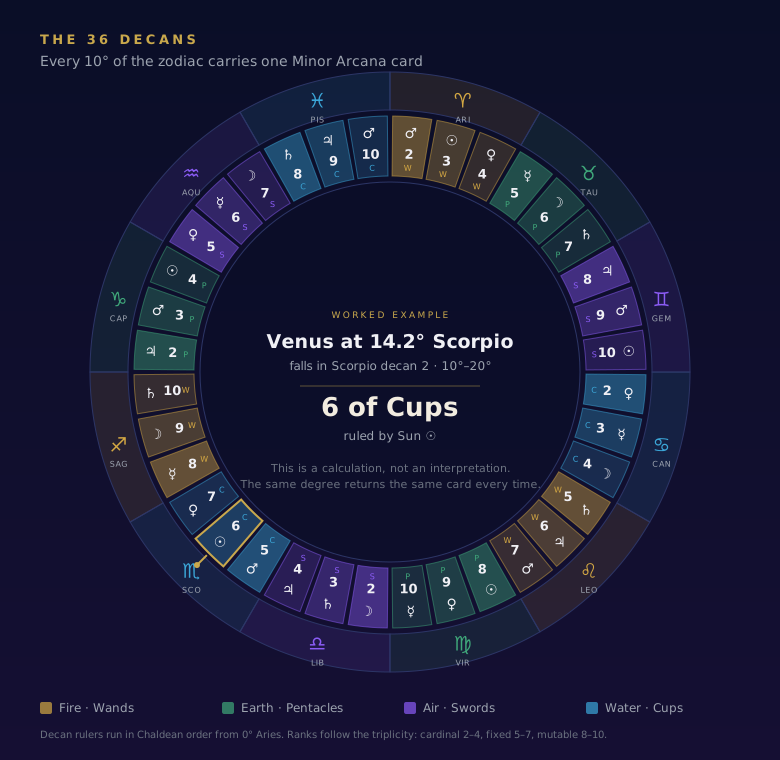
The rulers run in what is called Chaldean order: the seven classical planets arranged by how slowly they appear to move, Saturn, Jupiter, Mars, Sun, Venus, Mercury, Moon, then round again. Starting at zero degrees of Aries with Mars, the sequence walks the whole circle and lands back where it started after thirty-six steps, because thirty-six and seven share no factors.
The Minor Arcana were laid over it
The Golden Dawn laid the Minor Arcana over that existing structure rather than inventing a new one. The suits follow the elements — Wands to the fire signs, Cups to water, Swords to air, Pentacles to earth — and the ranks follow the modalities, so Twos, Threes and Fours fall in cardinal signs, Fives, Sixes and Sevens in fixed, and Eights, Nines and Tens in mutable.
Which is what makes the table checkable
That structure is why the table is checkable rather than arbitrary. The Six of Cups has to be a water sign, because Cups are water; it has to be a fixed sign, because Sixes are fixed; and the only fixed water sign is Scorpio. Its ruler has to be the Sun, because the Sun is what the Chaldean sequence reaches at that point in the circle. Three independent constraints, one answer. A wrong table breaks at least one of them.
The twenty-two Majors
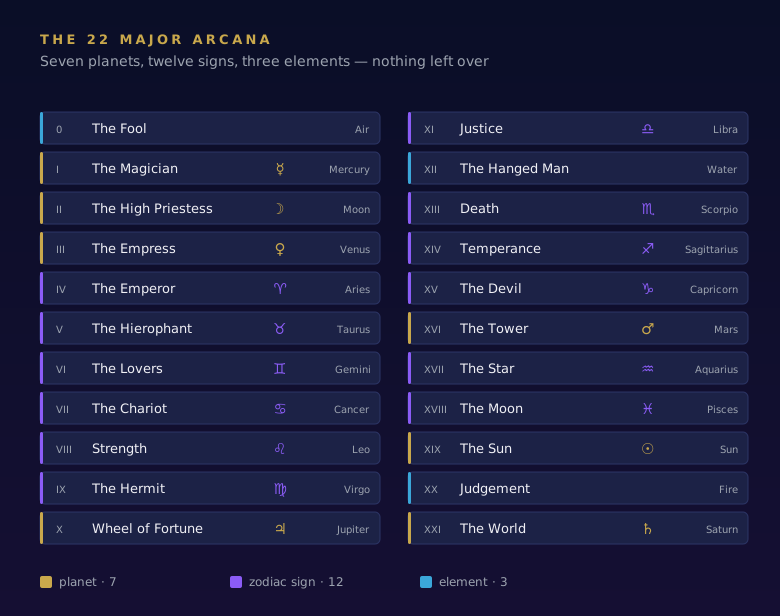
The Majors work differently. There are twenty-two of them and only twelve signs, so they cannot map one to one onto the zodiac the way the decans do. The Golden Dawn split them three ways: twelve cards take the twelve signs, seven take the seven classical planets, and three take elements.
Twelve plus seven plus three
Twelve plus seven plus three is twenty-two, which is the whole argument for the scheme. It is not a scheme that leaves anything over or needs anything doubled up, and that tidiness is the reason it became the standard attribution rather than one of several.
Strength and Justice: the numbering trap
One point catches people out. In the Rider-Waite deck Strength is numbered eight and Justice eleven; in the Golden Dawn’s own sequence it is the other way round. Waite swapped the numbers, not the signs. Strength is Leo and Justice is Libra under either numbering, and a table that moves the sign along with the number has made an error that looks like a correction.
The twelve signs
| Card | Rules |
|---|---|
| 4The Emperor | Aries |
| 5The Hierophant | Taurus |
| 6The Lovers | Gemini |
| 7The Chariot | Cancer |
| 8Strength | Leo |
| 9The Hermit | Virgo |
| 11Justice | Libra |
| 13Death | Scorpio |
| 14Temperance | Sagittarius |
| 15The Devil | Capricorn |
| 17The Star | Aquarius |
| 18The Moon | Pisces |
The seven classical planets
| Card | Rules |
|---|---|
| 1The Magician | Mercury |
| 2The High Priestess | Moon |
| 3The Empress | Venus |
| 10Wheel of Fortune | Jupiter |
| 16The Tower | Mars |
| 19The Sun | Sun |
| 21The World | Saturn |
The three elements
| Card | Rules |
|---|---|
| 0The Fool | Air |
| 12The Hanged Man | Water |
| 20Judgement | Fire |
A worked example
Take a chart with Venus at 224.2 degrees of ecliptic longitude. Longitude is measured from zero degrees of Aries, so divide by thirty to get the sign: 224.2 over 30 is seven and a bit, and counting from Aries at zero, sign seven is Scorpio. The remainder, 14.2, is the degree within the sign.
Step 2
Now the decan
Now the decan. Fourteen point two falls in the second ten-degree arc of Scorpio, so this is Scorpio’s second decan, running from 220 to 230 degrees. The Chaldean sequence reaches the Sun at that point, so the decan is Sun in Scorpio.
Step 3
And the card
And the card. Cups are water, Scorpio is water. Sixes are fixed, Scorpio is fixed. The Six of Cups. Nothing in that chain is a judgement call, which is why the answer comes out the same however many times you run it and whoever runs it.
The tool does this nine times, with your degrees
The tool at the top of this page does exactly this, nine times, with your own degrees. It prints the degree beside every card for one reason: so that the claim stays falsifiable. A reading you cannot check is a reading you have to take on faith, and this category already has more than enough of those.
What this does not do
It does not predict anything. A card here is a prompt for reflection attached to a fixed feature of your chart, and the copy rules that govern every other tool on this site apply unchanged: timing of your own actions, never prediction of events, and nothing said that cannot be traced back to the placement that produced it.
It does not shuffle
It also does not shuffle. A drawn tarot reading and a chart spread are different objects. A draw is about this moment and is different every time by design; a chart spread is about a birth moment that will never move, so it is the same nine cards for as long as you live. Both are worth having and they answer different questions — confusing them is how you end up with a page that claims a fixed fact changes daily.
It does not reach past the correspondence
And it does not extend past what the correspondence covers. The spread uses the seven classical planets plus the two angles, because those are what the Golden Dawn table was built around. Adding Uranus or Neptune would mean citing a correspondence nobody published, which is the one thing this page cannot afford to do.
Angles are dropped, never estimated
When your birth time is unknown the two angles are dropped rather than estimated. The Ascendant moves about a degree every four minutes; from a noon guess it can be several signs out, and a card drawn from that would have the exact appearance of a lookup while being invention. The planets survive because they need only the date.
How to read what comes back
Start with the Sun, Moon and Ascendant, which is why the tool puts them first. Those are the three placements people actually recognise in themselves, so they are the three where you can tell quickly whether the correspondence is saying anything or not.
Then look at what repeats
Then look at what repeats. Nine cards drawn from one chart will usually cluster: several Cups, or a run of fixed-sign Sixes and Sevens, or one suit missing entirely. The suit tally is more informative than any single card, because a single card is one placement and a cluster is a pattern the chart keeps making.
Keep the birth cards separate
Treat the birth cards separately from the rest, and the page keeps them in their own block for that reason. They come from adding the digits of your birth date, which is a twentieth-century numerological convention rather than a statement about the sky. It is deterministic and it is shown with its arithmetic, so you can check the sum — but checking the sum is not the same as checking a degree, and a page that presents the two as the same species of fact is making a claim it cannot support.
If you want the cards themselves explained
If you want the cards themselves explained, the card meanings index covers all seventy-eight. If you want the moving half — what is crossing your chart this week rather than what has been fixed in it since birth — that is the daily reading, and it is a different tool for a different question.
The same chart, read the usual way
These cards come from the same computed degrees your birth chart is made of. If you want the chart itself — every planet, house and aspect with its exact degree — that is the free birth chart calculator, and nothing in it is gated.