Your Money Reading
Read from your second and eighth houses, their rulers, Venus, Jupiter and Saturn — with the degrees on screen, so you can check every line of it.
Reading the financial part of your chart…
Why money is two houses and not one
The second house is what you earn and hold: income, possessions, and — the part usually skipped — what you actually consider valuable, which is not always the same as what you are paid for. The eighth is what you share, owe and inherit: joint finances, debt, other people's money, and anything that arrives through someone else.
They sit opposite each other
They are opposite each other, and most of what people call a money problem lives in the relationship between them rather than in either one. Earning well and still feeling precarious is a second and eighth house question, not a second house question, and a reading that looks at only one of them will miss the half that is actually moving.
The three bodies around them
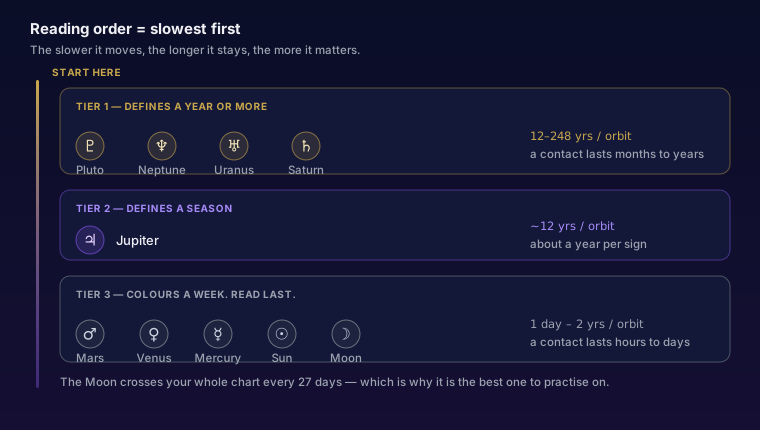
Around them sit three bodies. Venus describes what you consider worth having, which is where value and money stop being the same subject. Jupiter describes where it expands and what taking all of that expansion costs. Saturn describes the constraint, and it is the one whose transits people most often experience as a personal failing rather than as a period with an end date.
Those, and nothing else
This reading uses those and nothing else. The full list is on the page with every degree, and the shortness is deliberate: a reading drawing on the whole chart can support any conclusion, because there is always some placement that fits.
What a money reading actually is
The standing pattern does not change and is not about amounts. It describes a disposition: how you tend to treat what you have, what you count as security, where you are inclined to be generous and where you tighten. People usually recognise it across very different income levels, which is the clearest sign that it was never about the number.
The transits, and here they are mostly slow
The transits are the moving half, and here they are mostly slow. A Saturn transit to the second house ruler is a period of months to years with a beginning and an end, and knowing which part of it you are in is most of what the reading is for.
This is not financial advice
What it is not is financial advice, and it is not a forecast. Nothing here will tell you what to buy, what to sell, or when money will arrive — and a reading that does is making a claim about a future it cannot see, in the one area where acting on that claim is most expensive.
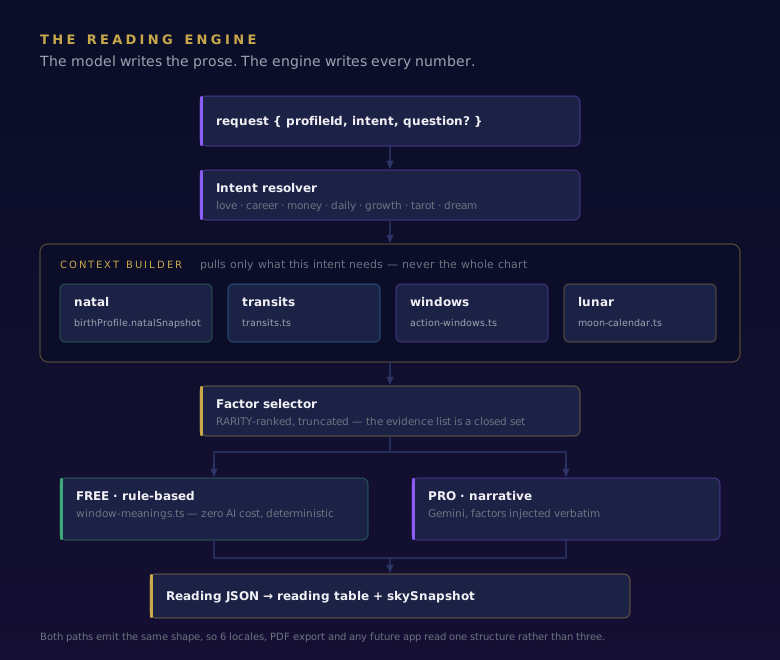
What this reading is read from
The complete list, fixed in advance and identical for every chart. It is published because a method nobody can inspect is a method nobody should trust.
- The second house and its ruler — what you earn and hold, and what you count as worth having.
- The eighth house and its ruler — what you share, owe or receive through someone else.
- Venus — value as distinct from money, and where the two come apart.
- Jupiter — where it expands, and the cost of taking all of the expansion.
- Saturn — the constraint, and the period it lasts.
- And whatever is currently within orb of those, with the exact date each aspect perfects.
Your sun sign is not on this list, and neither is most of your chart. An evidence panel short enough to read is the only kind you can check — and in this area that matters more than usual, because a reading long enough to be unfalsifiable is also long enough to justify a decision that costs you money.
What this will not do
It will not give financial advice. The written reading is instructed not to tell you what to decide, and the rule-based guidance attached to each transit is about the timing of your own actions — a stretch where a commitment is worth reading twice, never an instruction to make or avoid one.
It will not predict amounts or arrivals
It will not predict amounts or arrivals. "Money will come in March" is unfalsifiable and, in this area specifically, acting on it costs real money. What the page gives instead is the date a transit perfects, which is a computed fact you can check against any ephemeris and against your own quarter.
Without a birth time, both houses disappear
And when your birth time is unknown, both houses disappear — which is most of a money reading. Venus, Jupiter and Saturn still work, so you get something real rather than nothing, and the page says plainly what is missing instead of deriving cusps from a noon guess that could be four hours out.
Using it when something feels off
Start with the standing pattern, because most money discomfort is older than any transit. If the reading describes a disposition you recognise from three different income levels, that is the thing worth working on — and it is also the thing no raise has ever fixed, which is usually the discovery people find most useful here.
Where you are inside the slow transits
Then look at where you are inside the slow transits. A tight eight months and a Saturn aspect that has been in orb for eight months are worth looking at together, not because the transit caused the tightness but because knowing a period has an end date changes what you do inside it. The page gives you that date rather than a feeling about it.
Which of the two houses is moving
And pay attention to which of the two houses is moving. Pressure in the second is usually about earning and holding; pressure in the eighth is usually about something shared, owed or arriving through someone else. People often treat the second as the whole subject and then cannot work out why the advice does not fit — the eighth is where a surprising amount of financial weather actually comes from.
The same chart answers narrower questions too
This reading covers the area. Ask My Chart takes one specific question and reads it from the placements it actually depends on — the same evidence panel, aimed at something smaller.