Your Love Reading
Read from Venus, the Moon, Mars and your relationship houses — with the degrees on screen, so you can check every line of it.
Reading the relationship part of your chart…
Why a love reading starts at Venus and not at your sun sign
Your sun sign says something about you. It says nothing in particular about how you love, because the Sun is not the placement relationships are read from — Venus is, along with the Moon, Mars, and the two houses that govern romance and partnership. A column addressed to one twelfth of the living world cannot reach any of them, which is why it never tells you anything you could check.
Venus, the Moon, and what each one answers
Venus describes what you are drawn to and what you consider worth having. The Moon describes what settles you once you have it, which is a different question and frequently a conflicting one — plenty of people are attracted to exactly what does not soothe them, and that tension is visible in a chart long before it is visible in a relationship.
Mars, the part most readings skip
Mars describes how you pursue, which is the part most readings skip and most people recognise instantly. The fifth house covers romance as something you do; the seventh covers partnership as something you build. They are not the same house and they are frequently not in agreement.
Those, and nothing else
This reading uses those and nothing else. The full list is on the page, with every degree, and that shortness is deliberate: a reading that draws on the whole chart can support any conclusion, because there is always some placement that fits.
What a love reading actually is
Two halves, and they work differently. The standing pattern does not change: your Venus is at the degree it was at birth and will be there in forty years. What it describes is a disposition, not an event — the kind of thing you keep finding yourself doing, which is why people recognise it rather than learning it.
The transits are the part that moves
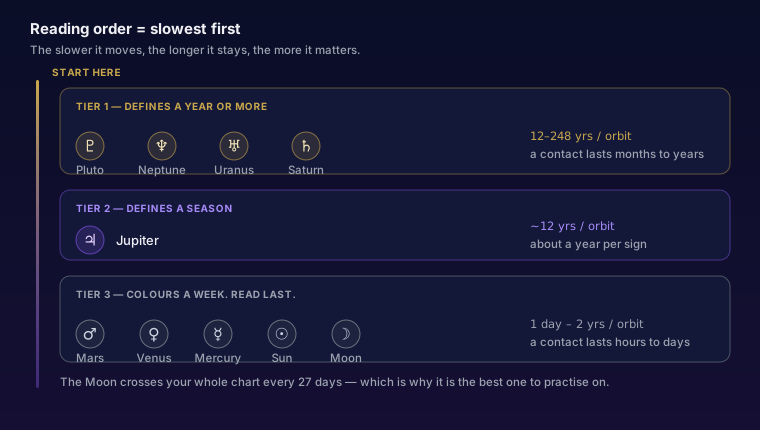
The transits are the part that moves. Saturn crossing your Venus is a period, with a beginning and an end and an exact moment in between, and this page gives you all three because they are computed rather than felt.
What it is not
What it is not is a forecast. Nothing here will tell you when you will meet someone, and a reading that does is describing a future it cannot see. The honest version is more useful anyway: knowing that a pattern exists is what lets you notice yourself repeating it.
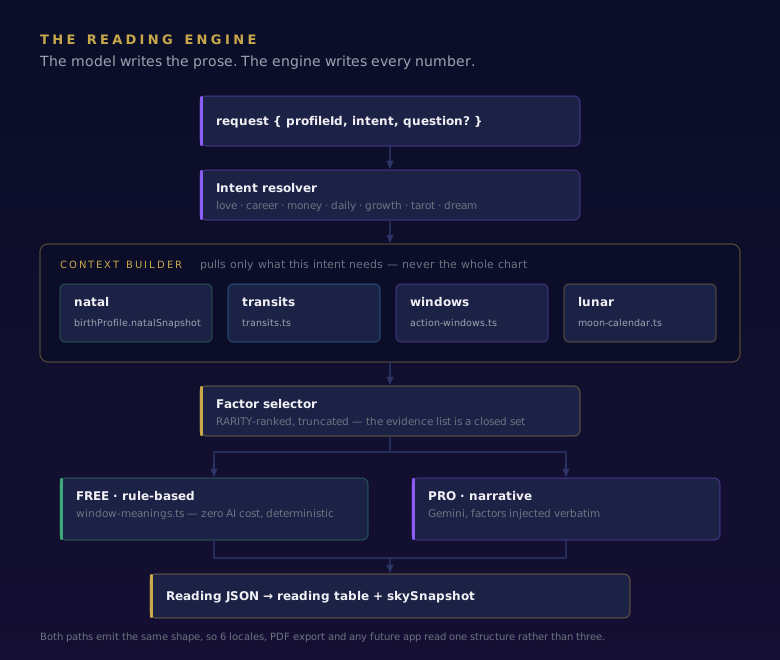
What this reading is read from
The complete list, fixed in advance and identical for every chart. It is published because a method nobody can inspect is a method nobody should trust.
- Venus — what you are drawn to, and what you count as worth having. Its sign describes the style, its house describes where you go looking, and its aspects describe what it has to negotiate with.
- The Moon — what settles you. Often in tension with Venus, which is one of the more useful things a chart can show you about yourself.
- Mars — how you pursue, and how you handle friction once you are in something. The placement people recognise fastest.
- The fifth house and its ruler — romance as an activity: attraction, play, the early part.
- The seventh house and its ruler — partnership as a structure: what you look for in a counterpart, and what you unconsciously hand over to them.
- And whatever is currently within orb of those, with the exact date each aspect perfects.
Notice what is absent. Your sun sign is not on this list, and neither is most of your chart. That is the point: an evidence panel short enough to read is the only kind you can actually check.
Patterns, not predictions
Everything written here is about a disposition and its timing, never about an event. The difference matters more in love readings than anywhere else, because this is the area where people most want to be told what will happen and where being told is least useful.
What that sounds like in practice
"You tend to move faster than you are comfortable admitting, and Saturn is currently making that expensive" is something you can hold up against your own last six months. "You will meet someone in November" is not, and it cannot be wrong, which is exactly what is wrong with it.
Periods with real dates
So the transits here are given as periods with real dates and the guidance attached to them is about timing your own actions — a stretch where a conversation is worth having slowly, not a conversation that will happen. If you want the year-scale version of the same logic, that is what Action Windows does.
Reading it single, and reading it partnered
Single, the standing pattern is the more useful half. It describes what you are drawn to and what actually settles you, and the gap between those two is usually where the repeating story lives. Nothing in the chart says whether you should be in a relationship; it says what you tend to do when you are.
Partnered, the transits explain the present
Partnered, the transits are usually the half that explains the present. A relationship that has felt heavy for eight months and a Saturn transit that has been in orb for eight months are worth looking at together — not because the transit caused it, but because knowing the shape of a period tells you whether to wait it out or act.
This reading is about one chart
Either way, this reading is about one chart. If you want the two-chart version — what happens between your placements and someone else's — that is synastry, and it is a different calculation with different evidence.
The same chart answers narrower questions too
This reading covers the area. Ask My Chart takes one specific question and reads it from the placements it actually depends on — the same evidence panel, aimed at something smaller.