Death
An ending rather than a death; the oldest and most consistently misread symbol.
What dreaming about Death usually means
Death is the symbol people arrive at this kind of page most frightened by, and the reading that every tradition shares is that it is not a prediction. It is read as an ending — a phase, a role, a version of a relationship — and the consistency of that across otherwise incompatible traditions is unusual enough to be worth weight. What varies is what is taken to be ending, and the dream rarely says. The detail that does the work is who died, and in the accounts people give, dreams of a person dying attach far more often to a change in the relationship with that person than to anything about their health. Dreaming of your own death is a different case and is treated separately below. None of this makes the dream less unpleasant to wake from, and that is worth stating: a symbol can be entirely benign in its readings and still leave you shaken for an hour, and the shaking is not evidence that the readings are wrong.
Common variations
Dreaming of your own death
Reported as less frightening than dreaming of someone else’s, which surprises people. The accounts often describe it as strangely neutral or even freeing, and the readings attach to a phase ending rather than to a loss. Whether you watched or experienced it is the detail worth keeping.
Dreaming that a living person has died
The version that sends people looking, and the one where the folk reading does the most harm. Across the traditions that have anything useful to say, it is read as a change in the relationship rather than a warning about the person. What was happening between you recently is the more productive question.
Dreaming of someone who has died
A different category from the rest, and one people describe as comforting more often than not. The accounts emphasise presence rather than event, and they cluster around anniversaries and around periods when the person would have been relevant. It is reported as vivid and remembered far longer than other dreams.
A funeral
The ceremony rather than the death, and that shifts the reading toward the public and the finished. Who attended is the detail people remember, and it does more work here than the coffin. Attaches to endings that have already been acknowledged by others.
Dying and then coming back
Reported often enough to be its own case, and the traditions read it as the clearest version of what they claim the whole symbol is: an ending followed by what comes after. What people remember is usually the return rather than the death, and the accounts attach to situations already past their worst. It is one of the few dreams in this category people describe as leaving them better than they woke.
Four ways this is read
The Jungian reading
Treats the image as belonging to a shared vocabulary rather than a personal one, and asks what the image does rather than what it reminds you of. On this account the figures in a dream are closer to characters in a story everybody already knows than to coded references to your own week.
Reads death as the most important transformation image in the repertoire, structurally identical to the death-and-return that organises a large share of the world’s myths. On this account the dream is read as the end of a configuration rather than of a person, and its frequency at turning points is the evidence the tradition points at.
The Freudian reading
Treats the image as a disguise and asks what it is standing in for. It is the most parodied of the four and it produced one durable observation worth keeping: the feeling in a dream is often attached to something other than the thing the dream appears to be about.
Read dreams of a living person’s death as wish rather than fear, an interpretation that causes more distress than it resolves and is included here for completeness rather than recommendation. The durable part of the reading is narrower: strong feeling toward a person can produce images that the waking mind would refuse, and the image is not the feeling.
The cognitive or continuity reading
The one closest to current sleep science. It holds that dreams continue waking concerns rather than encoding messages, so the useful question is never "what does it mean" but "what in my week does this resemble". It is also the reading that explains recurrence most simply: an unresolved situation keeps producing similar material.
Points out that dreams of death rise around actual bereavement, around anniversaries and during periods of change, which is what a continuity account predicts. It also notes that the dead appearing in dreams is extremely common among the recently bereaved and is not read as anything other than what it plainly is: the mind continuing to process a person who is no longer there.
The folk tradition
The oldest layer, and the one with the least explanation attached. Its readings vary sharply between cultures, which is itself informative — a symbol read the same way everywhere is behaving differently from one that is not.
The richest and least reliable layer for this symbol. Many traditions read a death dream as its opposite — a long life for the person dreamed about — and a smaller number read it literally, which is the version that frightens people. Both are recorded, neither is supported, and the contradiction between them is the most honest thing about the folk record here.
How this one is usually misread
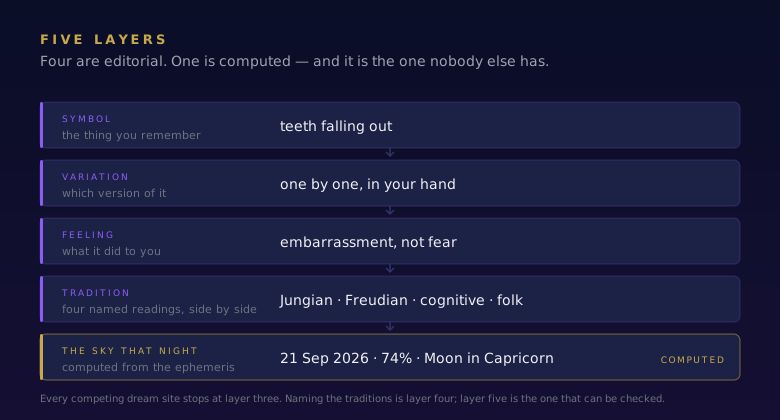
The misreading is the literal one, and it is the reason most people arrive at this page frightened. No tradition that has thought about the question reads a death dream as a prediction, and the folk record itself contradicts the belief: a number of traditions read the same dream as its opposite, a long life for whoever was dreamed about. Two incompatible folk readings of one image is the clearest evidence available that neither is tracking anything. The second error is subtler and more common among people who have already been reassured: treating the dream as purely symbolic when someone recently died. Dreams of the dead after a bereavement are extremely frequent, and reading them as a metaphor for an ending misses what they plainly are.
The feeling matters more than the image
The tone splits this symbol more cleanly than almost any other. Grief, terror and a flat calm are all commonly reported, and they attach to different circumstances: grief most often to an ending already underway, calm to one that has completed, terror more often to a relationship under strain than to a loss. The other detail worth recording is whether you were present or were told. Being informed of a death in a dream is reported quite differently from witnessing one, and the dictionaries that treat them as the same entry are discarding the distinction that carries most of the signal.
The Moon on the night you dreamed it
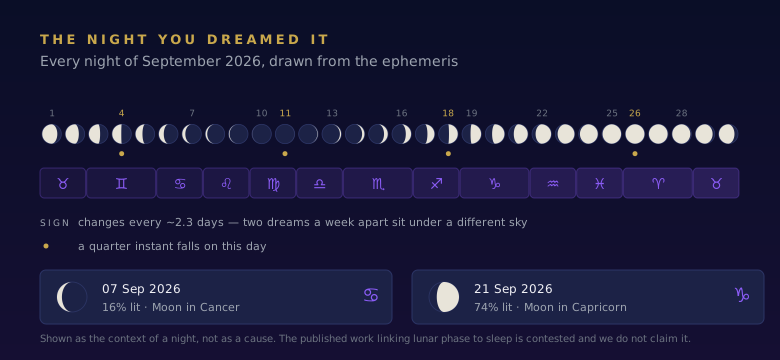
The one thing on this page that can be verified. Enter the night you went to sleep and you get the phase, the illuminated fraction and the sign the Moon held in the small hours, computed rather than asserted. It is context, not a cause — the published research on the Moon and sleep is contested, and the page on it says so.
Related symbols
These are descriptions of how a symbol is commonly read, never statements about you, and nothing here is medical or psychological advice.