Water
Feeling itself, with its clarity or murkiness doing most of the work.
What dreaming about Water usually means
Water is the most broadly read symbol in the category and the one most often flattened into a single line about emotion. The readings do converge on feeling, across traditions that otherwise disagree, but the useful part is not that convergence — it is that water carries its state with it. Clear, murky, still, rising, contained, unbounded: these produce different readings that a single entry for "water" cannot hold. It is also the symbol most often reported in combination, which is worth knowing when you look it up. A snake in water, a house flooding, drowning: in each case the pairing changes both halves and the reading belongs to the pair. Where a dream dictionary sends you to "water" and stops, it has given you the least specific part of what you saw, which is why this page treats the state of the water as the entry and the water itself as the category.
Common variations
Clear water
The version consistently read as favourable across traditions, and the accounts of it are unusually calm — people rarely wake from this one. Read against situations that are understood rather than resolved; clarity in the reports attaches to seeing, not to fixing.
Muddy or dark water
The contrast case, and read as its opposite nearly everywhere. What recurs in the accounts is not danger but not being able to see into it, which is a different and more specific thing. Attaches to situations where the facts are not available rather than where they are bad.
A flood
Volume and direction together. A flood is water that has left where it belongs, and the readings attach to something that has exceeded its container — a demand, a feeling, a situation that has spread past the area it started in. What people remember is usually the rising rather than the water.
The sea
The largest form, and read less as feeling than as something too big to be an individual matter. Accounts of it are more often awed than frightened, and the detail that recurs is whether you were in it, on it or looking at it — three quite different positions.
A swimming pool
Water with edges, and that is the reading: something felt but contained, in a setting that is social rather than natural. It is the most modern of the water variations and its accounts attach more often to being watched than to being immersed.
Rain
Water arriving rather than water encountered, and read differently for that reason. Rain is the one form that falls on you without your having gone to it, and the accounts divide on whether it was sheltered from or stood in. What recurs is that it is rarely reported as frightening — the readings attach to something unavoidable but survivable, which is a narrower and more useful category than water in general.
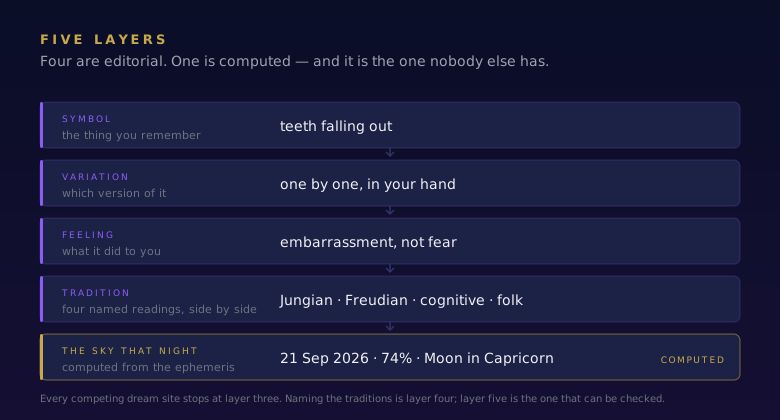
Four ways this is read
The Jungian reading
Treats the image as belonging to a shared vocabulary rather than a personal one, and asks what the image does rather than what it reminds you of. On this account the figures in a dream are closer to characters in a story everybody already knows than to coded references to your own week.
Reads water as the standing image for what lies below awareness, and the depth in a dream as how far down it goes — the surface being the part available to the waking mind. It is the single most consistent reading in the tradition, and it is where the popular phrase about the unconscious being an ocean comes from.
The Freudian reading
Treats the image as a disguise and asks what it is standing in for. It is the most parodied of the four and it produced one durable observation worth keeping: the feeling in a dream is often attached to something other than the thing the dream appears to be about.
Connected water dreams to birth and to memories older than language, with a great deal of specific interpretation attached that has not survived. The part that has is modest: water is one of the few images in dreams that regularly comes with a physical sensation, and sensations in sleep get written into the story.
The cognitive or continuity reading
The one closest to current sleep science. It holds that dreams continue waking concerns rather than encoding messages, so the useful question is never "what does it mean" but "what in my week does this resemble". It is also the reading that explains recurrence most simply: an unresolved situation keeps producing similar material.
Declines the symbolism and asks what in the week resembled it. It also notes something worth knowing: water dreams are more frequently reported by people who live near it and by people who swam that day, which is what the continuity account predicts and the symbolic accounts do not.
The folk tradition
The oldest layer, and the one with the least explanation attached. Its readings vary sharply between cultures, which is itself informative — a symbol read the same way everywhere is behaving differently from one that is not.
Unusually consistent across traditions, and unusually specific: clear water is favourable and troubled water is not, a reading recorded from Mesopotamian dream-books to early modern European ones. When a symbol is read the same way in cultures with no contact, that is either a deep commonality or an obvious metaphor, and here it is likely the second.
How this one is usually misread
The standard error is stopping at "water means emotion" and going no further. It is not wrong, and it is nearly useless, because every instance of the symbol satisfies it. What actually varies — and what the traditions agree on far more specifically than the one-line version suggests — is the state: clear against murky, still against rising, contained against unbounded. A second habit worth breaking is looking up the water and ignoring what it was with. This symbol appears in combination more than any other on the list, and in a flooding house or a snake in a pool the reading belongs to the pair, not to either half.
The feeling matters more than the image
What separates instances of this symbol is almost never the water and almost always the relation to it. Being in it, watching it, held under it and moving across it are four different dreams sharing one noun, and the accounts attach to different circumstances accordingly. The second thing worth recording is temperature, which people mention far more often for water than for any other symbol and which no dictionary entry covers. Cold water and warm water are reported differently and attach differently, and since it costs one word to write down, it is the cheapest useful detail available on this page.
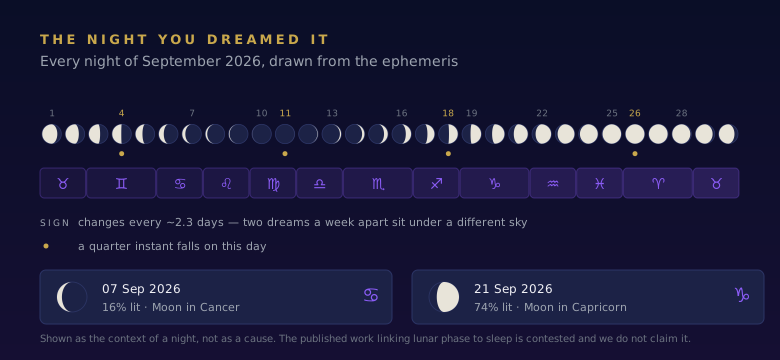
The Moon on the night you dreamed it
The one thing on this page that can be verified. Enter the night you went to sleep and you get the phase, the illuminated fraction and the sign the Moon held in the small hours, computed rather than asserted. It is context, not a cause — the published research on the Moon and sleep is contested, and the page on it says so.
Related symbols
These are descriptions of how a symbol is commonly read, never statements about you, and nothing here is medical or psychological advice.