Today's Astrology Reading
Not your sun sign. The transits touching your actual birth chart today, with the degree, the orb and the exact moment each one perfects.
Reading the sky against your chart…
Why a daily reading has to come from your chart, not your sun sign
A sun-sign horoscope divides the world into twelve groups and writes one paragraph for each. There are about eight billion people alive, so each of those paragraphs is addressed to roughly 670 million readers at once. A daily astrology reading cannot work that way: whatever a sun-sign column says has to be true of all of them, which is why it never says anything you could check.
A transit reading starts from the opposite end
A transit reading starts from the opposite end. It takes the positions in your birth chart — your Venus at its own degree, your Midheaven at its own degree — and asks which moving bodies are currently within orb of them. Two people born the same week in the same city get different answers, because their charts are different.
The difference is measurable, not philosophical
The difference is measurable rather than philosophical. A sun-sign column cannot tell you that an aspect perfects on Thursday, because it does not know which degree it would be perfecting to. A daily astrology reading can, and this one prints the degree beside the claim so you can check it against any ephemeris.
No language model anywhere on this path
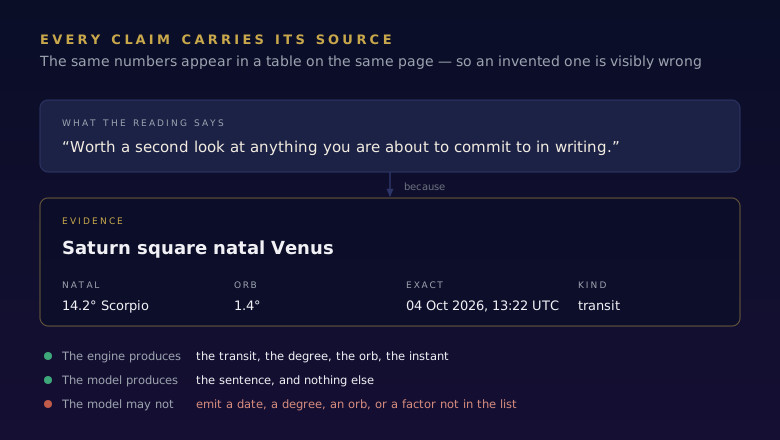
That is also the reason nothing here is generated by a language model. Every line comes from a rule attached to a computed transit. A model can phrase a rule; letting it decide the dates would give back exactly the vagueness this reading exists to avoid.
What is a daily astrology reading?
A daily astrology reading lists the transits — the positions of moving planets relative to a fixed birth chart — that are within orb on a given day, and says what each one is conventionally taken to mean. It is personal because the birth chart is personal.
Three kinds of thing can be live on a day
Three kinds of thing can be live on any given day. An aspect is a specific angle between a moving planet and a natal point: Saturn ninety degrees from where your Sun was at birth, for instance. A retrograde is a planet appearing to move backwards, which is the same for everyone alive but still shapes the period. A house transit is a moving planet crossing one of the twelve sectors your birth time defines.
Each has a width, called an orb
Each of those has a width, called an orb. An aspect is not a switch that flips on the exact day; it comes inside orb, tightens to exact, then widens out again. That is why a daily reading tells you how many days from exact you are, and not only that something is happening.
The Moon is handled separately, on purpose
The Moon is handled separately, and deliberately so. It moves about thirteen degrees a day and would otherwise generate more windows than everything else combined. Its sign and phase are the part of the sky that is genuinely different tomorrow, so they get their own block rather than competing with the slow transits for space.
How to read your day in four steps
- 1
Start with the top line, not the list
The influences are ranked, and the first one is ranked first for two reasons: how rare that transit is, and how close it is to exact right now. A once-in-thirty-years transit that perfects tomorrow will outrank three common ones that are merely in orb.
- 2
Check the phase label
Building, exact, easing or backdrop. A transit that perfects in two days is a different situation from the same transit six weeks past exact, even though both are inside orb. Backdrop means its exact moment falls outside the year we searched — it has been running a long time and will keep running.
- 3
Read the evidence line under each one
It names the natal placement, its degree and the current orb. That line is the reason to trust the sentence above it, and it is checkable: put your birth details into any ephemeris and the degree should match to a fraction.
- 4
Then look at the Moon and the exact moments
These are the parts that actually change between today and tomorrow. If the moments list is empty, that is the honest answer for most days — no aspect perfected, the Moon held its sign, no quarter fell.
What your daily reading computes, and what it refuses to
Every transit in the reading is found by scanning the ephemeris around today and bisecting to the boundary where the aspect enters and leaves orb. The exact moment is then refined inside that window. Nothing is looked up in a table of pre-written dates.
Retrogrades are found the same way
Retrograde periods are found the same way, from the point where a planet's apparent speed crosses zero. Because that is a real zero crossing and not an approximation, the stations land on the same days the published ephemerides give.
It will not give you a best hour
What a daily reading here will not do is give you a best hour. You will see "exact at 13:22" when an aspect genuinely perfects at 13:22, and you will see nothing when nothing perfects. A lucky window between two invented times would be easy to print and impossible to check, and it would undermine every real number in the reading.
And it will not predict events
It also will not predict events. The guidance attached to each transit is about the timing of your own actions — worth a second look before you commit something to writing, rather than you will have an argument on Thursday. The first is usable and falsifiable against your own week; the second is neither.
Without a birth time, house transits disappear
When your birth time is unknown, house transits disappear entirely. Houses are cut by the horizon at the moment of birth, so a noon guess produces cusps that could be four hours wrong. Saying a planet has crossed into your seventh house on that basis would be a guess wearing the clothes of a fact.
Today's reading versus a daily horoscope
Both claim to tell you about your day. Only one of them knows anything about you.
| Today's reading | Daily horoscope | |
|---|---|---|
| What it knows about you | Your full birth chart | Your sun sign — one of twelve |
| How many people get this text | One | Roughly 670 million |
| Dates | Computed to the minute, shown only when real | Rarely given |
| Can you check it | Yes — degrees and orbs are printed | No |
| On a quiet day | Says the day is quiet | Writes the same length anyway |
| Where the words come from | A rule attached to the computed transit | A writer, or a model, with no chart in front of them |
That last row is the one that matters most. A horoscope has to fill a fixed space every day whether or not anything is happening, so it fills it. A daily reading is allowed to tell you that nothing much is inside orb, which is the only way the days when something is can mean anything.
What to do with your daily reading
Treat a building aspect as a heads-up about timing rather than an instruction. If something perfects in four days and touches the part of your chart that governs agreements, that is a reason to schedule the careful read-through of a contract for next week rather than tonight.
The same logic across a whole year
If you want the same logic extended across a whole year instead of a day, Action Windows ranks the year's transits and merges the multiple passes of a single event into one period, so a triple pass reads as one stretch rather than three separate dates.
And if you have not looked at the chart underneath
And if you have not looked at the chart underneath all of this, start there. The transits in this reading are angles to specific degrees in your birth chart, and they make considerably more sense once you have seen where those degrees are.
Your chart, every morning
Save your birth details once. The reading is free and stays free; Pro adds the written interpretation and the year-scale timing on top of the same computed transits.
Questions about today's reading
Is this really free?
Yes, and there is no signup for the astrology reading itself. No language model is called anywhere in this path — the whole thing is computed from the ephemeris and a rule table, so it costs us almost nothing to run and there is no reason to put it behind a wall.
Do I need my exact birth time?
Not for most of it. Aspects between transiting planets and your natal placements need only longitudes, which depend on the date and barely on the time. House transits do need the time, and the daily reading drops them rather than deriving them from a noon guess.
Why does my reading barely change from yesterday?
Because some of it genuinely does not. Saturn square your natal Sun is a months-long situation, and a page that reshuffled it daily would be lying about what a slow transit is. The Moon block and the exact moments are the parts that change, which is why they have their own sections.
Where do the interpretations come from?
A fixed rule table, keyed to the transiting body, the aspect and the natal point it touches. The same transit always produces the same words. Where we have no rule written yet, the reading shows the dates and the placement and says so, rather than filling the gap with something generic.
Can I see a different day?
You can step up to a year either side. Beyond that the search gets expensive without getting more useful — nobody plans around a transit three years out, and the further ahead you look the less the exact dates mean for a decision you have not made yet.
Why is the Moon separate from the other transits?
It moves about thirteen degrees a day, so it forms and breaks aspects constantly. Mixed into the ranked list it would crowd out everything slower and more meaningful. Kept separate, its sign and phase are the most specific thing in the reading about today in particular.
What is the difference between this and Action Windows?
Scope. This is one day, free, and rule-based. Action Windows takes a whole year, merges the repeated passes of a single transit into one period and ranks what is worth planning around; it is part of Pro because the year-scale version is what a general chatbot structurally cannot produce.