What Moon Was Up the Night You Dreamed It
Enter the date you went to sleep. You get the phase, the illuminated fraction and the zodiac sign the Moon held in the small hours — the part of the night you were actually dreaming.
Why the night, and not the date
Almost every tool that turns a date into moon facts resolves that date to midday. For a birthday that is a reasonable default. For a dream it is the wrong twelve hours.
Dreaming is not spread evenly through a night
Dreaming is not spread evenly through a night. REM periods lengthen as sleep goes on, so the long, vivid, narrative dreams people remember well enough to look up are concentrated in the last third of a sleep period — the small hours of the following morning. Someone who says "I dreamed this on the 14th" almost always means the early hours of the 15th.
The Moon is the fastest-moving body in the sky
That gap matters because the Moon is the fastest-moving body in the sky. It covers about 13.2° a day, which is more than a degree an hour. Resolving a dream to midday on the stated date can put the Moon fifteen to eighteen hours away from where it actually was, and that is half a zodiac sign.
So the night is anchored at 3am
So this page anchors the night at 3am on the morning after the date you give it, and it prints that instant rather than hiding it. You can check the number against any almanac, which is the point.
Phase, illumination and sign are three different answers
They get used interchangeably and they are not the same thing, so it is worth separating them before you read your own result.
Phase
The phase is a name for a range. There are eight of them, each covering about 45° of the Moon–Sun angle, so "waxing gibbous" describes roughly three and a half days rather than a moment. Four of the eight — new, first quarter, full, last quarter — are genuinely instants, and the other four are the intervals between them.
Illuminated fraction
The illuminated fraction is a number, and it is the one that actually varies from night to night within a phase. It is the lit portion of the visible disc: 0 at new moon, 1 at full. It follows from the same angle as the phase name by a fixed geometric relation, which is why the figure and the picture on this page can never disagree.
Sign
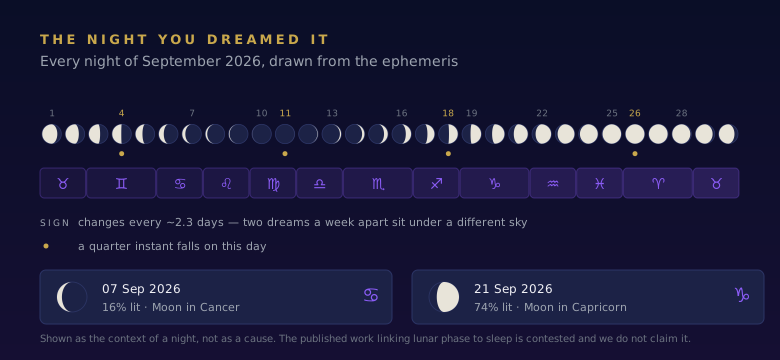
The sign is a different clock entirely. Phase depends on where the Moon is relative to the Sun; the sign depends on where it is against the zodiac. The two cycles are close but not equal — 29.5 days against 27.3 — so they drift against each other and a full moon does not fall in the same sign twice running.
What the research actually says about the Moon and sleep
This is the question most sites in this category either dodge or answer with a confidence nobody has earned, so here is the state of it, with the papers named so you can read them yourself.
2013
Basel, Current Biology — an effect (n=33)
In 2013 a group at Basel published a study in Current Biology reporting that around the full moon, 33 volunteers sleeping in a laboratory took about five minutes longer to fall asleep, slept about twenty minutes less, and showed roughly 30% less deep-sleep activity on EEG. It was a striking result and it was reported everywhere.
2014
Current Biology — none, and the file drawer (n=1265)
In 2014 a second group published in the same journal under the title "Lunar cycle effects on sleep and the file drawer problem". They re-analysed sleep data from 1,265 participants — a sample nearly forty times larger — and found no significant lunar effect at all. Their argument was partly about publication bias: studies that find nothing are less likely to be written up, so the published record over-represents positive results.
2021
Science Advances — actimetry, a small effect
In 2021 a third group published in Science Advances, using wrist actimetry rather than a laboratory, across indigenous Toba/Qom communities in Argentina both with and without access to electric light, and separately among university students in the United States. They found sleep starting later and running shorter on the nights before the full moon — not on the full moon itself — in all three settings.
Why the third result is the interesting one
That third result is the interesting one, because the mechanism it proposes is ordinary: in the nights leading up to a full moon, the Moon is up and bright during the hours just after dusk, which is exactly when people would otherwise be settling down. It is a claim about available light, not about lunar symbolism, and it predicts the effect on the wrong nights for anyone hoping the full moon is special.
Where that leaves it
So: contested, with the largest sample finding nothing and the most careful field study finding something small on nights nobody expected. This page shows you the sky over your dream because it is a fact you can check, and for no other reason. It does not claim the Moon caused anything.
Roughly one night in seven, the Moon changes sign
The Moon spends about two and a third days in each sign. A night runs eight hours. Divide one by the other and about 14% of nights contain a sign change — measured across 2026, 53 nights of 365, which is exactly what the arithmetic predicts.
On those nights there is no single right answer
On those nights there is no single right answer, because the answer depends on the hour you were actually dreaming, and that is something you do not know and this page cannot find out. Every other tool resolves it silently by picking a moment.
So both signs are named, with the crossing
This one names both signs and gives you the crossing instant, so if you have any sense of when you woke, you can settle it yourself. If you do not, then the honest position is that it was one of two and you cannot tell which — which is a better thing to be told than a confident wrong answer.
Using this alongside the dream itself
The lunar context is one column of a record, not a reading. What it is genuinely good for is the thing a dream dictionary cannot do: it gives every dream an objective coordinate.
Alongside the symbol itself
If you look up the symbol as well — and the dream dictionary here covers the twenty-four people search for most — you end up with a note that has both halves: what you dreamed, and what the sky was doing. Over a dozen entries, the first half starts showing patterns on its own.
What you should not do
What you should not do is read the phase as a cause. "I dreamed of water and it was a full moon" is a record. "I dreamed of water because it was a full moon" is a claim, and nothing on this page supports it.
Keeping the record is the part that pays off
A single dream interpreted in isolation is a guess. The same symbol appearing four times in a year, always in a particular part of your life, is data about you rather than about the symbol.
Where that shows up on this site
That is why recurring dreams get their own treatment on the symbol pages here, and why the date field exists at all. Write the dream down in the morning, note the date, and let the pattern accumulate — no interpretation, however good, substitutes for that.
Questions people ask about this
- Which date do I enter — the night or the morning?
- The evening you went to sleep. If you went to bed on Friday and woke on Saturday, enter Friday. The page moves the anchor forward to 3am Saturday for you.
- Why 3am and not midnight?
- REM periods lengthen through the night, so the long narrative dreams people remember are concentrated in the last third of a sleep period. 3am is a reasonable centre for that. Midnight would sit before most of the dreaming.
- Does the moon phase affect dreams?
- The published work is contested. A 2013 laboratory study reported an effect on sleep, a much larger 2014 re-analysis found none, and a 2021 field study found a small effect on the nights before the full moon, attributed to moonlight after dusk. This page shows the sky as context, not as a cause.
- Do I need my birth details?
- No. A moon phase is the angle between the Moon and the Sun as seen from Earth, which is the same from everywhere at a given instant. No birthplace, no birth time, no account.
- What if the Moon changed sign that night?
- You are told so, along with the exact instant it crossed. Both signs are named, because which one applies depends on when you were dreaming, and that is not knowable from a date.
- How far back can I go?
- Any date from 1900 to 2100. The underlying ephemeris is good well beyond that; the range is a limit on what this endpoint will answer for.
- Is this free?
- Yes, and there is no account, no limit and no AI involved. It is a lookup against an astronomical calculation, and it returns the same answer for the same date every time.
Check the same night against the calendar
The moon phase calendar lays out every quarter of every lunation from 2020 to 2035, so you can see the night you looked up sitting in its own cycle. The birthday calculator does the same for the night you were born.