Naked in public
Exposure without the option of covering, and who notices matters.
What dreaming about Naked in public usually means
The nakedness dream is one of the oldest recorded and one of the most reliably reported across cultures, which makes it unusual on this list for having both a long folk record and a straightforward modern reading. Both converge on exposure — being seen as you are, without the layer you normally present. What the accounts add, and what dictionaries usually skip, is that the reaction of other people in the dream is the variable that matters most. Dreams where nobody notices are reported as often as dreams where everybody does, and those two attach to entirely different situations. It is also one of the few symbols where the setting does real work: at school, at work and in the street are different dreams. The common thread is not shame but visibility, and the two are worth keeping apart because only one of them appears in every instance. One detail separates this dream from the other exposure symbols here and is almost never recorded: in most accounts the dreamer cannot leave. Teeth and hair can be hidden and a room can be walked out of, but the nakedness dream typically places you somewhere you are expected to remain — a classroom, a meeting, a street you have to cross. That constraint is doing as much work as the exposure, and it is what makes the nobody-notices version so unsettling rather than merely odd.
Common variations
Nobody notices
Reported nearly as often as the version where everyone does, and almost never covered. The dread is entirely the dreamer’s and the world is indifferent, which attaches to a felt exposure nobody else has registered — a much more specific and usually more accurate circumstance.
Partially dressed
Underwear, one missing item, clothes that will not stay on. The accounts describe this as worse than full nakedness rather than better, because the effort to cover is visible. It attaches to situations of partial exposure where you are still managing appearances.
At work
The setting narrows the reading to professional standing, and this version is reported disproportionately during new roles and probation periods. Who was present is the detail that does the work — peers and superiors produce different accounts.
At school
Like the exam dream, reported by people decades past it, which is the same evidence for the same conclusion. It attaches to being judged by a group rather than by an individual, which is the specific social geometry a classroom supplies.
Realising part way through
The dream begins normally and the discovery arrives mid-scene, which is reported as worse than starting out exposed. The accounts attach to situations where something was fine until you noticed how it looked, and the recurring detail is how long you had been there. It is the version that most often involves other people having already seen.
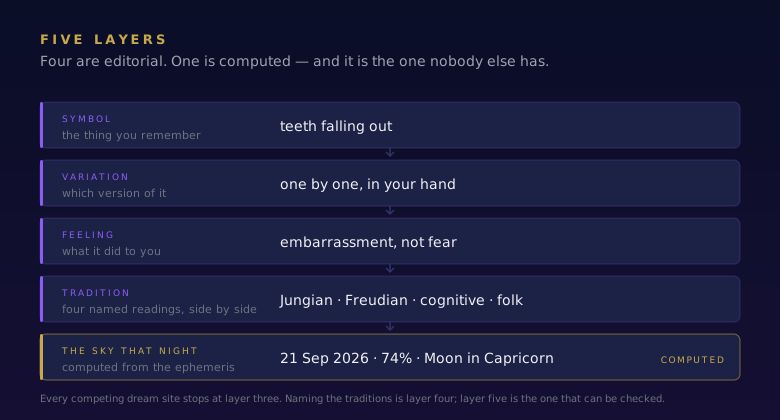
Four ways this is read
The Jungian reading
Treats the image as belonging to a shared vocabulary rather than a personal one, and asks what the image does rather than what it reminds you of. On this account the figures in a dream are closer to characters in a story everybody already knows than to coded references to your own week.
Reads the clothing rather than the body: the persona is the layer worn for others, and its loss is the reading. That framing is what makes the nobody-notices version legible rather than anomalous, since on this account the dream is about the covering and not about being seen.
The Freudian reading
Treats the image as a disguise and asks what it is standing in for. It is the most parodied of the four and it produced one durable observation worth keeping: the feeling in a dream is often attached to something other than the thing the dream appears to be about.
Discussed this dream at length and connected it to early childhood, when being unclothed was ordinary and unremarked. The specific developmental machinery has not lasted; the observation that the dream frequently carries a feeling disproportionate to its content is generic to the tradition and holds here.
The cognitive or continuity reading
The one closest to current sleep science. It holds that dreams continue waking concerns rather than encoding messages, so the useful question is never "what does it mean" but "what in my week does this resemble". It is also the reading that explains recurrence most simply: an unresolved situation keeps producing similar material.
Points to the obvious correlates: the dream rises during periods of being newly visible — a new job, a presentation, a return after absence — and it does not require the body to stand for anything. On this account it is the most available image of being seen without preparation.
The folk tradition
The oldest layer, and the one with the least explanation attached. Its readings vary sharply between cultures, which is itself informative — a symbol read the same way everywhere is behaving differently from one that is not.
Long-recorded and usually inverting, which is worth knowing because the inversion is so consistent. A number of European traditions read nakedness in a dream as honour or gain approaching rather than as disgrace, on the general principle that dreams show the opposite. The reading is old, widespread and unsupported, but it is at least cheerful.
How this one is usually misread
The near-universal error is reading the dream as being about shame, when the variable the accounts actually turn on is visibility — and the nobody-notices version, which is reported about as often, has no shame in it at all. An entry built on embarrassment cannot accommodate half its own instances. The second misreading is the folk inversion taken literally: the idea that dreaming of nakedness means honour is coming. It is recorded widely, it is unfalsifiable, and it survives for that reason rather than any other.
The feeling matters more than the image
The tone divides this symbol into two dreams that share an image. Mortification attaches to being seen; a colder, stranger unease attaches to not being seen, and the second is the one people find harder to describe and more often remember. The detail worth recording is who was there and whether they reacted, because that single fact is what separates the two and it is completely gone by the time most people think to write anything down. Also worth noting is whether you were trying to cover up, which distinguishes exposure that is being managed from exposure that has been accepted.
This one is felt, not only seen
People report this dream partly as a bodily sensation rather than an image — which is why it is remembered vividly and why it is hard to describe afterwards. The sensation is worth noting alongside the content when you write it down, because it is usually the part that changes between one instance and the next.
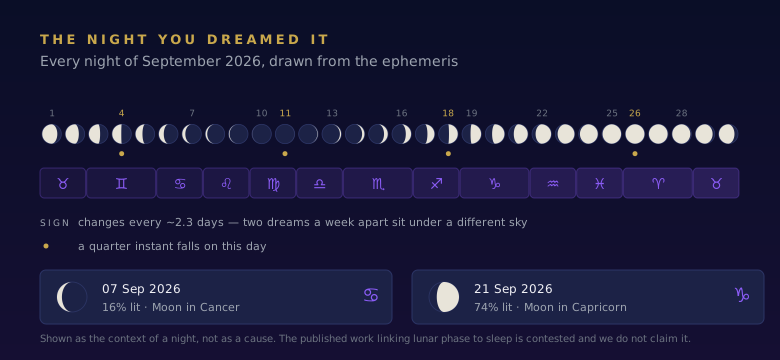
The Moon on the night you dreamed it
The one thing on this page that can be verified. Enter the night you went to sleep and you get the phase, the illuminated fraction and the sign the Moon held in the small hours, computed rather than asserted. It is context, not a cause — the published research on the Moon and sleep is contested, and the page on it says so.
Related symbols
These are descriptions of how a symbol is commonly read, never statements about you, and nothing here is medical or psychological advice.