Your Career Reading
Read from your Midheaven, Saturn, Jupiter and the houses that govern work — with the degrees on screen, so you can check every line of it.
Reading the working part of your chart…
Why a career reading starts at the Midheaven
The Midheaven is the highest point the ecliptic reaches at the moment you were born — the part of the sky directly overhead. Astrologically it is what you are seen doing, which is a narrower and more useful idea than what you are good at. It is also, unlike your sun sign, specific to the minute: two people born the same day in the same city four hours apart have different Midheavens and therefore different readings here.
The three houses around it
Around it sit the three houses that divide work into its parts. The tenth is direction and public standing — the thing on the business card. The sixth is the daily practice, which is where most of the hours actually go and where most of the friction lives. The second is what it pays, and whether that lines up with what you value.
Saturn and Jupiter set the pace
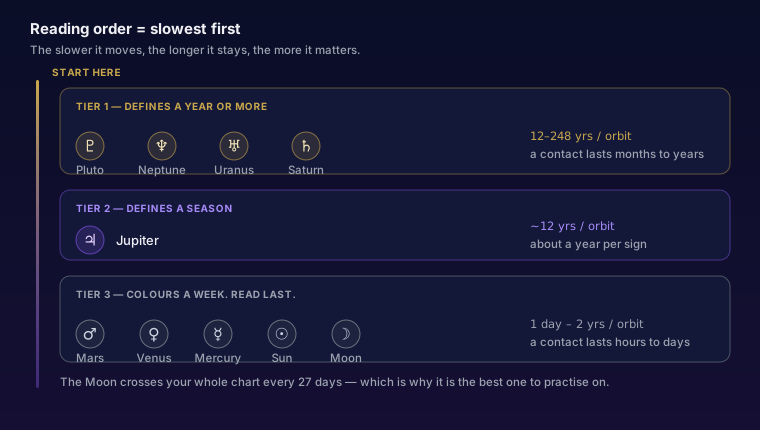
Saturn and Jupiter are the two bodies that set the pace across a working life. Saturn describes the constraint that shapes an ambition and the cost of not respecting it; Jupiter describes the expansion, and what it costs to take all of it. A career reading that does not look at both is describing a mood rather than a trajectory.
Those, and nothing else
This reading uses those and nothing else. The full list is on the page with every degree, and the shortness is the point: a reading drawing on the whole chart can support any conclusion, because there is always some placement that fits.
What a career reading actually is
The standing pattern does not change. Your Midheaven is at the degree it was at birth and stays there, and what it describes is a disposition toward work rather than a job title. People usually recognise it across several roles that looked unrelated from the outside.
The transits matter more here than almost anywhere
The transits are the moving half, and in career they matter more than almost anywhere else because they are slow. A Saturn transit to the Midheaven is a two-to-three-year situation, not a mood, and knowing you are eighteen months into one explains a great deal that otherwise reads as personal failure.
It will not tell you to take the job
What it will not do is tell you to take the job. It describes the shape of a period and the timing of your own actions; the decision is yours, which is both the honest position and the only one a chart is entitled to.
What this reading is read from
The complete list, fixed in advance and identical for every chart. It is published because a method nobody can inspect is a method nobody should trust.
- The Midheaven — what you are seen doing, and the direction the working life points in. Specific to the minute of birth.
- The Sun — what you are trying to become through the work, as distinct from what you are paid for.
- Saturn — the constraint that shapes the ambition, and the cost of ignoring it. The slowest and usually the most decisive.
- Jupiter — where it expands, and what taking all of that expansion costs.
- The tenth house and its ruler — direction and standing.
- The sixth house and its ruler — the daily practice, where the hours actually go.
- The second house and its ruler — what the work pays, and whether that matches what you value.
- And whatever is currently within orb of those, with the exact date each aspect perfects.
Your sun sign is not on this list, and neither is most of your chart. An evidence panel short enough to read is the only kind you can check.
Why career transits are the ones worth dating
Because they are long. A Mars transit lasts days and you will have forgotten it by the time it matters; Saturn crossing the Midheaven runs for years, and the difference between month three and month thirty is the difference between holding on and having held on too long.
The dates are computed, not estimated
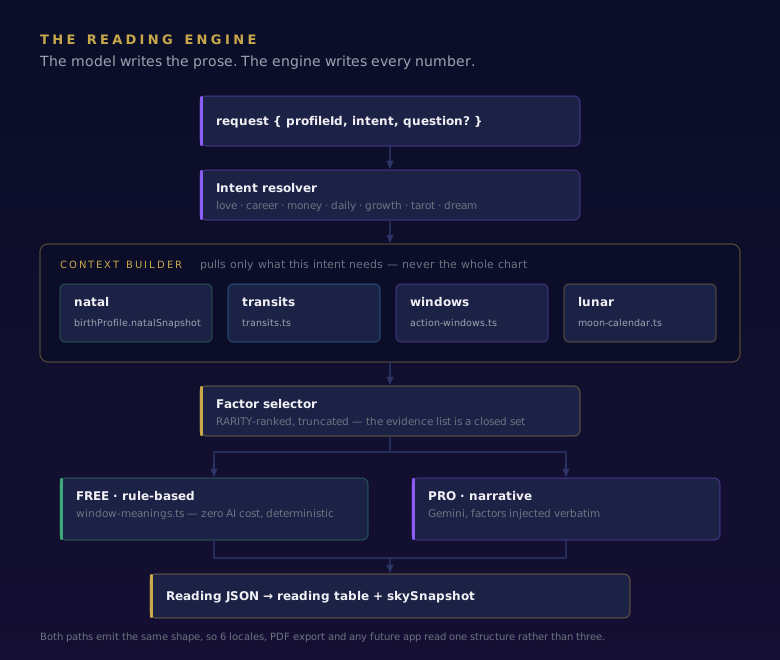
So the dates on this page are computed rather than estimated. Each transit is found by scanning the ephemeris and bisecting to the boundary where the aspect enters and leaves orb, and the exact moment is refined inside that window. The page shows the beginning, the end and the perfection, because with a multi-year transit knowing where you are in it is most of the value.
It will not tell you a promotion is coming
It will not tell you that a promotion is coming. The guidance attached to each transit is about the timing of your own actions — a stretch where a contract is worth reading twice, not a contract that will arrive. The first you can check against your own quarter; the second cannot be wrong, which is what is wrong with it.
Using it when you are deciding something
Start with the standing pattern rather than the transits. If the reading describes a disposition you recognise across three jobs, that is the thing worth planning around; a transit is a period, and periods end. People who make decisions purely on transits tend to make the same decision repeatedly.
Where you are inside the slow transits
Then look at where you are inside the slow transits. A choice made two months before a Saturn aspect perfects and the same choice made two months after are being made under different conditions, and the page gives you the date rather than a feeling about it.
If the question is narrower than the area
And if the question is narrower than the area — whether to take a specific offer, why one particular working relationship keeps snagging — Ask My Chart reads that from the placements the question itself depends on, with the same evidence panel.
The same chart answers narrower questions too
This reading covers the area. Ask My Chart takes one specific question and reads it from the placements it actually depends on — the same evidence panel, aimed at something smaller.