Baby
A new responsibility, or a part of yourself that needs tending.
What dreaming about Baby usually means
A baby in a dream is read almost universally as something new that needs tending, and the readings hold together across traditions better than for most symbols on this list. What distinguishes the instances from each other is the relationship in the dream: whether the baby was yours, whether you were responsible for it, and whether you were managing. Those three questions do more work than the image. The version that recurs most in the accounts and least in the dictionaries is the forgotten baby — discovering a child you were supposed to be caring for and had not thought about for days. It is reported with a distinctive guilt that other versions do not carry, and it attaches with unusual consistency to obligations that have been let slide. A dictionary entry that reads "baby means new beginnings" is true and has thrown away everything that tells one instance from another. One further asymmetry is worth knowing before reading your own: the dream is reported by people with children and people without in roughly similar numbers, but they describe it differently. Parents more often dream of a specific child and a specific failure of care; everyone else more often dreams of an unidentified baby and a general one. The two are worth keeping apart, because only the second is doing symbolic work at all.
Common variations
A baby you forgot you had
The version people report with the most distress and the one most often left out of dictionaries. The guilt is the content: something you took responsibility for and stopped attending to. It attaches to neglected obligations with unusual reliability, and people frequently identify what it was within minutes of waking.
A baby crying
A demand that cannot be negotiated with and cannot be ignored. Accounts of it attach to situations requiring attention now rather than to anything about children. Whether you could soothe it is the detail that varies and the one worth writing down.
Holding a baby
The calmest version and one of the few dreams on this list people describe as restful. It reads as something new being in hand rather than in prospect, and the accounts attach to recently settled situations more often than to new ones.
A baby in danger
The most frightening version and the hardest to wake from. It is reported disproportionately by new parents, where the continuity reading applies directly and no symbolism is needed. Where it is not, the readings attach to something new and vulnerable that feels inadequately protected.
A baby that is not yours
Being handed, or left with, a child belonging to someone else. It separates cleanly from the other versions because the responsibility is real and the claim is not, and the accounts attach to obligations inherited rather than chosen — covering for a colleague, absorbing a family matter, holding something that was passed along. What people remember is usually not knowing when the parent was coming back.
Four ways this is read
The Jungian reading
Treats the image as belonging to a shared vocabulary rather than a personal one, and asks what the image does rather than what it reminds you of. On this account the figures in a dream are closer to characters in a story everybody already knows than to coded references to your own week.
Reads the child as one of the most important images in the shared repertoire — not innocence but potential, the thing that has arrived and is not yet what it will be. The tradition treats it as consistently favourable even in frightening versions, on the grounds that the danger in the dream is to something worth protecting.
The Freudian reading
Treats the image as a disguise and asks what it is standing in for. It is the most parodied of the four and it produced one durable observation worth keeping: the feeling in a dream is often attached to something other than the thing the dream appears to be about.
Read the baby in relation to the dreamer’s own childhood and to wishes formed then, with a body of specific interpretation that has not lasted. The general point that remains: a figure in a dream is frequently doing double duty, standing for both the person in the image and the dreamer at that age.
The cognitive or continuity reading
The one closest to current sleep science. It holds that dreams continue waking concerns rather than encoding messages, so the useful question is never "what does it mean" but "what in my week does this resemble". It is also the reading that explains recurrence most simply: an unresolved situation keeps producing similar material.
Notes that this dream is very substantially more frequent among new parents and among people caring for anyone dependent, where it continues the day directly. Outside those, the question it asks is what recently arrived and needs attention — and the forgotten-baby version answers it so precisely that the continuity reading barely has to work.
The folk tradition
The oldest layer, and the one with the least explanation attached. Its readings vary sharply between cultures, which is itself informative — a symbol read the same way everywhere is behaving differently from one that is not.
Generally favourable, and across several traditions specifically read as news arriving. Some records reverse it in the way folk dream-books often do, reading a baby as difficulty ahead. The favourable reading is much the more common of the two.
How this one is usually misread
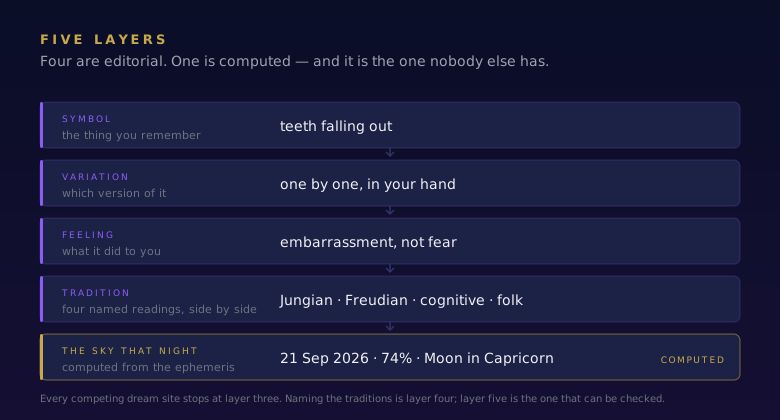
The usual error is the flat one: "a baby means a new beginning", which is true of every instance and therefore distinguishes none of them. What separates one baby dream from another is responsibility — whose baby, whether you were managing, whether you had forgotten it — and an entry that stops at the noun has discarded all of it. The second misreading is predictive, the same shape as the pregnancy one and kept alive by the same asymmetry: nobody records the times nothing followed. A dream about a baby is not news about a birth, and the traditions that have thought about the symbol do not claim it is.
The feeling matters more than the image
Tenderness, panic and guilt are all commonly reported and they point at quite different circumstances. Guilt is the most specific of the three and belongs almost entirely to the forgotten-baby version; panic attaches to situations where responsibility exceeds capacity; tenderness, which is the least often looked up because it needs no explanation, attaches to things going well. The detail worth recording alongside is whether anyone else was present. A baby dream with other adults in it is reported quite differently from one where the responsibility was entirely yours, and the difference tracks the waking situation more closely than the baby does.
The Moon on the night you dreamed it
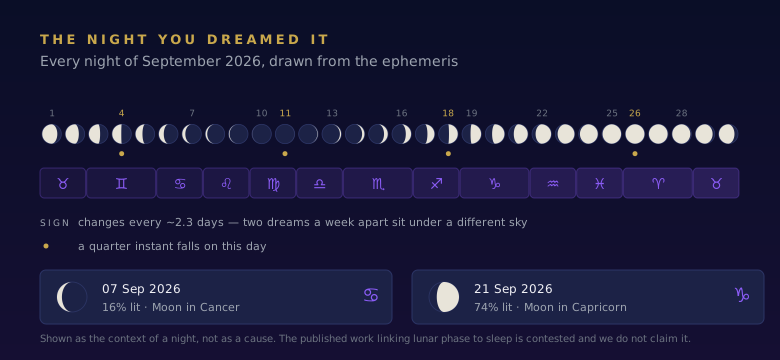
The one thing on this page that can be verified. Enter the night you went to sleep and you get the phase, the illuminated fraction and the sign the Moon held in the small hours, computed rather than asserted. It is context, not a cause — the published research on the Moon and sleep is contested, and the page on it says so.
Related symbols
These are descriptions of how a symbol is commonly read, never statements about you, and nothing here is medical or psychological advice.