Money
Worth rather than wealth — what you think you are owed or owe.
What dreaming about Money usually means
Money in a dream is almost never read as money, and the traditions are unusually united on this: it is read as worth, exchange and what you believe you are owed or owe. That reframing is what makes the symbol useful, because it turns a dream about coins into a question about value that can actually be tested against a situation. The accounts support it — reports of money dreams cluster around periods of being under- or over-valued at work, around obligations, and around changes in status, far more than around actual financial pressure. Where there is genuine financial pressure the continuity reading applies flatly and the symbolism adds nothing. The detail that carries the most information is the direction: finding, losing, being given and being unable to spend are four different dreams that share a noun. Worth noting before the variations, because it changes how to read them: money almost never appears alone in these accounts. It is being handed over, counted, searched for, refused — the dreams are about transactions rather than about sums, and the other party is usually present even when the dreamer does not recall who they were. A dictionary entry organised around amounts has missed that the symbol is fundamentally about exchange, and that the second person in the dream is frequently the part carrying the information.
Common variations
Finding money
Reported as pleasant and read as recognition of something already yours rather than as gain — the accounts frequently involve money found in your own coat or an old bag. It attaches to capacities or entitlements being noticed rather than acquired.
Losing money
The more common of the two and reported with more intensity. The readings attach to something valued being spent without return, and the recurring detail is whether you knew where it went — an unexplained loss and a known one map onto different situations.
Being given money
Introduces a second person and the reading follows them. The accounts divide on whether the gift felt free or obliging, which is the distinction that matters: one attaches to support received, the other to a debt being created.
Money that turns out to be fake
A distinct and frequently reported version, and the sharpest of the four. Something presented as valuable that is not, discovered after it was accepted. The accounts attach to arrangements that looked like fair exchange and were not.
Having money you cannot spend
The version that sounds like a contradiction and is reported consistently: the money is there, the transaction will not complete. Cards refused, a sum that is somehow the wrong kind, notes that the other person will not take. It separates from losing money because nothing has gone — the resource exists and cannot be converted into anything. The accounts attach to capacities with no outlet, which is a circumstance people recognise immediately once it is named: skills the current role has no use for, goodwill that cannot be spent, a position of some strength in a situation that offers nothing to do with it. What recurs in the reports is the other person’s indifference rather than any hostility.
Four ways this is read
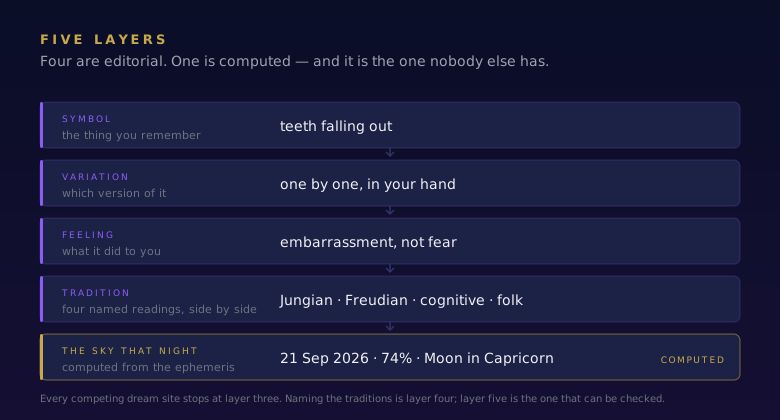
The Jungian reading
Treats the image as belonging to a shared vocabulary rather than a personal one, and asks what the image does rather than what it reminds you of. On this account the figures in a dream are closer to characters in a story everybody already knows than to coded references to your own week.
Reads money as a symbol of energy and value in circulation rather than of wealth — what you spend yourself on. The tradition is generally uninterested in the literal financial reading, and treats a dream of losing money as a question about where your resources are going rather than about a sum.
The Freudian reading
Treats the image as a disguise and asks what it is standing in for. It is the most parodied of the four and it produced one durable observation worth keeping: the feeling in a dream is often attached to something other than the thing the dream appears to be about.
Produced the best-known and most parodied reading in this area, connecting money to a particular stage of childhood development. It is included because it is encountered rather than because it is usable. The general point that survives: an object in a dream can carry a feeling about retention and release that has nothing to do with the object.
The cognitive or continuity reading
The one closest to current sleep science. It holds that dreams continue waking concerns rather than encoding messages, so the useful question is never "what does it mean" but "what in my week does this resemble". It is also the reading that explains recurrence most simply: an unresolved situation keeps producing similar material.
Observes that money dreams rise with financial stress in exactly the way the continuity reading predicts, and that outside such periods they track situations of exchange more broadly — negotiations, obligations, questions of fairness. The useful question is what recently felt like an unequal trade.
The folk tradition
The oldest layer, and the one with the least explanation attached. Its readings vary sharply between cultures, which is itself informative — a symbol read the same way everywhere is behaving differently from one that is not.
Frequently inverting, and consistently enough to be worth noting: a number of traditions read finding money as loss ahead and losing it as gain. The inversion principle is common in folk dream-books generally, and money is one of the symbols where it is most often recorded.
How this one is usually misread
The dominant misreading is the literal one — treating a money dream as being about money — and it survives because the image is so concrete that a symbolic reading feels like a stretch. The traditions are unusually united against it. The second error is the folk inversion taken as a rule: the idea that finding money in a dream means losing it in life is widely repeated, has nothing behind it, and is unfalsifiable in the specific way that keeps such beliefs alive. Worth knowing that it exists, and worth not carrying.
The feeling matters more than the image
The tone splits this symbol more usefully than the amount does. Relief, anxiety about a shortfall, and a specific indignation at unfairness are all commonly reported, and the third is the most informative — it attaches almost exclusively to situations of unequal exchange rather than to anything about scarcity. The detail worth recording is whether you could spend it. A dream of having money you cannot use is reported distinctly from both having and lacking it, and it attaches to capacities that exist and have no outlet, which is a circumstance people recognise immediately once it is named.
The Moon on the night you dreamed it
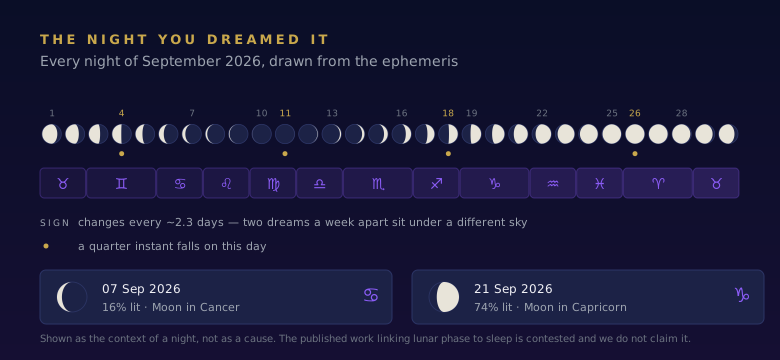
The one thing on this page that can be verified. Enter the night you went to sleep and you get the phase, the illuminated fraction and the sign the Moon held in the small hours, computed rather than asserted. It is context, not a cause — the published research on the Moon and sleep is contested, and the page on it says so.
Related symbols
These are descriptions of how a symbol is commonly read, never statements about you, and nothing here is medical or psychological advice.