Dogs
Loyalty, protection, and sometimes the threat that loyalty turns into.
What dreaming about Dogs usually means
Dogs are read more consistently than cats across traditions, and the reading is loyalty and protection — with a second, sharper meaning that the friendly version obscures. A dog is the animal that is on someone’s side, and a dream tells you whose. The accounts divide almost entirely on that question: a dog with you, a dog against you, and a dog belonging to someone else are three different dreams sharing an animal. As with cats, personal experience dominates. Dog owners dream about dogs constantly and the continuity reading covers it; people afraid of dogs dream about them for the same plain reason. What remains for everyone else is a symbol about allegiance, which is narrow enough to be tested against a situation and broad enough to often fit. What the accounts add to the traditions here is a matter of proximity. A dog at a distance and a dog beside you are reported as different dreams even when nothing happens in either, and the distance tracks the waking relationship more reliably than any incident does. It is one of the few symbols where the geometry alone carries the reading, and it is completely lost in any entry that summarises the dream as an encounter with an animal.
Common variations
Being bitten by a dog
Loyalty turning, which is why this version is reported with a distinct sense of betrayal rather than simple fear. The accounts frequently identify the dog as known rather than strange, and that detail is the reading.
A dog barking at you
Warning rather than attack, and the accounts attach it to being told off or warned away by something with standing to do so. Whether it was restrained is the detail people remember.
A dog you used to have
Extremely common and, like the equivalent cat version, reported as comforting far more often than sad. Especially frequent after a pet has died, where it continues an ordinary grief and needs no symbolic reading at all.
A dog that is simply friendly
The least looked up and one of the more informative. A companionable animal with no incident attached is reported during settled periods, and it is worth recognising as the absence of a problem rather than the presence of a message.
A pack rather than one dog
Number transforms this symbol, and unlike the cats equivalent it does not simply multiply the feeling — it changes which feeling. One dog is a relationship, with allegiance on one side or the other; a pack is a force, and the question of whose side it is on stops being answerable. The accounts attach to group dynamics rather than to individuals: a team that has turned, a crowd forming an opinion, a situation where the people involved have stopped acting separately. The detail that recurs is whether any single animal was identifiable, because a pack with a known dog in it is reported quite differently from an anonymous one, and it puts the dream back in the territory of the bitten version.
Four ways this is read
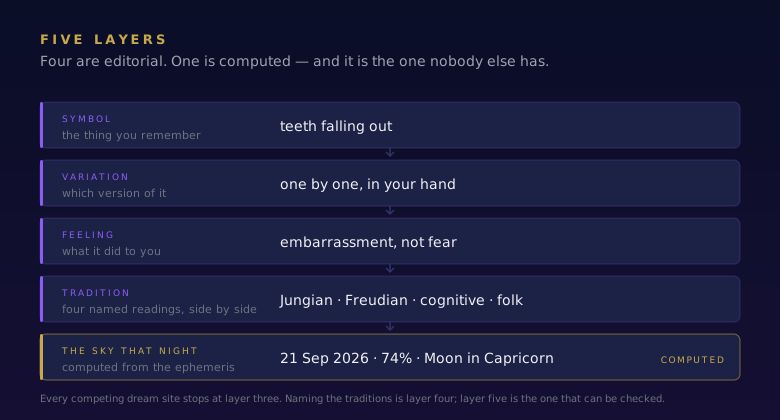
The Jungian reading
Treats the image as belonging to a shared vocabulary rather than a personal one, and asks what the image does rather than what it reminds you of. On this account the figures in a dream are closer to characters in a story everybody already knows than to coded references to your own week.
Reads the dog as the domesticated companion to the wolf that appears elsewhere in the repertoire — instinct that has agreed to terms. The pairing matters to the tradition: the same animal tamed and wild is one of its standing contrasts, and the being-chased entry on this site draws on the same observation.
The Freudian reading
Treats the image as a disguise and asks what it is standing in for. It is the most parodied of the four and it produced one durable observation worth keeping: the feeling in a dream is often attached to something other than the thing the dream appears to be about.
Little specific, and the general animal reading applies: a creature in a dream frequently carries a feeling about a person that the waking mind has not assigned. For this symbol that reading is unusually easy to test, because the accounts so often identify whose dog it was.
The cognitive or continuity reading
The one closest to current sleep science. It holds that dreams continue waking concerns rather than encoding messages, so the useful question is never "what does it mean" but "what in my week does this resemble". It is also the reading that explains recurrence most simply: an unresolved situation keeps producing similar material.
Accounts for most instances without symbolism. Dog owners, people who walked past one, people who are afraid of them — all dream about dogs more, and in each case the dream continues the day. The allegiance question only becomes interesting when none of those applies.
The folk tradition
The oldest layer, and the one with the least explanation attached. Its readings vary sharply between cultures, which is itself informative — a symbol read the same way everywhere is behaving differently from one that is not.
More consistent than most entries on this list and generally favourable: guardianship, fidelity and protection recur across widely separated traditions. The exceptions are specific rather than general — particular records treat a howling dog as an omen — and they are narrow enough that the overall consistency is the more notable fact.
How this one is usually misread
The standard entry reads "dog means loyalty" and stops, which misses the sharper half of the symbol: a dog is loyal to someone, and the dream is usually telling you who. The bitten version is the clearest case — it is reported with betrayal rather than fear, and the dog is more often known than strange. The second misreading is the one this symbol shares with cats: for anyone who owns a dog, or fears one, the likeliest reading is the literal one, and reaching past it for something symbolic is a habit dictionaries encourage and the accounts do not support.
The feeling matters more than the image
Warmth and fear are both common and they sort the dream almost completely, which is unusual — for most symbols here the tone modifies the reading and for this one it nearly determines it. The third and most informative report is betrayal, which belongs to the bitten version and attaches with real precision to situations involving someone trusted. The detail worth recording is whose dog it was. That single fact converts a vague symbol into a specific one, and it is available for about ninety seconds after waking.
The Moon on the night you dreamed it
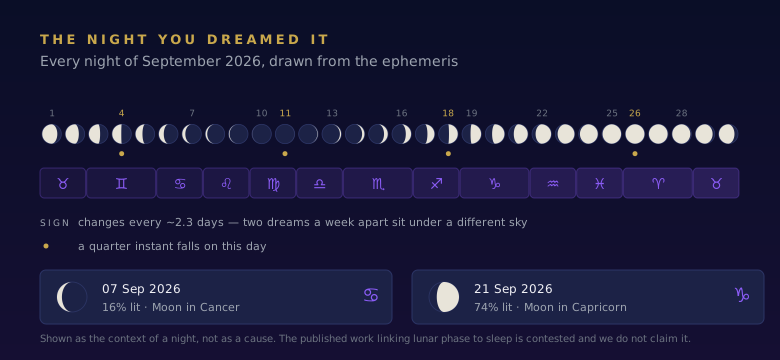
The one thing on this page that can be verified. Enter the night you went to sleep and you get the phase, the illuminated fraction and the sign the Moon held in the small hours, computed rather than asserted. It is context, not a cause — the published research on the Moon and sleep is contested, and the page on it says so.
Related symbols
These are descriptions of how a symbol is commonly read, never statements about you, and nothing here is medical or psychological advice.