Spiders
Entanglement and patience — the web is usually the point, not the spider.
What dreaming about Spiders usually means
Spiders divide the people who dream about them more sharply than almost any other symbol, because a substantial minority of the population finds them frightening while awake, and for those dreamers the continuity reading applies before any symbolism does. For everyone else, the readings converge on two things that are genuinely distinct: entanglement and patience. The web is the more interesting half and the half dictionaries tend to skip — a structure built slowly, invisible until you are in it, belonging to something waiting rather than pursuing. That is a specific enough idea to be worth testing against a situation. The spider itself is usually read as threat, which is the less informative reading of the two, and the accounts support it least in the cases where the spider did nothing.
Common variations
One very large spider
Size is the whole variation and it behaves oddly: a large spider is reported as less frightening than many small ones by a clear margin. The readings attach to a single identifiable problem, which is more tractable than a diffuse one and is often how the accounts describe it afterwards.
Many spiders
The version people wake from. Volume rather than size, and it attaches to being overwhelmed by a number of small things rather than confronted with one large one. The detail that recurs is whether they were moving toward you or simply present.
A web, with or without the spider
The most informative version and the least looked up. A web is a structure built slowly by something patient, and the readings attach to situations you are already inside and did not see being made. Whether you were caught in it is the question that separates the accounts.
Being bitten
Rarer than the fear suggests and more specific. The bite localises the dream, and the readings follow where it landed and whether you saw it coming. Reports of this version more often involve a person than a situation.
A spider on your body
Contact rather than sight, and it moves the dream from the visual to the physical — this is the version people wake up brushing at themselves. The accounts attach to something unwanted that has got past the distance you normally keep, and unlike the bite it involves no injury, which is why the reports describe revulsion rather than fear.
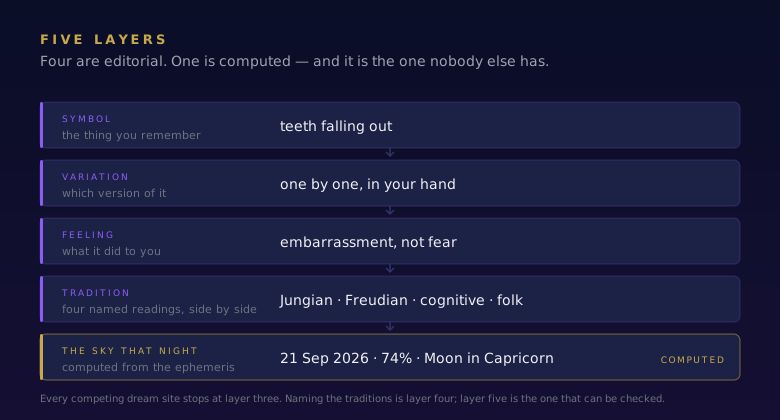
Four ways this is read
The Jungian reading
Treats the image as belonging to a shared vocabulary rather than a personal one, and asks what the image does rather than what it reminds you of. On this account the figures in a dream are closer to characters in a story everybody already knows than to coded references to your own week.
Reads the spider as a maker rather than a predator, which is a less obvious and more productive angle: the web is the artefact, and the tradition attends to what has been constructed and who constructed it. The devouring reading also exists in this tradition and is applied more cautiously than popular summaries suggest.
The Freudian reading
Treats the image as a disguise and asks what it is standing in for. It is the most parodied of the four and it produced one durable observation worth keeping: the feeling in a dream is often attached to something other than the thing the dream appears to be about.
Produced readings tied to particular family relations that are now mostly of historical interest. The part worth keeping is generic to the tradition: an animal in a dream is frequently carrying a feeling that the waking mind would not attach to a person.
The cognitive or continuity reading
The one closest to current sleep science. It holds that dreams continue waking concerns rather than encoding messages, so the useful question is never "what does it mean" but "what in my week does this resemble". It is also the reading that explains recurrence most simply: an unresolved situation keeps producing similar material.
Notes that arachnophobia is common and that the dream tracks it closely — people afraid of spiders dream about them more, and for them the dream continues a waking fear with nothing further to decode. It also observes that spiders, like snakes, are detected unusually fast in visual tests, which accounts for some of their frequency without any symbolism.
The folk tradition
The oldest layer, and the one with the least explanation attached. Its readings vary sharply between cultures, which is itself informative — a symbol read the same way everywhere is behaving differently from one that is not.
Unusually favourable in several traditions, which surprises people. A number of European and West African records read a spider as industry, patience or good fortune arriving, and the association with weaving and storytelling is widespread. The threatening reading is the modern and largely Anglophone one.
How this one is usually misread
The dominant misreading is treating the spider as a threat by default, which is a cultural reading presented as the reading — several traditions read it as industry or as fortune, and the association with weaving is old and widespread. The second error is more practical: dictionaries put the spider at the centre and the web at the edge, when the accounts suggest the reverse. A web is a slow structure you did not see being built and are now inside, which is a far more specific idea than "something frightening", and it is the half of this symbol that actually distinguishes one dream from another.
The feeling matters more than the image
Fear is the expected report and it is worth separating from disgust, which people describe differently and which attaches to different situations — fear to a threat, disgust more often to something unwanted that has got close. A third of the accounts describe neither, and those cluster around the web versions, where the dream is more often unsettling than frightening. The detail worth recording is whether the spider moved. A stationary spider and an approaching one are two different dreams, and the difference is the same one that separates a situation you are watching from one that is arriving.
This one is felt, not only seen
People report this dream partly as a bodily sensation rather than an image — which is why it is remembered vividly and why it is hard to describe afterwards. The sensation is worth noting alongside the content when you write it down, because it is usually the part that changes between one instance and the next.
The Moon on the night you dreamed it
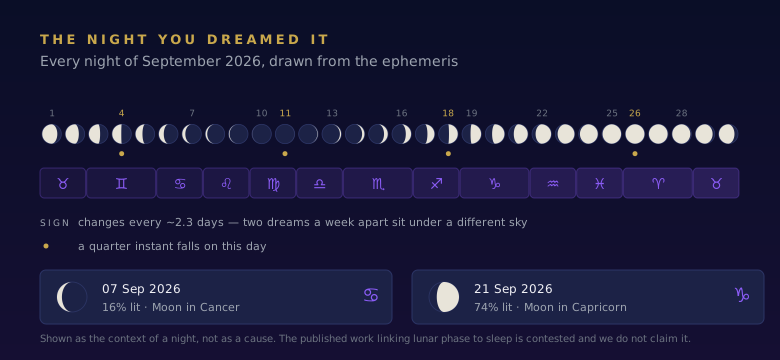
The one thing on this page that can be verified. Enter the night you went to sleep and you get the phase, the illuminated fraction and the sign the Moon held in the small hours, computed rather than asserted. It is context, not a cause — the published research on the Moon and sleep is contested, and the page on it says so.
Related symbols
These are descriptions of how a symbol is commonly read, never statements about you, and nothing here is medical or psychological advice.