Tarot birth card calculator
Two cards from one birth date, and they usually disagree. One comes from adding up the digits; the other from where the Sun actually was. The page shows the working for both.
Why a birth card calculator should return two cards
Search for a tarot birth card calculator and every result does the same thing: it adds up the digits of your birth date, reduces the total to twenty-two or less, and hands you a Major Arcana card. That is a real tradition, it is the one most people mean by the phrase, and this page computes it — but on its own it leaves out something the same birth date already contains.
Your birth date also fixes where the Sun was
Your birth date also fixes where the Sun was. And under the Golden Dawn correspondences every ten degrees of the zodiac belongs to one Minor Arcana card, so the Sun on your birthday stood inside exactly one of them. That is also a card that is yours, arrived at a completely different way, and no calculator for this keyword returns it.
They almost always disagree
The two almost always disagree, and that is the interesting part rather than a problem to resolve. They are not two measurements of one thing that ought to match. One is arithmetic performed on the way we write dates; the other is a fact about the solar system. Showing both side by side is the only way to make that visible.
Both, with the working shown
So the tool above returns both, and prints the working under each — the digit sum for one, the Sun’s degree for the other. If a calculator will not show you how it got there, the number it gives you is worth exactly as much as your trust in the site, which is not a good basis for anything.
How the tarot birth card is calculated
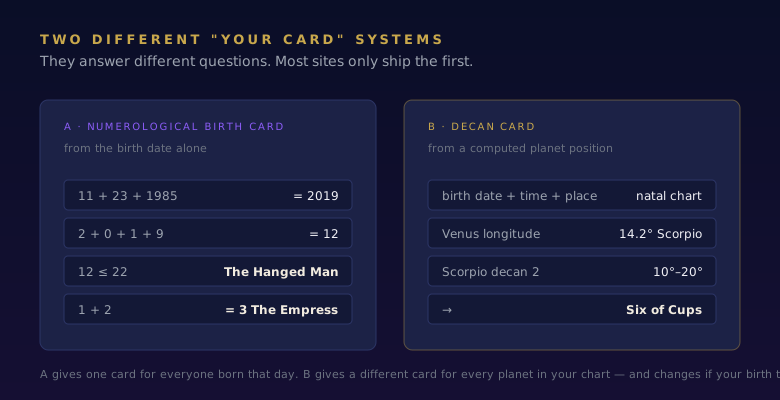
Add the month, the day and the four-digit year. Born on 14 May 1970, that is 5 + 14 + 1970 = 1989. If the total is larger than twenty-two, add its digits: 1 + 9 + 8 + 9 = 27. Still larger, so again: 2 + 7 = 9. Nine is the Hermit, and that is the birth card.
The second card, from reducing once more
Where the result has two digits, reducing once more gives a second card, usually called the soul card while the first is the personality card. A total of twenty lands on Judgement with the High Priestess behind it; a total of nine, as above, is already a single digit, so both cards are the Hermit and that is not an error.
Why twenty-two folds onto the Fool
Twenty-two folds onto the Fool, which is numbered zero. That is the one arbitrary-looking step and it is a genuine convention rather than a rounding: the Fool is unnumbered in older decks and zero and twenty-two are treated as the same position in the sequence.
What this is not
All of which is checkable, and the tool shows each step so you can check it. What it is not is astronomy. The calculation would give the same answer in a universe with no Sun in it, because its only input is the way a calendar date is written down — and a calendar is a human convention that has been revised more than once.
How the Sun’s decan card is calculated
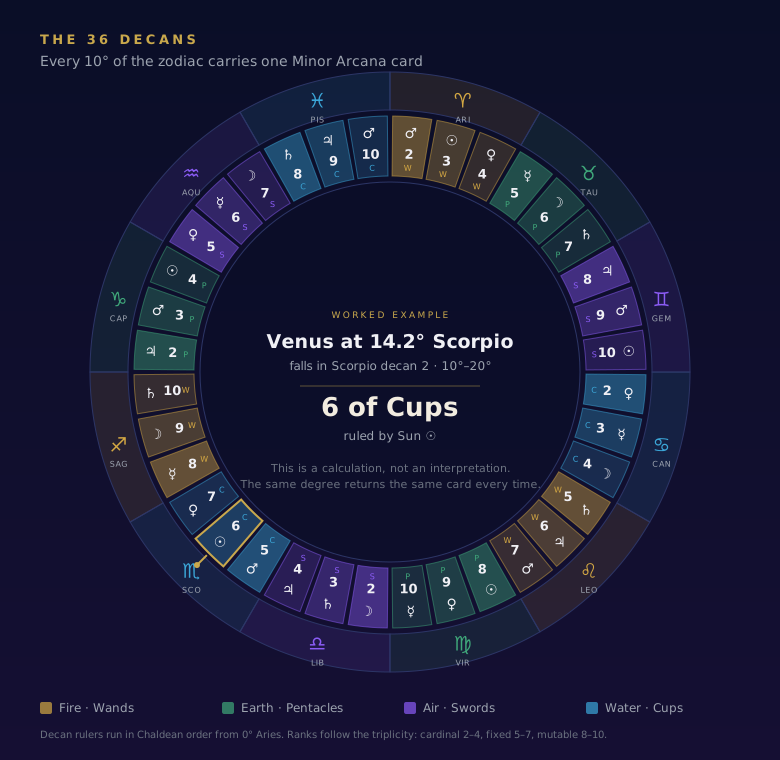
A decan is ten degrees of the zodiac, and there are thirty-six of them. The Golden Dawn assigned one Minor Arcana from Two to Ten to each, covering the circle exactly once. So a position in the zodiac resolves to a card the way a postcode resolves to a street — it is a lookup, not a judgement.
About ten days per decan
The Sun moves a little under one degree a day, so it spends about ten days in each decan. Computing your card means computing the Sun’s ecliptic longitude on your birth date and reading off which ten-degree arc it fell in. Born with the Sun at 14.2 degrees of Scorpio, you are in Scorpio’s second decan, and Scorpio’s second decan is the Six of Cups.
This is the half that can be wrong
This is the half that can be wrong, which is what makes it worth having. You can check the degree against any ephemeris and the card against any published correspondence table, and if either is off the answer is off. The digit sum has no such exposure — there is nothing external it could disagree with.
And the half that is genuinely yours
It is also the half that is genuinely yours rather than shared with everyone born on that calendar day of any year. Two people born on 14 May in different years have the same birth card only by coincidence of the year’s digits, but their Suns sit within a degree of each other, which is a real similarity rather than an arithmetic one.
The one day in ten where a date is not enough
Because the Sun covers about 0.96 degrees a day, it crosses a decan boundary roughly every ten days. If you were born on one of those days, the answer depends on the hour: someone born in the morning and someone born that evening have different cards.
Every other calculator resolves this silently
Every other calculator resolves this silently, usually by taking noon and saying nothing. On a boundary day that is wrong for roughly half of the people who ask, and wrong in the way that matters most — invisibly, with no sign that a choice was made on their behalf.
Both candidates, and the exact crossing
This one says so instead. On a boundary day it names both candidates and prints the exact UTC instant the Sun crossed, so you can settle it yourself if you know roughly when you were born. If you do not, you have two cards and a reason, which is a more honest position than one card and a coin flip.
On every other day the date settles it
Away from those days the date alone settles it completely, which is most of the time, and the tool says nothing about times because there is nothing to say. Asking everybody for a birth time to cover a case that affects one birthday in ten would be a worse trade than handling the case properly when it comes up.
Which card should you actually use?
It depends what you are doing, and the honest answer is that they are good for different things rather than that one is better.
The birth card is what the tradition built on
The birth card is the one the tradition has built around. There is a body of writing about personality and soul cards, year cards and the pairs they form, and if you want to read into that literature or talk to someone who works with it, that is the card they mean. Its value is as a shared reference point, which does not depend on it being derived from anything physical.
The Sun card is what connects to a chart
The Sun card is the one that connects to the rest of a chart. It comes from a real position, it sits in a real decan with a real ruling planet, and it is the same lookup that resolves every other placement you have — so it is the one that lets a tarot reading and a birth chart be talking about the same object. If you want to go further than one card, that is the thread to pull.
If the two land on the same card
And if the two happen to land on the same card, treat it as the coincidence it is. Nothing links the two methods, so agreement is not confirmation of anything; it is two unrelated procedures returning the same value, which over seventy-eight possible outcomes happens often enough not to be remarkable.
Going further than one card
The Sun is one placement out of nine, and the same lookup works on all of them. Your Moon sits in a decan, so does Venus, so does Mars, and each resolves to its own card by exactly the procedure above. A birth date alone is enough for the planets; the Ascendant and Midheaven need a birth time, and are dropped rather than guessed when it is missing.
What repeats is what matters
Read together those cards say more than any single one, mostly because of what repeats. Several Cups, or a run of fixed-sign Sixes and Sevens, or a suit entirely absent — those are patterns in the chart rather than facts about one placement, and they are what a single birth card structurally cannot show you.
Where to go from here
That is what the tarot and astrology page does, and the card meanings index has all seventy-eight with the degrees each one rules, so you can check any of it by hand. Neither costs anything and neither calls a model: they are lookups, and the whole point of a lookup is that you do not have to take it on faith.
Your Sun is one placement of nine
The same lookup that gave you the Sun’s card works on the Moon, Venus, Mars and the rest. Enter your birth details and see all nine, with the degree printed beside each one.