A wedding
Commitment and its witnesses; who is present says more than the ceremony.
What dreaming about A wedding usually means
A wedding is a commitment made in front of witnesses, and it is the second half that makes the symbol distinctive. The readings attach less to partnership than to the public act of binding yourself to something, which is why the dream is reported around contracts, new roles and decisions that will be visible to others at least as often as around relationships. The detail that carries most information is who was present, and it is the detail dictionaries reliably ignore in favour of the partner. A wedding with nobody there and a wedding in front of everyone you know are different dreams. The traditions are also unusually split here: several folk records read a wedding dream as its opposite and connect it to a funeral, which is the kind of inversion worth knowing about precisely because it is startling. A last structural point before the variations: this is the only symbol on the list built around a formal promise. Everything else here is something that happens to the dreamer or around them, and a wedding is something they say. That makes the question of whether you spoke, and what you said, unusually informative — the accounts divide between dreams that reach the vows and dreams that stop before them, and the second is far more common than the dictionaries would suggest.
Common variations
Your own wedding
The core version, and reported by people who are single, married and uninterested alike — which rules out the literal reading. The accounts attach to commitments being formalised, and the recurring detail is whether you were ready rather than whether you were happy.
Marrying someone you do not know
Common and disconcerting. The partner being unidentifiable moves the whole reading onto the act rather than the person, which is usually where it belongs. The accounts attach to commitments whose consequences are not yet visible.
The wedding going wrong
Missing rings, the wrong dress, nobody arriving. Reported with a specific public-facing distress that separates it from other failure dreams. It attaches to commitments where the exposure rather than the commitment is the problem.
Marrying an ex-partner
Combines two loaded symbols and the reading belongs to the pair. The accounts attach to unfinished business given a formal shape, and as with the ex-partner entry the tone matters more than the event — relief and dread go to very different places.
Attending someone else's wedding
Far more commonly reported than your own and almost never given its own entry. You are a witness rather than a participant, which inverts the symbol: the commitment being made is not yours, and the reading follows your position relative to it. The accounts divide sharply between weddings where you had a role — best man, speech, seating plan — and ones where you were simply present, and those attach to different circumstances: obligation in the first case, and in the second a more ambivalent feeling about watching other people settle something. The recurring detail is whether you knew the couple, because a wedding of strangers reads as a general observation about commitment and a wedding of friends reads as a specific one.
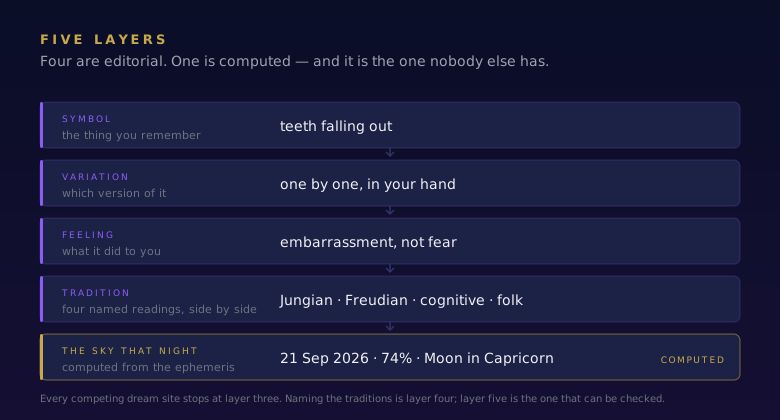
Four ways this is read
The Jungian reading
Treats the image as belonging to a shared vocabulary rather than a personal one, and asks what the image does rather than what it reminds you of. On this account the figures in a dream are closer to characters in a story everybody already knows than to coded references to your own week.
Reads the wedding as one of the oldest union images in the repertoire and specifically as the joining of opposites — not two people so much as two parts of one person. On that account the identity of the partner is often the least important detail, which matches what the stranger version suggests.
The Freudian reading
Treats the image as a disguise and asks what it is standing in for. It is the most parodied of the four and it produced one durable observation worth keeping: the feeling in a dream is often attached to something other than the thing the dream appears to be about.
Read marriage dreams in terms of desire and prohibition together, with specific machinery that has not lasted. The durable observation is narrower and useful here: a ceremony in a dream frequently carries a feeling about being watched that has nothing to do with the ceremony.
The cognitive or continuity reading
The one closest to current sleep science. It holds that dreams continue waking concerns rather than encoding messages, so the useful question is never "what does it mean" but "what in my week does this resemble". It is also the reading that explains recurrence most simply: an unresolved situation keeps producing similar material.
Points out the obvious correlates and they are strong — the dream rises before actual weddings, around engagements, and among people attending one, where it continues the day. Outside those the question is what commitment is currently becoming public, and for a symbol this specific the answer is usually available.
The folk tradition
The oldest layer, and the one with the least explanation attached. Its readings vary sharply between cultures, which is itself informative — a symbol read the same way everywhere is behaving differently from one that is not.
Contains one of the most striking inversions in the whole record: several European traditions read a dream of a wedding as a death, and a dream of a funeral as a wedding. The pairing is old and widespread. It has nothing behind it, and it is worth knowing about because someone who encounters it is likely to be alarmed by it.
How this one is usually misread
The obvious error is the literal one — reading the dream as being about getting married — which the reporting immediately contradicts, since people who are married, single and uninterested all have it in similar proportions. The second misreading is the folk inversion, the old pairing of weddings with funerals, which is widely recorded and frightens people who come across it. It is unfalsifiable, unsupported and survives for those reasons. The third and quieter error is the one the dictionaries share: putting the partner at the centre. The accounts put the witnesses there, and the stranger version — where there is no identifiable partner at all — makes the point on its own.
The feeling matters more than the image
Joy, dread and a flat sense of going through with something are all commonly reported, and the third is both the most frequent and the least covered. It attaches to commitments being completed rather than chosen, which is a specific circumstance and one people recognise immediately when it is named. The detail worth recording is the guest list. Who was there, who was missing, and whether anyone objected are the three facts that turn this symbol from a vague one into a precise one, and all three are gone within minutes of waking.
The Moon on the night you dreamed it
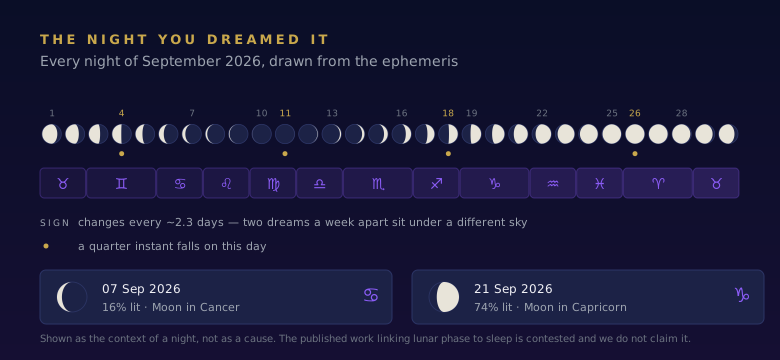
The one thing on this page that can be verified. Enter the night you went to sleep and you get the phase, the illuminated fraction and the sign the Moon held in the small hours, computed rather than asserted. It is context, not a cause — the published research on the Moon and sleep is contested, and the page on it says so.
Related symbols
These are descriptions of how a symbol is commonly read, never statements about you, and nothing here is medical or psychological advice.