Career tarot reading
Three cards for a question about work — where you stand, what is in the way, what the next move asks. Each is checked against the placements work is actually read from.
- Where you stand
- What is in the way
- What the move asks
Shuffled in your own browser with a cryptographic random source.
What a career tarot reading is checked against here
Six things, and the list is fixed before you draw: the Sun, Saturn, Jupiter, and the cusps of the tenth, sixth and second houses. That is the same set the written career reading on this site uses, imported from the same module rather than typed out again, so the two cannot come to disagree about what work is made of.
Point
Sun
What you are trying to become through the work, separately from what it pays.
Point
Saturn
The constraint that shapes the ambition, and the bill for ignoring it.
Point
Jupiter
Where the work expands, and what all that expansion costs.
House X
Tenth House
Direction and standing — the thing on the business card.
House VI
Sixth House
The day itself: the routine, the practice, the hours.
House II
Second House
The money, and whether it lines up with what you value.
The Sun is what you are trying to become through the work, separately from what you are paid for. Saturn is the constraint that shapes an ambition and the cost of not respecting it — the slowest of them and usually the most decisive. Jupiter is where it expands, and what taking all of that expansion costs.
The three houses split the working life the way it actually splits. The tenth is direction and standing, the thing on the business card. The sixth is the daily practice, where most of the hours and most of the friction actually live. The second is what it pays and whether that lines up with what you value.
What is not in the set
What is deliberately not in the list is everything else. Venus is not here, the Moon is not here — not because they say nothing, but because a career spread checked against a whole chart would find something every time, and a set that always produces a hit tells you nothing.
The spread: where you stand, what is in the way, what the move asks
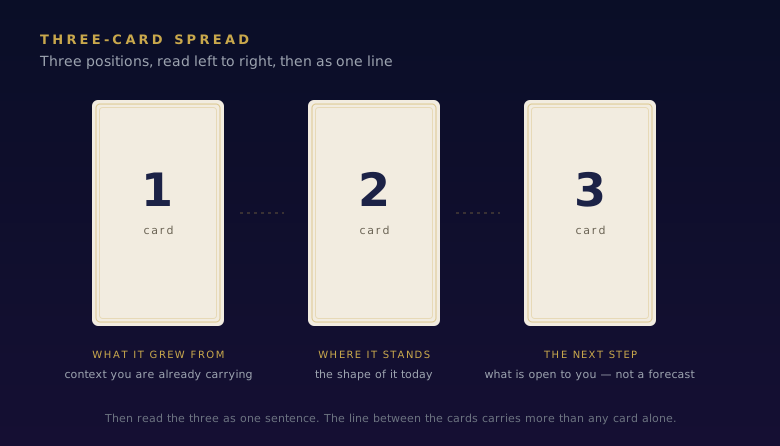
Three positions, and none of them is an outcome. The first is the position you are actually in, which in a work question is usually less dramatic and more constrained than it feels from inside. The second is the obstacle — and the useful version of that card is rarely a person.
Why the third card is not an outcome
The third is deliberately not "what will happen". It is what the next move asks of you: the cost, the thing you would have to be willing to do. Framed as a prediction it becomes a fortune about a promotion. Framed as a requirement it becomes something you can decide about this week.
The position outranks the card
Positions matter more than the cards here for the same reason they do anywhere. The Eight of Pentacles in the first slot says you are already in the repetition; in the third it says the move asks for more of it. Same card, opposite instruction.
A Major in the obstacle slot
A Major in the second slot is worth a pause. Twenty-two of seventy-eight are Majors so one is not unusual, but in the obstacle position it tends to indicate that the thing in the way is structural — a constraint of the field or the stage, rather than a task you have been avoiding.
Why narrowing the check is the whole point
It would be trivially easy to check a drawn card against every body in a chart. It would also be worthless, and the reason is arithmetic rather than philosophy.
The arithmetic
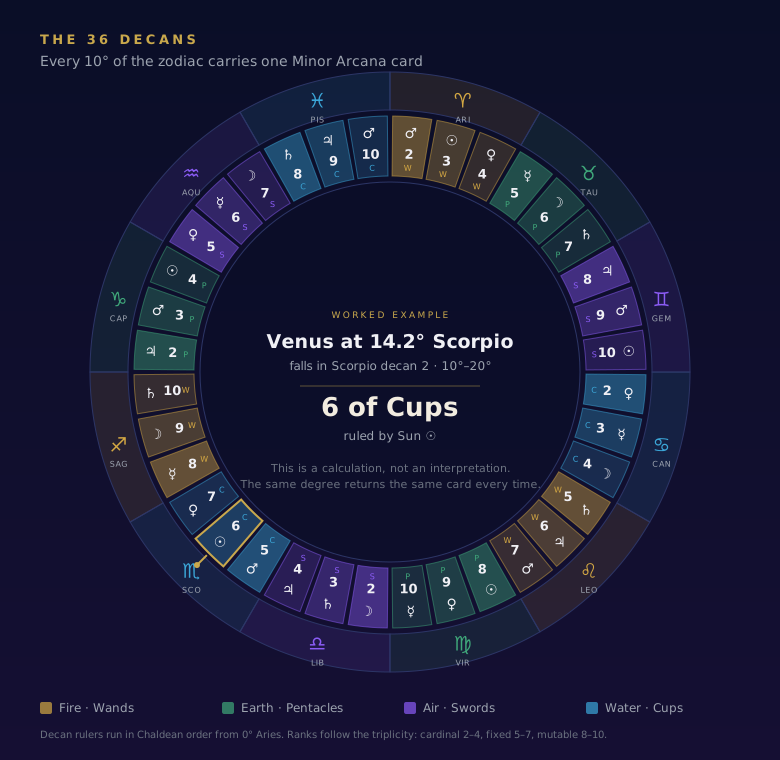
A decan is ten degrees out of three hundred and sixty. Check three cards against a handful of bodies and roughly two spreads in five turn up a contact — measured over thousands of draws against real charts, not estimated. Check the same three cards against a full chart with the outer planets, the nodes, Chiron and twelve house cusps and you are close to guaranteeing a hit every time.
A check that always hits is a slot machine
At that point the feature stops being information and becomes a slot machine that always pays. Every draw would feel meaningful, which is exactly how you would know none of them were. The narrow set is what keeps a contact rare enough to mean anything at all.
Narrowness is what makes the claim falsifiable
It is also what makes the claim falsifiable. Saturn is at one degree, the card rules ten, and you can check both. Nothing here is a judgement about whether Saturn "relates to" the card — it either falls inside the arc or it does not, and the panel prints the degree so you can settle it yourself.
The tenth, sixth and second houses, and when they disappear
The tenth is the direction a working life points and how it is seen from outside. The sixth is the day: the practice, the routine, the colleagues, the part that consumes the hours. The second is the money and whether it matches what you actually value, which is a separate question from whether it is enough.
All three need an exact birth time
All three need an exact birth time, and without one they are dropped rather than estimated. The Midheaven moves about a degree every four minutes, so a cusp derived from a noon guess can be several signs out — and "the card you drew rules your tenth house cusp" would then be a fabrication with the exact shape of a lookup, which is the worst kind.
What survives without one
The Sun, Saturn and Jupiter survive a missing birth time because they need only the date. So a reading without a time is genuinely smaller rather than fake, and the panel says which half is missing instead of quietly producing six placements from three.
The standing rule
A cusp is dropped, never estimated. A Midheaven guessed from noon can be several signs out, so a card said to rule a cusp that was never really computed would be fabrication with the exact shape of a lookup.
What a hit on each placement actually means
The panel names which of the six it found, and they are not interchangeable. A card landing on your Saturn is not the same event as one landing on your Jupiter, and treating them as one undifferentiated contact would throw away the only structure the narrow set gives you.
Point
Sun
The Sun is what you are trying to become through the work rather than what you are paid for, and the distinction matters most in exactly the situations people bring to a career reading. A card ruling your Sun degree is speaking to the ambition underneath the job, which is frequently not the same thing as the job.
Point
Saturn
Saturn is the slow one and usually the decisive one. A card on your Saturn degree is describing a constraint — the shape the ambition has to take, and the bill for ignoring it. Read in the obstacle position it tends to be the most accurate card in the spread, and also the least welcome, because Saturn constraints are rarely the kind that can be argued with.
Point
Jupiter
Jupiter is expansion and what expansion costs. A Jupiter contact usually reads as an opening, which is right, but the useful second half is the price: more scope, more surface, more that can go wrong. In the third position — what the move asks — it is often asking whether you want the larger version of the problem.
The three houses
The three houses split the working life the way it actually splits. A tenth-house cusp contact is about direction and standing, the thing visible from outside. A sixth is about the day: the routine, the practice, the hours, which is where most working dissatisfaction actually lives and where it is least often looked for. A second is about the money and whether it lines up with what you value, which is not the same as whether there is enough of it.
Natal or transiting
And if the panel finds something transiting rather than natal, read it as weather rather than as character. A natal contact describes a fixed feature of how you work. A transiting one describes a passing condition — and with a slow body like Saturn, passing can mean two years, which is a distinction the card by itself cannot make.
What this will not tell you
Whether you will get the job. Whether to accept the offer. Whether the company will last. A spread has nothing to offer on questions with factual answers, and a page that implied otherwise would be selling a certainty it cannot produce.
The copy rules that apply here too
The copy rules that govern every tool on this site apply here without exception: the timing of your own actions, never the prediction of events, and nothing said that cannot be traced back to the card or the placement that produced it. The decision stays yours, which is both the honest position and the only one a deck has any claim to.
This is not the timing layer
And it will not stand in for the timing layer. This checks three cards against a handful of fixed positions. When a slow transit actually reaches one of them, with dates, is a different calculation — that is Action Windows, and it is the part a spread structurally cannot do.
The same placements, read as words
This page checks your Sun, Saturn, Jupiter and work houses against three drawn cards. The career reading takes the same set and writes what they say — no deck involved, and the degrees are printed there too.