Solar Eclipse 2027 — The Longest Totality for 87 Years
At the solar eclipse of 2027, on August 2, 2027, the Moon covers the Sun completely for up to 6m 23s along a band from Spain to Somalia. Every time on this page is computed from the ephemeris and shown in your own timezone.
Greatest eclipse falls on August 2, 2027.
- Type
- Total solar eclipse
- Sun at
- 9.9° Leo
- Node gap
- 1.62°
- Moon ÷ Sun
- 1.061
- Moon distance
- 357,375 km
- Greatest eclipse
- 25.5°N 33.2°E
When is the solar eclipse of 2027?
The solar eclipse of 2 August 2027 is a total solar eclipse: the Moon passes directly between the Earth and the Sun and covers it completely. Greatest eclipse falls at 10:06 UTC, and totality lasts up to 6m 23s — longer than any other total solar eclipse until 2114.
There are two solar eclipses in 2027, and the one people mean is the second. The first, on 6 February, is annular and crosses southern South America. The solar eclipse of 2027 that is being called the eclipse of the century is the total one on 2 August, and it is what this page is about.
The instant given for the solar eclipse of 2027 above is the moment of greatest eclipse, when the axis of the Moon's shadow passes closest to the centre of the Earth. Your local maximum will be earlier or later than that depending on where you are, because the shadow sweeps across the surface at roughly two thousand kilometres an hour. The city lookup further down gives your own time rather than this one.
The solar eclipse of 2027 is visible as a partial eclipse across almost all of Europe, the Middle East, North and East Africa and parts of South Asia. Totality is confined to a band a little over a hundred kilometres wide.
From most of Europe the partial phase of the solar eclipse of 2027 runs for something over two hours from first contact to last, with maximum somewhere near the middle. Inside the band of totality the sequence is the same, except that for a few minutes in the middle of it the Sun disappears altogether, the temperature drops, and the brighter stars come out.
Where you can see the solar eclipse of 2027, and how much
The path of totality of the solar eclipse of 2027 makes landfall in southern Spain, crosses the Strait of Gibraltar into Morocco, then runs east through Algeria, Tunisia, Libya and Egypt before continuing over Sudan, Saudi Arabia, Yemen and Somalia. Ten countries see the Sun disappear entirely.
Everywhere else on the daylit side gets a partial eclipse, and how much of the Sun is covered falls away quickly with distance from the track. The discs below are computed for each city individually, not read off a map, and the shaded area of each one really is the percentage printed beneath it.
Distance from the centre line matters more than distance from the ends of the track. Standing fifty kilometres to the side of the line costs you a large fraction of the totality; standing on the line a thousand kilometres further along it costs you very little. Anyone travelling for the solar eclipse of 2027 is aiming at the centre line, not simply at the shaded band on a map.
Luxor
Total
Cádiz
Total
Tunis
97%
Cairo
95%
Rome
74%
London
42%
Berlin
34%
Istanbul
59%
Dubai
53%
New York
—
Ten cities at maximum eclipse on 2 August 2027. Discs are drawn with equal apparent diameters; the real Moon is a few per cent larger or smaller depending on its distance, which is exactly what separates a total eclipse from an annular one.
Upper Egypt is where the eclipse is deepest and longest, which is why the archaeological sites along the Nile are expecting an unusual August. Southern Spain sees a shorter totality because the shadow arrives there with the Sun much lower in the sky.
Check your own city
Looking at it safely
Never look at a partially eclipsed Sun without ISO 12312-2 eclipse glasses or a certified solar filter. Ordinary sunglasses are not enough, and neither is a camera, phone or telescope without a proper filter over the front. The only moment it is safe to look with the naked eye is during totality itself, inside the narrow band where the Sun is completely covered — and you must look away again the instant the first bead of sunlight returns.
Why the 2027 solar eclipse lasts so long
Three things have to line up for a long totality, and at the solar eclipse of 2027 all three do at once. None of them is mysterious, and all three are numbers you can check.
The alignment is almost exact
A solar eclipse only happens when the new moon falls near a lunar node — one of the two points where the Moon's tilted orbit crosses the plane of the Earth's orbit. At this eclipse the Sun sits just 1.62° from the node, the closest of the 16 solar eclipses between 2024 and 2030. The shadow therefore crosses the Earth almost centrally rather than clipping it at an angle.
The Moon is unusually close
The Moon is near perigee, 357,375 km from Earth against an average of 384,400 km. A closer Moon looks bigger, and a bigger Moon takes longer to cross the Sun.
The Sun is unusually far
The Earth passes aphelion, its furthest point from the Sun, in early July, so in early August the Sun is still near its smallest apparent size of the year. A smaller Sun is easier to cover.
Put together, the Moon's apparent width comes to 1.061 times the Sun's — it covers the Sun with about 6.1% to spare. That surplus is what buys the extra minutes. An eclipse where the ratio dips below 1 cannot be total at all, however perfect the alignment: the Moon leaves a ring of sunlight around itself and the result is an annular eclipse.
It is worth putting that surplus in perspective. If the Moon were a few per cent smaller in the sky on 2 August 2027, with no change to the alignment at all, the solar eclipse of 2027 would be annular rather than total, and maximum would be a ring of sunlight instead of a black Sun with the corona around it. The difference between the most famous sight in observational astronomy and a merely interesting one is a couple of per cent of apparent diameter.
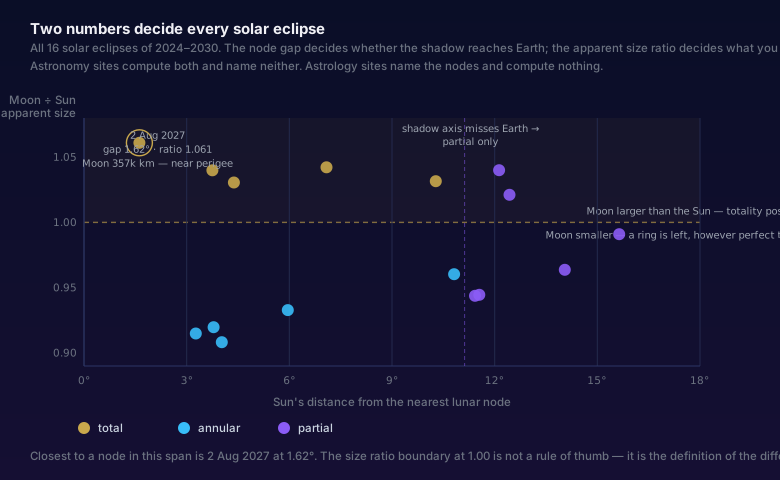
The two are independent, and it is worth being precise about which does what. Node gap alone does not separate total from annular — measured across 1980 to 2060 the ranges overlap. What separates them is the size ratio, and it does so exactly, because that is the definition of the difference.
Why there isn't a solar eclipse every month
The solar eclipse of 2027 raises an obvious question. There is a new moon roughly every 29.5 days, and at every one of them the Moon passes between the Earth and the Sun. If the two orbits were in the same plane there would be a solar eclipse every month, and a lunar eclipse a fortnight later.
The Moon's orbit is tilted about 5.1° to the ecliptic. Most new moons therefore pass a little above or a little below the Sun as seen from Earth, and the shadow misses us entirely — it goes off into space above the north pole or below the south. Only when a new moon happens close to one of the two crossing points, the nodes, can the shadow land on the surface.
The working limit is about 15.4°. If the Sun is further than that from a node at the moment of new moon there is no eclipse anywhere on Earth. In 2026 there are twelve new moons and only two of them fall inside the limit, which is why there are exactly two solar eclipses that year.
The same rule explains why the solar eclipse of 2027 is so deep. Being near a node is not a yes-or-no condition but a matter of degree, and this one is nearer than any other solar eclipse of the decade.
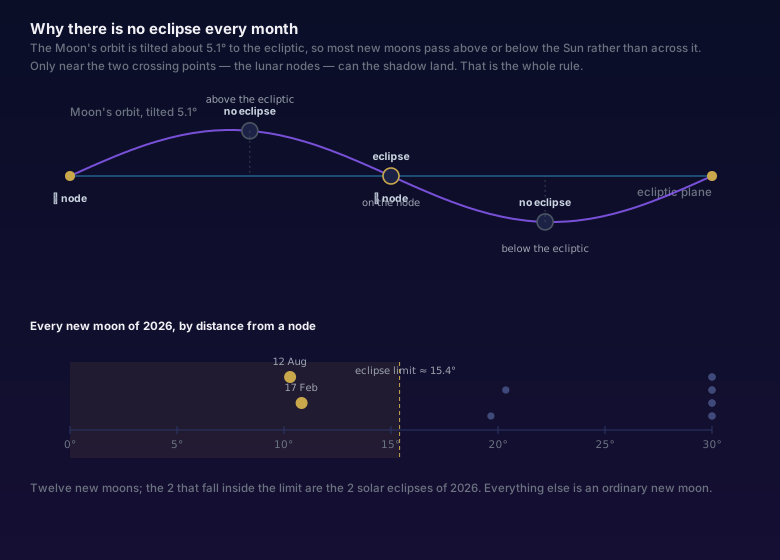
This is also why eclipses come in seasons rather than at random. The Sun passes each node once a year, so there is an eclipse window roughly every six months, and within it a solar and a lunar eclipse usually arrive a fortnight apart.
The solar eclipse of 2027 is one of a pair
Eclipses arrive in seasons, not singly. The Sun passes each lunar node once a year, and while it is near one, any new moon becomes a solar eclipse and any full moon a lunar one. That is why the solar eclipse of 2027 in August has a lunar eclipse a fortnight away from it rather than standing alone in the year.
2027 opens with a different season entirely. On 6 February there is an annular solar eclipse over southern South America, with the Moon too far from Earth to cover the Sun and a ring of light left around a black disc. It is the same geometry as August and a completely different sight, and the reason is the one number this page keeps coming back to: apparent size.
The August season is the one that matters here. The solar eclipse of 2027 falls at the deepest part of it, with the Sun almost exactly on the node, which is why this eclipse and not the February one is the event people are booking flights for.
A year can hold as few as two solar eclipses and as many as five. Two is the common case and it is what 2027 gets: one annular in February, and the total solar eclipse of 2027 in August.
You have seen this solar eclipse before
Eclipses repeat, and the solar eclipse of 2027 is no exception. After 223 lunar months — 18 years, 11 days and 8 hours, a period called a saros — the Sun, the Moon and the nodes return to very nearly the same arrangement, and an eclipse of almost identical character happens again.
The predecessor of the solar eclipse of 2027 was on July 22, 2009, and it was also a total solar eclipse with an exceptionally long totality. If you were alive then, that eclipse and this one belong to the same family. The one before it was in 1991, and the next return will be in 2045.
The extra eight hours in the saros period are why each return is visible from a different part of the world: the Earth has turned an extra third of a rotation by the time the family comes round, so the track lands roughly 120° of longitude further west each time.
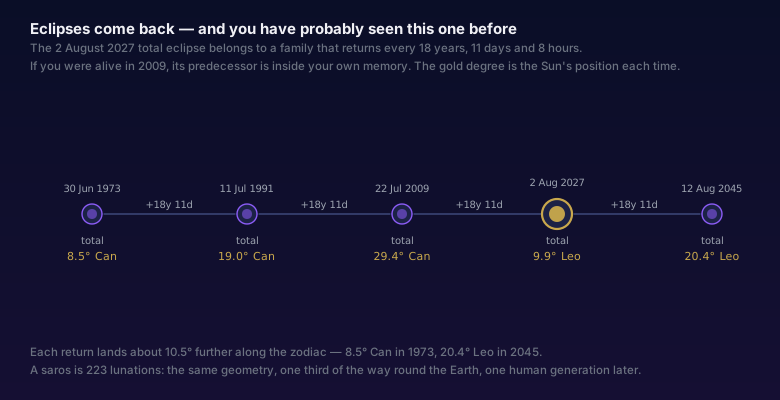
The family relationship shows up in our own numbers rather than only in the literature. The 2009 eclipse had a node gap of 0.81° and a size ratio of 1.062 — slightly better aligned and slightly larger than 2027 on both counts — and its totality ran correspondingly longer. Two eclipses, ordered the way the geometry says they should be.
What a solar eclipse means in astrology
In astrology the solar eclipse of 2027 is read the way any eclipse is, as a new moon with the volume turned up. A solar eclipse is a new moon, so it carries the sense of a beginning; what makes it different from an ordinary new moon is that it happens on the nodal axis, which is the part of the chart associated with the direction a life is moving in.
The node the eclipse falls closest to is part of how it is traditionally read. Eclipses near the north node are treated as bringing something in, and eclipses near the south node as bringing something to a conclusion. This eclipse falls at 9.9° Leo, which places it near the south node, the end traditionally read as bringing something to a conclusion.
The sign matters less than most horoscope writing suggests. An eclipse at 9.9° Leo is at that degree for everyone on Earth — it is the same event whether you read about it in Lisbon or Jakarta. What differs from person to person is whether that degree happens to touch anything in your own chart, and that is not something a sun-sign column can know.
It is also worth saying plainly what an eclipse is not. It does not schedule events, and no honest reading can tell you what will happen to you on a given date. What the astrological tradition offers here is a way of timing your own attention and your own decisions — which is a much smaller claim, and the only one this site is willing to make.
Eclipse families are sometimes read as long arcs in a life, since one saros brings the same eclipse back after eighteen years. Whatever one makes of that as symbolism, the arithmetic behind it is real and checkable, and it is the part this site can actually compute: the previous member of this family, its degree, and the interval to the next one.
The 2027 solar eclipse in your birth chart
The solar eclipse of 2027 falls at 9.9° Leo. That degree is fixed and public. Whether it means anything for you depends on two things that are not: which house of your chart it lands in, and whether it forms a close aspect to anything you were born with.
Anyone with a planet or an angle within a few degrees of 9.9° Leo — or within a few degrees of the opposite point, or square to it — has this eclipse landing directly on their chart rather than in the general background. In practice that means placements near the middle degrees of the fixed signs: Taurus, Leo, Scorpio and Aquarius.
House placement needs an accurate birth time, because the houses turn a full circle every twenty-four hours. Without one, the aspects are still meaningful and the house is guesswork — which is why our calculators drop house placements entirely when the birth time is unknown rather than quietly using noon.
There is a second, subtler contact worth checking. The solar eclipse of 2027 falls close to the lunar nodes by definition, so it also touches whatever sits near the nodal axis of your own chart. That is a slower and less obvious kind of contact than an aspect to a planet, and it is one reason the north node calculator is linked below.
If you already know your chart, the fastest check is simply to look for anything between about 5° and 15° of Taurus, Leo, Scorpio or Aquarius. That range is where this eclipse is felt most directly.
Generate your birth chart free and see where 9.9° Leo falls in it. The calculation is complete and costs nothing; there is no signup and no email gate.
Calculate my birth chartHow these solar eclipse times are calculated
Every date, degree and duration given here for the solar eclipse of 2027 is computed when the page is built, using the astronomy-engine library, from the same ephemeris that produces the chart tables everywhere else on this site. Nothing here is copied from another site's table.
Local circumstances — your city's maximum, its obscuration, and how long totality lasts if you are on the track — are computed per location on request rather than interpolated between nearby places.
The point of saying this is that it makes the page checkable. Our figure for greatest eclipse is 10:06 UTC, which matches the published value. The Sun's position computes to 9.9° Leo, and astrology publishers who list this eclipse independently give the same degree to the arcminute. Our computed duration at Luxor comes to 6m 25s, against a published maximum of 6m 23s at the point of greatest eclipse a little to the south.
None of this makes the interpretation of the solar eclipse of 2027 more or less true. It makes the numbers underneath it verifiable, which is a different and smaller claim, and the one worth making, because you can test it against any ephemeris you like.
Where a figure on this page comes from the literature rather than from our own computation, it says so. The claim that this is the longest totality until 2114 is one of those: it is a published result about the whole century, not something derived here.
Frequently asked questions
- When exactly is the solar eclipse of 2027?
- Greatest eclipse for the solar eclipse of 2027 is at 10:06 UTC on 2 August. Your local maximum will differ — the shadow crosses the Earth in a few hours, so the eclipse happens at a different clock time everywhere. Use the city lookup above to get the time where you are.
- Is this free? Do I need an account?
- Yes, and no. There is no signup, no email gate and no limit. These are public astronomical facts and there is nothing here worth metering. The paid part of this site is the interpretation of your own chart, not access to the sky.
- How accurate are these times?
- The times for the solar eclipse of 2027 are computed from the ephemeris rather than copied, and they agree with published values: greatest eclipse at 10:06 UTC, and a Sun position of 9.9° Leo that matches what astrology publishers list independently. The times you see are converted to your own timezone in your browser, so the underlying instant is always the same one.
- Can I see it from where I live?
- You will see at least a partial phase of the solar eclipse of 2027 if you are in Europe, Africa, the Middle East or western and southern Asia. Totality is only visible from a band about a hundred kilometres wide running from southern Spain to Somalia. The city lookup on this page computes your own obscuration rather than guessing from a map.
- Why is this called the eclipse of the century?
- Because of the duration. Totality at the solar eclipse of 2027 reaches 6m 23s, and no other total solar eclipse until 2114 lasts as long. Three things combine to produce it — an almost exact alignment with the lunar node, a Moon near its closest to Earth, and a Sun near its furthest. Together they give the Moon an apparent width 1.061 times the Sun's.
- What does a solar eclipse mean in astrology?
- The solar eclipse of 2027 is read as an intensified new moon falling on the nodal axis, so it carries a sense of beginning and of direction. The eclipse degree is identical for everyone; what varies is whether it touches your own chart. That is why a sun-sign horoscope cannot answer this question and a birth chart can.
- Will this eclipse affect me personally?
- The honest answer is that it depends on whether you have placements close to 9.9° Leo, or close to the point opposite it, or square to it — which in practice means the middle degrees of Taurus, Leo, Scorpio and Aquarius. If you do not, this eclipse is a spectacular astronomical event and not much more. If you do, it is worth knowing which house it falls in.
- When is the next total solar eclipse after this one?
- The next total solar eclipse after the solar eclipse of 2027 is on July 22, 2028. The next time this particular family returns is 2045, one saros later, and it will be visible from a different part of the world because the Earth will have turned an extra third of a rotation by then.
- Is it safe to look at the eclipse?
- Not without a proper filter, except during totality itself. This applies to the solar eclipse of 2027 exactly as it does to any other. A partially eclipsed Sun is as dangerous as an ordinary one and does not feel bright enough to warn you. Use ISO 12312-2 eclipse glasses, or a certified solar filter over the front of any camera, phone or telescope. Inside the band of totality, and only while the Sun is completely covered, it is safe to look with the naked eye — and you must stop the moment the first sunlight returns.