Birthday moon phase calculator
Enter your birth date and see the birthday moon phase you were born under — the exact illumination, the Moon's age and sign, and the years the same phase comes back to your birthday.
What your birthday moon phase is
Definition
Unlike almost everything else in a birth chart, this needs no birthplace. A moon phase is the geocentric Sun-Moon angle, identical from Tokyo and from Lima at the same instant, so the calculator above asks only for a date. That is why it is one of the few natal facts anyone can look up without knowing where they were born.
It is also why the birthday moon phase is not a personal placement in the way a moon sign is. Everyone born on your date shares it. What makes it interesting is not that it distinguishes you but that it places you in a cycle — a repeating rhythm rather than a fixed point.
Does the birth time matter?
Less than for any other part of a chart, and on most days not at all. The Moon covers about 12° of elongation a day, and the eight named phases are 45° wide, so a phase name holds for roughly three and a half days. A birth anywhere in the middle of that window lands on the same answer whether you enter a time or not.
It matters on the boundaries. If you were born within about half a day of a quarter instant — a new moon, first quarter, full moon or last quarter — the name can fall either side, and a birth time settles it. The illumination percentage shifts by a few points either way regardless, which is why the calculator prints it to one decimal rather than rounding to a phase name and hoping.
This is a genuinely different situation from the moon sign, where the Moon changes sign every two and a quarter days and a birth time is often decisive. Phase is forgiving; sign is not.
Why the same moon returns to your birthday every nineteen years
Nineteen tropical years is 6,939.60 days. Two hundred and thirty-five lunations is 6,939.69 days. The two agree to within about two hours, which is one of the tidiest coincidences in the solar system and has been known since at least the fifth century BC — it is the Metonic cycle, and it is still why the Hebrew calendar inserts seven leap months every nineteen years.
For a person the consequence is concrete: the Moon wears nearly the same phase on your birthday every nineteen years. Someone born under a waxing crescent had a waxing crescent birthday at nineteen, at thirty-eight and at fifty-seven, and will have another at seventy-six.
So the rhythm is real and the individual years are not derivable from it. Leap-year placement alone shifts a birthday against the lunation by up to a day, and the two-hour drift compounds across a lifetime. A page that printed 'every 19 years' as a rule would be right about the pattern and wrong about several of the years it named — which is why this one measures each candidate instead.
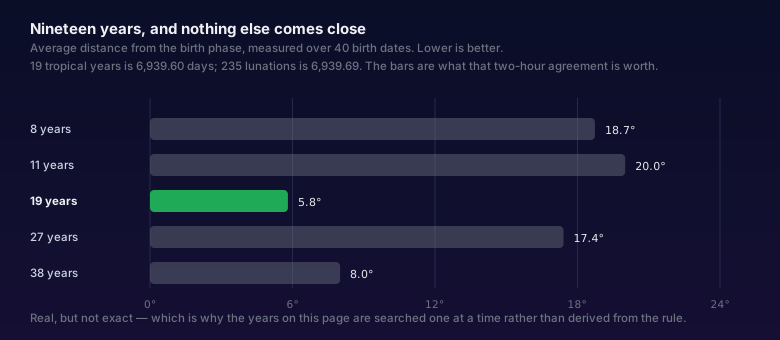
The word 'nearly' is doing real work, and it is why the years above are searched rather than assumed. Measured over forty birth dates, a nineteen-year step lands the phase within 5.8° of the birth phase on average and 15.4° at worst. Nothing else is close: an eight-year step averages 18.7° off and an eleven-year step 20.0°, despite both being decent lunar approximations in their own right. Only thirty-eight years — two Metonic cycles — is competitive, at 8.0°.
What the eight birth phases are read as
The lunation phase is a small but old branch of astrological practice, popularised in the twentieth century by Dane Rudhyar, who read the cycle as eight stages of a single process rather than eight separate types.
Born at a new moon: the start of a cycle, and read as instinctive, forward-pushing and not much interested in precedent.
Born at a waxing crescent: read as the struggle to establish something against the pull of what came before it.
Born at a first quarter: read as action under tension — building something that requires breaking something.
Born at a waxing gibbous: read as refinement and analysis, the stage of perfecting what is already underway.
Born at a full moon: read as illumination and relationship, the point where a thing becomes visible to others.
Born at a waning gibbous: read as communication and teaching — passing on what the cycle has produced.
Born at a last quarter: read as a crisis of meaning, where a structure is questioned rather than built.
Born at a waning crescent: read as release and preparation, the stage that clears ground for the next cycle.
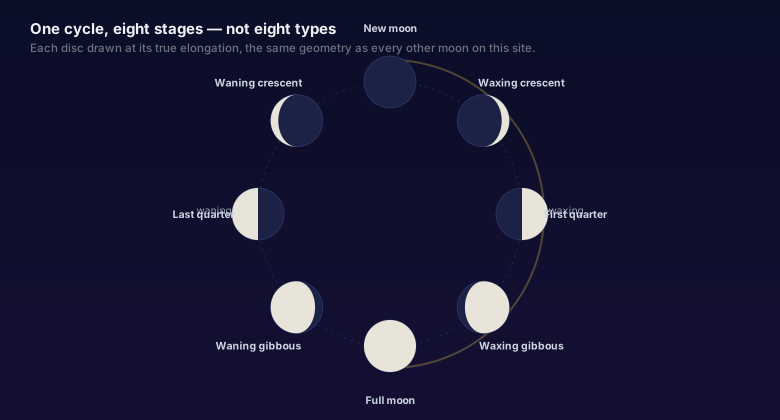
As with everything on this site, that is a lens rather than a prediction, and it is one of the least personal placements available — everyone born on your date shares it. What distinguishes one chart from another is where the Moon sat by sign and house, which needs a birth time and place.
Frequently asked questions
What moon phase was I born under?
Enter your birth date above and the calculator returns the exact illumination, the Moon's age in days and the named phase. It needs no birthplace, because a moon phase is the same from everywhere on Earth at a given instant.
I do not know my birth time. Does that matter?
Rarely. The eight phase names are 45° wide and the Moon covers about 12° a day, so a phase holds for around three and a half days. Only a birth within half a day of a quarter instant can fall either side of the boundary.
Why does this not ask where I was born?
Because a moon phase does not depend on it. The phase is the geocentric angle between the Sun and the Moon, identical from every point on the planet at the same moment. A moon sign or a birth chart does need a place; this does not.
Is it true the same moon phase returns every 19 years?
Nearly. Nineteen tropical years and 235 lunations agree to within about two hours — the Metonic cycle — so the phase on your birthday repeats closely every nineteen years. It is not exact, which is why the years listed above are measured individually rather than derived from the rule.
Is the birthday moon phase the same as my moon sign?
No, and they answer different questions. The phase is the Moon's angle to the Sun and is shared by everyone born on your date. The sign is the Moon's position in the zodiac, changes every two and a quarter days, and often needs a birth time to pin down.
What if I was born on a Blue Moon?
Then you were born at a full moon that happened to be the second in its calendar month. Astronomically nothing distinguishes it — the Moon does not know which month it is — but it is a genuinely uncommon birthday, since Blue Moons come round roughly every two and a half years.
Can I compare my birth phase with someone else's?
Yes — the moon phase compatibility test scores two birth phases against each other by their separation in the cycle. It is deterministic and rule-based, like this page.
Is this free?
Yes, with no signup, no email gate and no limit, and your birth date is used for the calculation rather than stored. What this site charges for is the AI interpretation of a full birth chart.
Related pages
Calculated live from the ephemeris. Page rebuilt daily.