Cats
Independence and instinct, read as fortune or warning depending on the tradition.
What dreaming about Cats usually means
Cats are the symbol on this list where personal experience overrides tradition most decisively, and any honest entry has to say so first: someone who lives with cats dreams about them the way they dream about their kitchen, and the continuity reading applies before anything else. For everyone else the readings converge on independence and instinct — an animal that is domestic without being obedient, present on its own terms. The traditions then split sharply on whether that is favourable, and the split is cultural rather than substantive. What the accounts suggest is more useful than either: the informative detail is the cat’s behaviour. A cat that approached, a cat that ignored you and a cat that scratched are three different dreams, and the difference is the same one that separates being chosen, being disregarded and being warned off. One thing the accounts show that the traditions do not address: cats appear in dreams far more often as company than as events. They are in the room, on a chair, following you through a house, and nothing happens. That is unusual on this list — most of these symbols arrive as incidents — and it means a large share of cat dreams are describing the texture of a situation rather than a development in it. Recognising when an image is atmosphere rather than content is a real skill, and this is the symbol that teaches it.
Common variations
A black cat
The version with the heaviest cultural load and the least consistent meaning: unlucky across much of Western Europe and North America, lucky in Britain and Japan, and unremarkable elsewhere. That contradiction is the most useful thing about it, because it demonstrates the reading is inherited rather than found.
Being scratched
Sudden, minor and from something you were handling. The accounts attach to small consequences from something you thought was manageable, and what people remember is usually that they had been petting it.
Many cats
Reported as overwhelming rather than threatening, which separates it from the equivalent spider version. It attaches to a number of independent things each requiring separate handling, and the exhaustion in the accounts is administrative rather than fearful.
A cat you used to have
One of the most commonly reported and most affecting versions, especially after a pet has died. The continuity reading covers it directly and no symbolism is required. The accounts describe it as comforting far more often than not.
A kitten rather than a cat
Age changes this symbol more than any other detail, and in the opposite direction to the adult animal. A cat is independence; a kitten is something small and self-willed that cannot yet look after itself, which is much closer to the baby entry than to the rest of this page. The accounts attach to new responsibilities that are charming and genuinely demanding at once — a role, a project, occasionally an actual animal. Where the adult versions turn on what the cat did, this one turns on whether you were equipped. People who report it frequently mention not having food, or a box, or any idea where it came from, and that helplessness is the content rather than the kitten.
Four ways this is read
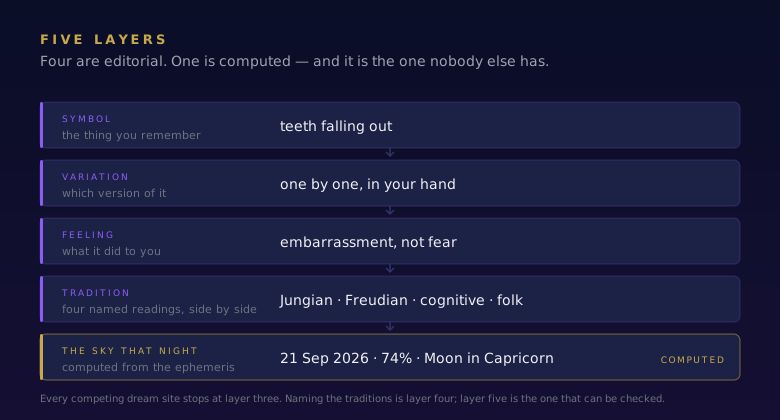
The Jungian reading
Treats the image as belonging to a shared vocabulary rather than a personal one, and asks what the image does rather than what it reminds you of. On this account the figures in a dream are closer to characters in a story everybody already knows than to coded references to your own week.
Would read the cat as instinct that has not been domesticated out — the part of a life that remains self-directed. The tradition attends to how the animal behaved rather than to what species it was, which in practice is the same advice the accounts support.
The Freudian reading
Treats the image as a disguise and asks what it is standing in for. It is the most parodied of the four and it produced one durable observation worth keeping: the feeling in a dream is often attached to something other than the thing the dream appears to be about.
Has little specific to say about cats, and what exists is largely subsumed into the general reading of animals as carriers for feelings not attached to people. That thinness is worth noting rather than filling.
The cognitive or continuity reading
The one closest to current sleep science. It holds that dreams continue waking concerns rather than encoding messages, so the useful question is never "what does it mean" but "what in my week does this resemble". It is also the reading that explains recurrence most simply: an unresolved situation keeps producing similar material.
Dominates here. Cat owners dream about cats, people who saw one that day dream about one, and the dream requires no interpretation in either case. The symbolic question only arises for dreamers with no recent cat, and then the honest answer is that the readings are weak and the traditions disagree.
The folk tradition
The oldest layer, and the one with the least explanation attached. Its readings vary sharply between cultures, which is itself informative — a symbol read the same way everywhere is behaving differently from one that is not.
The clearest example of cultural contradiction in this entire list. Black cats are unlucky across much of Western Europe and North America and lucky in Britain and much of Japan; cats generally are protective in Egyptian and Islamic traditions and suspect in early modern European ones. Reading the same animal in opposite directions is what a purely cultural symbol looks like.
How this one is usually misread
The commonest error is reading the folk association as a meaning — treating a black cat in a dream as an omen when the same animal is read as lucky two hundred miles away. The contradiction is easy to check and it settles the question. The second and more practical misreading is symbolic overreach: for anyone who lives with a cat, the dream is almost certainly about the cat, and a dictionary that leads with independence and mystery has skipped the likeliest explanation to reach an interesting one.
The feeling matters more than the image
Affection, unease and indifference are all common, and unlike most symbols here the indifferent reports are worth as much as the rest — a cat that was simply present in a dream is usually scenery, and recognising scenery is a real skill in reading your own records. The detail to write down is what the cat did. Behaviour is the whole symbol: approached, ignored, fled, scratched, sat watching. Those five produce five different accounts, and the noun on its own produces none.
The Moon on the night you dreamed it
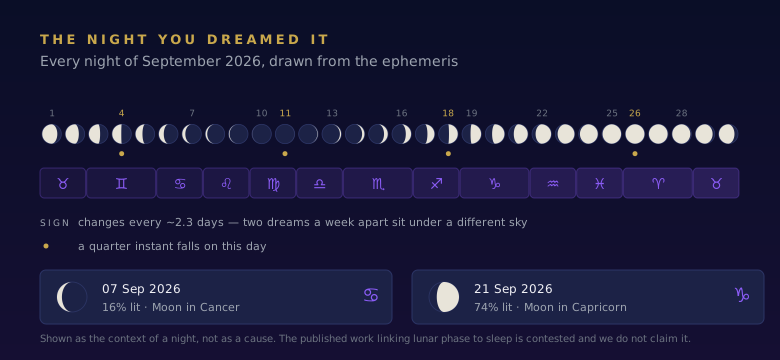
The one thing on this page that can be verified. Enter the night you went to sleep and you get the phase, the illuminated fraction and the sign the Moon held in the small hours, computed rather than asserted. It is context, not a cause — the published research on the Moon and sleep is contested, and the page on it says so.
Related symbols
These are descriptions of how a symbol is commonly read, never statements about you, and nothing here is medical or psychological advice.