Daily tarot
Not a shuffle. The Moon is standing in one of the thirty-six decans right now, and that decan has a card — so today’s card is a position you can check rather than a number we picked.
- The card right now
Why this daily tarot is not a shuffle
Almost every daily tarot page works the same way underneath. It takes the date, runs it through something that turns it into a number between one and seventy-eight, and shows you that card. Some sites animate a deck first. The result is the same either way: a card that came out of arithmetic performed on a calendar, with nothing behind it.
A hash is random, but it is not moving
That is not wrong exactly — a random draw is what a physical shuffle is too — but it does mean the answer cannot be checked, cannot be reproduced from anything outside the site, and would be exactly as convincing if the code had a bug in it. On a site whose whole argument is that its numbers survive checking, a hidden hash would be the one page that does not.
There is a real answer available
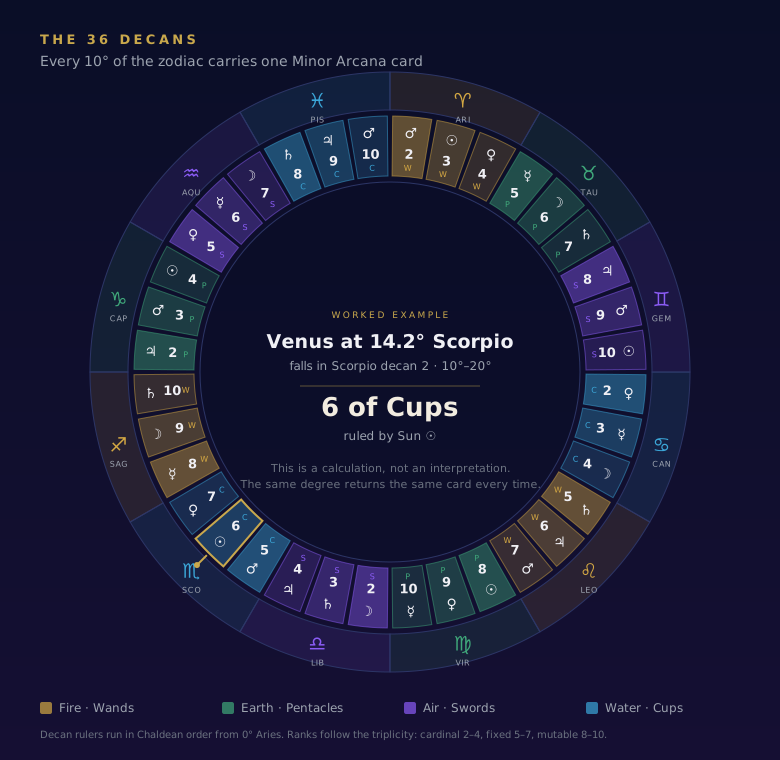
There is a real answer available and it is better in every way that matters. The Moon is somewhere right now. That somewhere falls in one of the thirty-six ten-degree decans, and under the Golden Dawn correspondences each decan is one Minor Arcana card. So the card above is a lookup from a position, exactly like every other card on this site, and you can verify it against any ephemeris and any published correspondence table.
It moves whether or not you look
It also moves on its own, which a date hash only pretends to do. The Moon covers about 13.2 degrees a day against a decan of ten, so the card genuinely turns over roughly every eighteen hours — faster than daily, at a time that is different each day, for a reason that has nothing to do with us.
How often the card changes
Every eighteen hours or so, which means the card you see in the morning is often not the one that was there the previous evening, and occasionally two cards fall inside one calendar day. That is what the Moon actually does; forcing it onto a twenty-four-hour grid would be tidier and less true.
What the panel above gives you
The panel above therefore gives you three things rather than one: the card now, the card next, and the exact moment the change happens, rendered in your own time zone. A card that turns over at 02:40 UTC turns over on a different calendar day in Los Angeles than in Berlin, so publishing a single zone — which the larger tarot sites do — is wrong by a whole day for most readers.
A whole zodiac in 27.3 days
The Moon also completes the whole zodiac in about 27.3 days, so over a lunar month you see all thirty-six numbered cards, each for roughly eighteen hours. Nothing repeats and nothing is skipped. That is a structural property of the orbit rather than a design decision, and it is why there is no such thing as getting the same card twice in a week here.
Eighteen hours is a median, not a constant
Eighteen hours is a median rather than a constant, because the Moon does not move at a fixed speed. Its orbit is an ellipse, so it runs fastest near perigee and slowest near apogee — about 15.4 degrees a day at one end and 11.8 at the other. Measured over 2026 with the same function that produces the times above, the 481 decan crossings of that year range from 15.7 hours to 20.3, with a median of 18.1. That is why the panel gives you the actual instant of the next change rather than telling you to come back tomorrow: tomorrow is not when it happens, and the gap is different every time.
The slower card underneath
The second panel shows the Sun’s decan card, and it is there because it moves at a completely different rate. The Sun covers just under a degree a day, so it holds one decan for about ten days. It is a season rather than a day.
The pairing is the actual information
Read the two together and the pairing is the actual information. The fast card is what is passing; the slow one is the stretch it is passing through. Two consecutive days with the same Sun card and different Moon cards are two variations on one theme, which is a more useful thing to know than either card alone.
Why there is no third layer
This is also the honest reason there is not a third layer. Mercury, Venus and Mars all sit in decans too, and each would resolve to a card by the same lookup — but they move slowly enough that they would say the same thing for weeks, and a page that adds panels which do not change is padding rather than depth.
What to do with today’s card
Read it as a prompt attached to a real position, not as a forecast. The copy rules that govern every tool on this site apply here without exception: the timing of your own actions, never the prediction of events, and nothing said that cannot be traced back to the placement that produced it. A card is a question to hold for a few hours, and it is better at that than at telling you what will happen.
Look once, then go and do something else
The most useful habit is to look once and then go and do something else. The Moon is the fastest-moving body in the chart and the one traditionally read as mood, attention and what is immediately in front of you — which is exactly the scale a single card is good for. It is not the scale on which decisions get made, and this page does not pretend otherwise.
If you want the card in full
If you want the card’s meaning in full — upright, reversed, in love, in work — the card meanings index has all seventy-eight with the degrees each one rules. And if you want to know which of those thirty-six cards your own chart falls under, that is a different question with a different answer, and it does not change from day to day.
How to check this yourself
Three steps, none of which need this site.
- —Look up the Moon’s current ecliptic longitude in any ephemeris.
- —Divide by ten and take the whole number — that is which of the thirty-six decans it stands in.
- —Find that decan in any Golden Dawn correspondence table and read off the card.
Why the degree is printed beside the card
The degree is printed beside the card above precisely so that the first step is already done for you and you can start at the second. If our number and the ephemeris disagree, the ephemeris is right and we have a bug worth reporting — which is a sentence a hash-based daily tarot has no way to write.
The standard every page in this cluster holds to
This is the same standard every page in this cluster holds itself to, and it is a deliberately low bar. Almost nothing in the daily tarot category clears it, not because it is hard but because nobody has tried.
Which of the thirty-six is yours?
The card above belongs to the Moon today. The cards that belong to you come from your own placements — your Sun, Moon, Venus and the rest each sit in a decan, and each resolves to a card the same way. They do not change.