A car crash
Loss of control over direction, usually somewhere you are the driver.
What dreaming about A car crash usually means
A car crash is one of the three symbols on this list with no folk tradition behind it, and the page says so rather than inventing one. What it does have is an unusually clear modern reading, because the image carries its own structure: a vehicle is something you steer, at a speed you chose, on a route you picked, and a crash is the failure of that. The readings attach to direction rather than to danger — a plan going wrong, a decision whose consequences arrived faster than expected, a course you cannot correct from where you are. The single most informative detail is whether you were driving. The accounts divide sharply between dreamers at the wheel and dreamers as passengers or bystanders, and those attach to completely different situations: one to your own choices and one to somebody else’s.
Common variations
Brakes that do not work
The most reported version and the most specific. It is not about crashing but about being unable to stop, which is a different complaint: the accounts attach to commitments already in motion rather than to bad decisions. What people remember is the pedal going to the floor.
Watching a crash happen
Removes your agency entirely and reads accordingly — the readings attach to watching someone else’s situation deteriorate with no standing to intervene. Who was in the car is the detail that does the work.
Driving from the back seat
A strange and surprisingly common version: the car is moving, you are responsible, and you are not where the controls are. It attaches with unusual precision to situations where you are accountable for something you do not actually control.
Walking away unhurt
The version people describe as the most confusing, because the dream delivers a catastrophe and then no consequence. The accounts attach to fears that were discharged rather than realised, and it is reported more often after a near miss in waking life than before one.
A crash that nearly happens
The collision that does not arrive, and reported with an odd residue: the adrenaline is real and the event is not. It attaches to consequences that were avoided rather than survived, which is a different circumstance from the walking-away-unhurt version, where the crash happened. People frequently describe waking at exactly the moment nothing occurred.
Four ways this is read
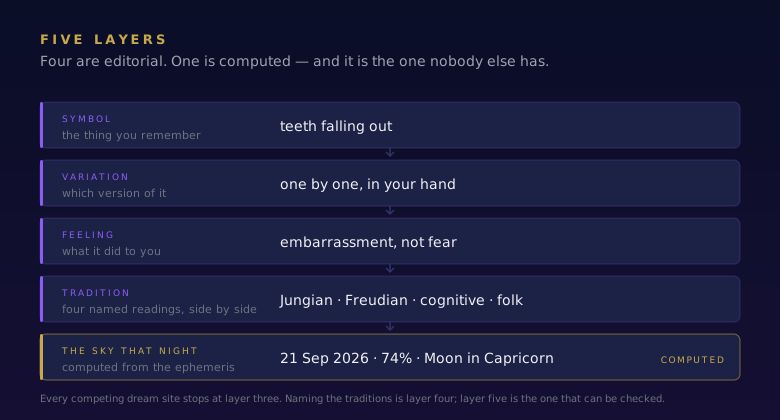
The Jungian reading
Treats the image as belonging to a shared vocabulary rather than a personal one, and asks what the image does rather than what it reminds you of. On this account the figures in a dream are closer to characters in a story everybody already knows than to coded references to your own week.
Would read the vehicle as the way you move through life rather than as an object — the manner, the pace, the degree of control — and the crash as that manner failing. The tradition has no ancient material to draw on here, which it would treat as unremarkable: the image is modern and the structure behind it is not.
The Freudian reading
Treats the image as a disguise and asks what it is standing in for. It is the most parodied of the four and it produced one durable observation worth keeping: the feeling in a dream is often attached to something other than the thing the dream appears to be about.
Predates the dream in any common form, so there is no direct reading. What the tradition contributes is general and applies: a dream of losing control is frequently attached to a situation where control was never the issue, and the alarm in it is not always about the thing it appears to be about.
The cognitive or continuity reading
The one closest to current sleep science. It holds that dreams continue waking concerns rather than encoding messages, so the useful question is never "what does it mean" but "what in my week does this resemble". It is also the reading that explains recurrence most simply: an unresolved situation keeps producing similar material.
Has the most to say. The dream is more common among people who drive daily, more common after any near miss, and more common during periods of decision, all of which the continuity account predicts. On this reading the question is not what a crash means but which current situation has the shape of something moving too fast to stop.
There is no folk tradition for this one
The thing in this dream did not exist before the twentieth century, so no pre-modern dream literature has anything to say about it. That is worth stating plainly rather than filling the gap: a dictionary that offers you an ancient reading of a missed flight is inventing one. The other three framings above still apply, and the continuity reading applies especially well, because a modern anxiety is exactly what it is built to describe.
How this one is usually misread
The misreading that matters is the predictive one: people look this dream up because they are about to drive somewhere and want to know whether to. Nothing in any tradition supports reading it as a warning about a journey, and the belief is kept alive by the usual asymmetry — the once it coincided is remembered and the hundred times it did not are not. The second and quieter error is dictionaries giving this symbol an ancient reading. There is none to give. A car is a twentieth-century object, no pre-modern dream literature addresses it, and an entry offering you a traditional meaning has fabricated the tradition.
The feeling matters more than the image
The emotion reported most often is not fear but a specific helplessness, and the distinction matters because the two attach to different situations — fear to a threat, helplessness to a process already underway. The brakes version carries it most clearly. The detail worth recording is your position: driver, passenger, or watching from outside. Those three are the closest thing this symbol has to a readout, because they map directly onto how much of the waking situation is actually yours to steer, and the answer is frequently not what the dreamer assumed before writing it down.
This one is felt, not only seen
People report this dream partly as a bodily sensation rather than an image — which is why it is remembered vividly and why it is hard to describe afterwards. The sensation is worth noting alongside the content when you write it down, because it is usually the part that changes between one instance and the next.
The Moon on the night you dreamed it
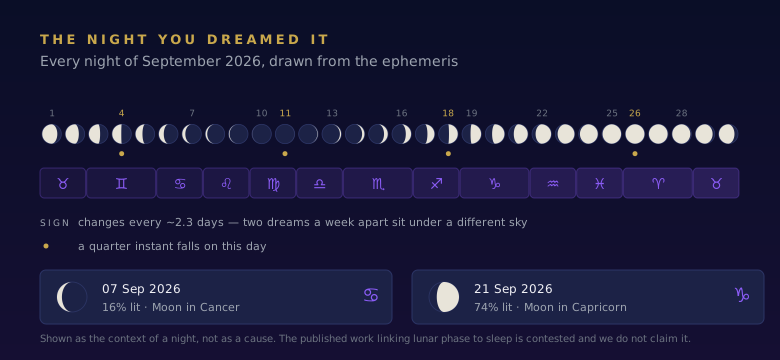
The one thing on this page that can be verified. Enter the night you went to sleep and you get the phase, the illuminated fraction and the sign the Moon held in the small hours, computed rather than asserted. It is context, not a cause — the published research on the Moon and sleep is contested, and the page on it says so.
Related symbols
These are descriptions of how a symbol is commonly read, never statements about you, and nothing here is medical or psychological advice.