Free Dream Interpretation — Symbols, Traditions and the Sky That Night
Describe the dream. You get the symbols it contains, the words that found each one, and what four different traditions say about them — plus, if you know the date, the moon that was up while you dreamed it.
Dream interpretation is the practice of reading the images in a dream against a body of accumulated readings — what other people have made of the same image — rather than decoding a fixed message. No tradition that has thought about it treats a symbol as having one meaning.
What dream interpretation actually is
The popular idea of dream interpretation is a lookup: dream contains snake, dictionary says betrayal, question answered. Every serious tradition rejects that, and so does this page.
Four methods, not one lookup
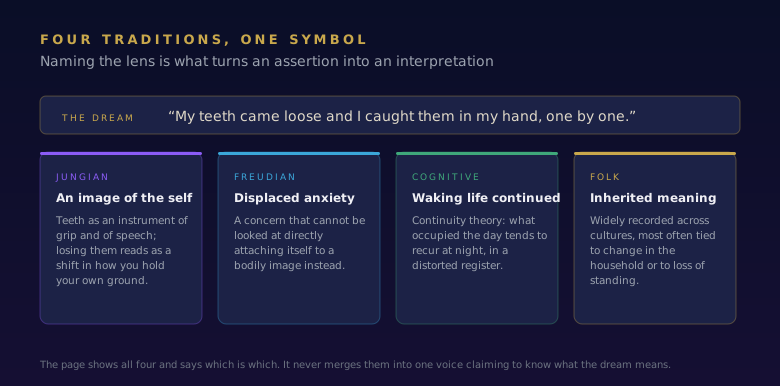
What the traditions actually offer is four different methods for asking what an image is doing. The Jungian reading treats it as part of a shared vocabulary that appears across unconnected cultures. The Freudian reading treats it as a disguise and asks what it stands in for. The cognitive or continuity reading — the one closest to current sleep science — holds that dreams continue waking concerns rather than encoding messages, so the question is what in your week the dream resembles. And the folk traditions are the oldest layer, with the least explanation attached and the widest disagreement between cultures.
They give different answers to the same dream
Those four give different answers to the same dream, and a dream interpretation that blends them into one anonymous voice has hidden the most useful thing about the field: that it disagrees with itself, visibly, and that the disagreement tells you the readings are interpretations rather than facts.
Which is why the tool produces no reading
Which is why the tool above does not produce a reading. It finds the symbols, shows you the words that found them, and sends you to pages where the four methods are set out separately. What the dream means is a question you answer, with those as material.
Why the night matters as much as the symbol
This site is an astrology site, and the thing it can add to a dream page is the one thing in the whole category that can be checked: the state of the sky on a particular night.
What a date actually gets you
Enter a date and you get the moon phase, the illuminated fraction and the zodiac sign the Moon held — computed from an ephemeris, verifiable against any almanac, identical every time you ask. Every other claim on a dream page, here and everywhere else, is an interpretation. This one is arithmetic.
Anchored at three in the morning, not midday
It is anchored at three in the morning rather than midday, and that is not a detail. REM periods lengthen as sleep goes on, so the long narrative dreams people remember well enough to look up are concentrated in the last third of the night. Resolving "I dreamed this on the 14th" to noon on the 14th can be eighteen hours away from the actual moment, and the Moon covers 13.2° a day.
This is not a claim that the Moon caused it
What this is not is a claim that the Moon caused the dream. The published research is contested — a 2013 laboratory study found an effect on sleep, a much larger 2014 re-analysis found none, and a 2021 field study found a small effect on the nights before the full moon, attributed to moonlight after dusk rather than to anything lunar in the symbolic sense. The sky is shown because it is a fact, and for no other reason.
How to interpret a dream, in four steps
The method below is not ours and is not new. It is the one that falls out of taking the continuity reading seriously while keeping the older traditions as material, and it interprets better than looking symbols up because it uses the part of the dream a dictionary cannot see.
One: write it down before you do anything else
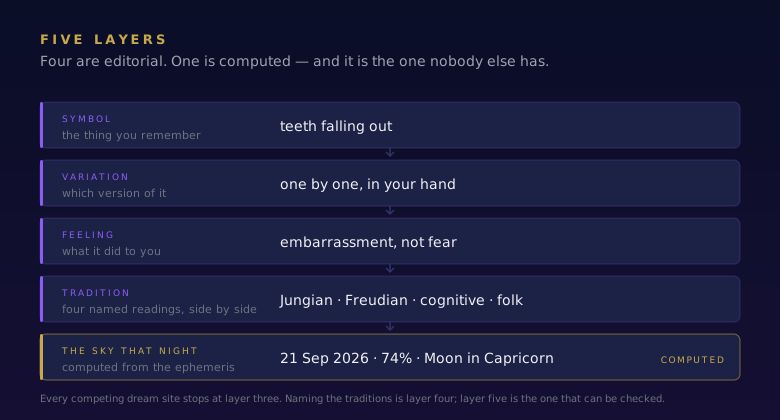
Dream memory is exceptionally bad. Most of a night is gone within minutes of waking, and what survives is reshaped every time it is told. Whatever you plan to do with a dream, the writing has to come first, and it has to come before coffee. Three lines is enough: what happened, who was there, how it felt.
Two: name the symbols, but do not stop there
Identify the recognisable images — that is what the tool above does — and read what the traditions say. Then treat all of it as a set of hypotheses rather than a set of answers. A reading that produces a reaction is telling you something about your situation. A reading that produces nothing is telling you nothing, and there is no obligation to make it fit.
Three: record the feeling, not just the image
This is the step people skip and it is the one that carries most of the information. Flying easily and flying while struggling to stay above the rooftops are reported as different experiences and attach to different circumstances; so are losing teeth with alarm and losing them with flat resignation. The object is identical in each pair. Only the tone separates them, and the tone is what is gone by lunchtime.
Four: check what the sky was doing
One date, and the entry has an objective coordinate attached to it. On its own that is a curiosity. Across a dozen entries it becomes the only column in your record that you did not write yourself, which makes it the only one that cannot be shaped by how you felt about the dream afterwards.
The symbols people search for most
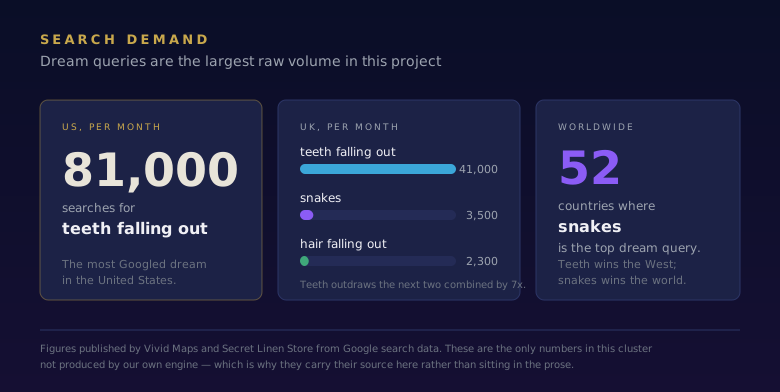
The twenty-four symbols on this site were chosen by measured demand rather than by alphabet, and four of them have published figures attached. Those figures are shown on the pages with their source next to the number, because a dream interpretation page that quotes volumes without saying where they came from is doing the thing this cluster exists to be the opposite of.
Teeth falling out: about 81,000 a month
Teeth falling out draws roughly 81,000 searches a month in the United States alone, per Ahrefs — the largest single dream query anywhere, and by a wide margin. In the United Kingdom, Google Trends puts it first as well, with snakes second at about 3,500 and hair falling out third at about 2,300.
Snakes, the more interesting case
Snakes is the more interesting case, because it is the most searched dream in the world by number of countries rather than by volume in any one of them. It is also the symbol where the traditions disagree most sharply: read as threat or deceit across much of Europe and North America, as a form of the divine in parts of India, as arriving wealth in some Chinese readings. A reader who looks it up in English is handed one culture’s answer presented as the answer.
No figure is invented for the rest
The rest of the list has no published figure and none is invented for it. The blank is the honest state of what was looked up, and filling twenty of them with estimates would poison the four that are real.
Reading a dream alongside your chart
The dream pages here compute one astronomical fact — the Moon on a given night — and deliberately stop there. But a chart carries its own placements that people reading dreams often want alongside them, and those are calculated elsewhere on this site, free and in full.
The Moon in a birth chart
The Moon in a birth chart is the placement most often connected to dreaming in astrological tradition, and the moon sign calculator returns it with the exact degree. The full birth chart adds the houses, and the twelfth in particular is the one traditionally associated with sleep and with what is not consciously available. Neither of those is a dream reading and neither is presented as one.
The same honesty rule applies
What ties them to interpreting a dream here is the same honesty rule that governs the lunar block: a computed placement is a fact you can check against another ephemeris, and it is offered as context rather than as an explanation of anything you dreamed.
Keeping a record is what makes any of this work
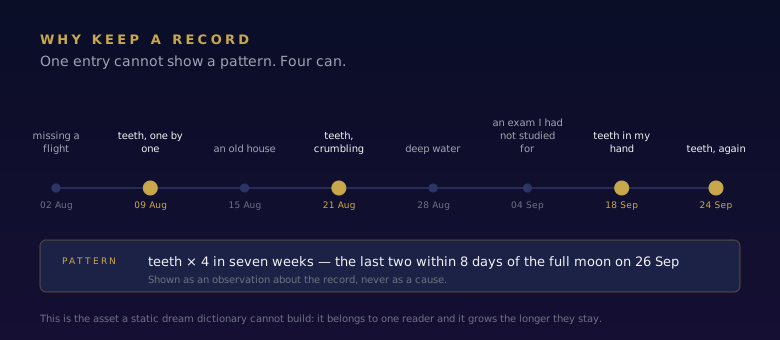
A single dream interpreted in isolation is a guess dressed up. The same symbol appearing four times in a year, always around a particular part of your life, is data about you rather than about the symbol — and it is the only form of evidence available in this whole field.
The continuity account makes a prediction
Recurring dreams are common, and the continuity account makes a prediction about them that you can test yourself: they tend to stop or change when the circumstances around them change. Nobody can check that for you, and no dream interpretation substitutes for it. It needs entries, dated, written the same morning.
Nine of the twenty-four
Nine of the twenty-four symbols here are commonly reported as recurring, and those pages carry a section on what to do about it. The rest of the work is a notebook and the habit of reaching for it before anything else.
Why there is no AI in this
Every new entrant in dream interpretation is an AI interpreter, and they all work the same way: the description goes to a model, the model returns several paragraphs, and the paragraphs are always good. That last part is the problem.
Fluency is not evidence
A model will produce a confident, well-written, specific-sounding reading for any input whatsoever — including for a dream it has nothing useful to say about, including for three words typed at random. There is no signal in the output that separates the cases, because fluency is not evidence and a model has no way to report that it is out of its depth. The reader cannot tell a grounded answer from an invented one, and neither can the site.
Worse at almost everything, better at one
The matcher above is worse than a model at almost everything and better at the one thing that matters here: it can only return the twenty-four symbols this site has actually written pages about, it shows the exact words that produced each hit, and when your dream contains none of them it says so and stops. A wrong match is visibly wrong — you can see that "sea" fired on "seasick" and discount it. That is the trade, and it is the same trade the rest of this site makes: the compatibility scores are a deterministic engine rather than a model, the tarot pages resolve a card from a computed degree, and the reason is identical in all three places.
And the cost is real
The cost is real and worth stating. A model would handle a dream about an elevator, or a dead phone, or a childhood street, and this will not — it will say it found nothing. Whether that is the right trade depends on what you want from the page. If you want something to read, a model is better. If you want to be able to tell whether what you are reading is grounded in anything, it is not close.
Questions people ask about interpreting dreams
- Is this free? Is there a limit?
- Free, unlimited, and no account. There is no AI anywhere in it — the tool matches your description against a fixed list of twenty-four symbols and returns what it found, identically every time for the same text.
- Is my dream stored anywhere?
- No. The description is matched and discarded within the request. It is not logged, not saved to an account and not sent to any model. A dream is the most personal thing this site is ever handed, and the honest arrangement is that it does not persist.
- How is this different from a dream dictionary?
- A dictionary gives one anonymous reading per symbol. Each dream interpretation here sets out four named traditions separately, says where they disagree, separates the common variations, names the popular misreading, and computes the moon phase for the night you dreamed it.
- Where do the meanings come from?
- Four named traditions — Jungian, Freudian, cognitive-continuity and folk — kept separate rather than blended. Where a symbol has no folk tradition, because the thing in the dream did not exist before the twentieth century, the page says so instead of inventing one.
- Does the moon phase actually affect dreams?
- The research is contested. A 2013 study reported an effect on sleep, a 2014 re-analysis with roughly forty times the sample found none, and a 2021 field study found a small effect on the nights before the full moon, attributed to available moonlight. The sky is shown as context, never as a cause.
- Why did it not find any symbols in my dream?
- Because this site has written about twenty-four of them and your dream contained none. That is a real answer, and it is a better one than reaching for the closest match — which is what a tool that always produces something is doing.
- Do I need my birth details?
- Not for anything on this page. The moon phase is the same from everywhere on Earth at a given instant, so it needs a date and nothing else. The chart tools linked above are separate and also free.
Look a symbol up directly
The dictionary lists all twenty-four with what each is usually read as, which traditions apply to it, and how many variations its page separates out.