Flying
Freedom and the effort it costs — how easily you fly is the whole reading.
What dreaming about Flying usually means
Flying is one of the few common dreams people report as pleasant, and the readings around it are correspondingly positive — freedom, perspective, release from a constraint. But the thing that carries the information is not the flight, it is the effort. Accounts divide cleanly between flying that is effortless and flying that requires constant work to stay above the ground, and those two attach to different situations reliably enough that treating them as one symbol loses most of what the dream has to offer. Flying is also disproportionately reported in lucid dreams, where the dreamer knows they are dreaming and often chooses it, which is worth separating out: a flight that was decided on is a different event from one that simply happened. Where a dream dictionary gives flying a single entry, it is answering a question nobody asked — the useful question is never whether you flew but how hard it was.
Common variations
Flying without any effort
The version people describe as the best dream they have had. It is reported most often during settled periods rather than difficult ones, which cuts against the idea that the dream compensates for a constraint. Read as it presents: something currently unobstructed.
Struggling to stay in the air
The commoner version and the more informative one. The effort is constant, the altitude is never quite enough, and the accounts attach to circumstances that are working but only through sustained attention. The detail people remember is how close the rooftops were.
Flying low over the ground
A distinct version that is reported as neither free nor frightening — more like a glide that never gains height. It attaches to situations with movement but no elevation, and it is often described afterwards as pleasant but unsatisfying.
Flying and being afraid of the height
Reverses the symbol. The capability is there and the experience is still unpleasant, and the accounts of it attach to situations where something has been achieved and does not feel secure. Worth noting whether the fear was of falling or of being seen.
Four ways this is read
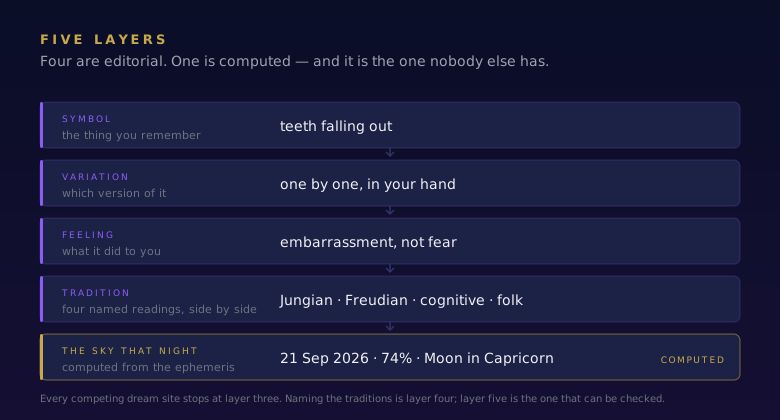
The Jungian reading
Treats the image as belonging to a shared vocabulary rather than a personal one, and asks what the image does rather than what it reminds you of. On this account the figures in a dream are closer to characters in a story everybody already knows than to coded references to your own week.
Reads flight as an image of transcending a situation rather than escaping it — the same family as the ascent images that appear across unrelated mythologies. The tradition tends to attend to what was below, because on this account the view is the content of the dream and the flying is only how it was arrived at.
The Freudian reading
Treats the image as a disguise and asks what it is standing in for. It is the most parodied of the four and it produced one durable observation worth keeping: the feeling in a dream is often attached to something other than the thing the dream appears to be about.
Read flying, like falling, as a bodily sensation given a story, and connected it to the memory of being lifted and carried as a child. It is one of the readings the tradition arrived at by asking what the sensation resembles rather than what the image represents, which is closer to the modern account than most of its conclusions.
The cognitive or continuity reading
The one closest to current sleep science. It holds that dreams continue waking concerns rather than encoding messages, so the useful question is never "what does it mean" but "what in my week does this resemble". It is also the reading that explains recurrence most simply: an unresolved situation keeps producing similar material.
Observes that the vestibular system — the balance apparatus — is active during REM without the usual input from movement, and that flying is one of the narratives the brain constructs from that. It also notes the lucid-dreaming connection: flight is the most commonly chosen action once dreamers realise they are dreaming, which makes a large share of flying dreams something closer to a decision than a message.
The folk tradition
The oldest layer, and the one with the least explanation attached. Its readings vary sharply between cultures, which is itself informative — a symbol read the same way everywhere is behaving differently from one that is not.
Generally read flight as good fortune or as the soul travelling, and in several traditions as a sign of rising status. It is one of the few symbols where the folk reading, the analytic readings and the reported experience all point the same direction, which is itself unusual enough to note.
How this one is usually misread
Flying is read as straightforwardly good in nearly every dictionary, and that is the misreading, because it collapses two dreams that share an image and nothing else. Effortless flight and a grinding struggle to stay above the rooftops are reported as opposite experiences and attach to opposite circumstances, and an entry that calls both "freedom" has thrown away the only part that distinguishes them. The second thing usually left out is lucidity: flying is what most people choose first on realising they are dreaming, so a large share of flying dreams are closer to a decision than to anything requiring interpretation.
The feeling matters more than the image
This is the symbol where the feeling is not a modifier but the whole reading. The same image — a person above the ground — is reported as the most joyful dream people have and as an exhausting struggle, and the difference between those is not in the content at all. When you write this one down, the thing to record is the effort: how much work it took, whether height was gained or only maintained, and what happened when the effort stopped. Those three details do more to identify what the dream attaches to than any amount of thinking about what flight means.
This one is felt, not only seen
People report this dream partly as a bodily sensation rather than an image — which is why it is remembered vividly and why it is hard to describe afterwards. The sensation is worth noting alongside the content when you write it down, because it is usually the part that changes between one instance and the next.
If it keeps coming back
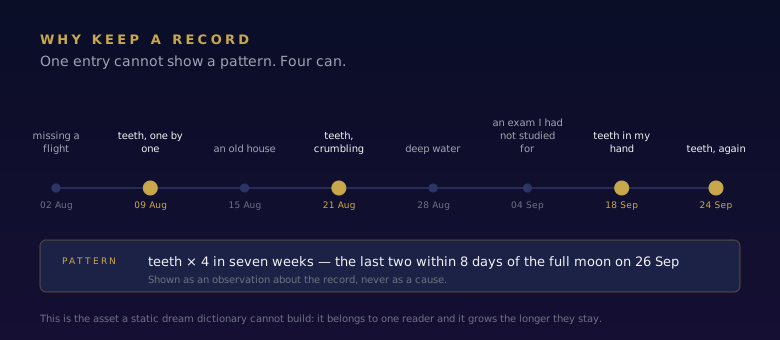
This is one of the symbols most often reported as recurring. The recurrence is more informative than the content: a single instance is an image, and eleven over two years is a pattern that can be checked against your life. The continuity account predicts something testable — recurring dreams tend to stop or change when the circumstances around them change — and people who keep records report exactly that.
The Moon on the night you dreamed it
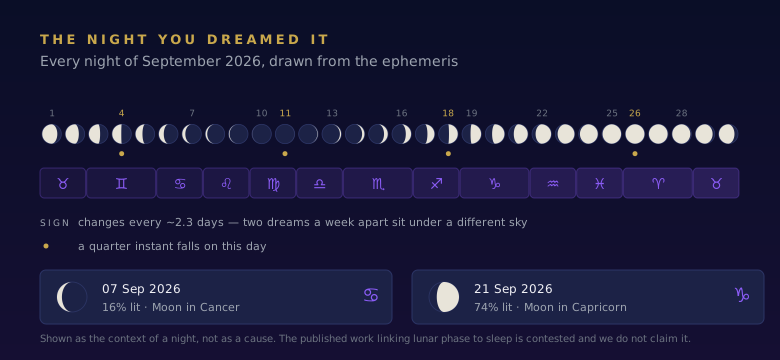
The one thing on this page that can be verified. Enter the night you went to sleep and you get the phase, the illuminated fraction and the sign the Moon held in the small hours, computed rather than asserted. It is context, not a cause — the published research on the Moon and sleep is contested, and the page on it says so.
Related symbols
These are descriptions of how a symbol is commonly read, never statements about you, and nothing here is medical or psychological advice.