Moon phase today — tonight's phase, illumination and moon sign
The moon phase today, computed from the ephemeris rather than copied from a table, and shown in your own timezone with the Moon's exact illumination, zodiac sign and the instant it changes.
This lunation runs from the new moon below to the next one. The four quarter instants are exact; the live phase appears once the page loads.
What is the moon phase today?
Definition
The block above gives the moon phase today for the exact moment you are reading it. The large disc is not one of eight stock images: its terminator — the line dividing lit from unlit — is drawn from the actual Sun-Moon angle right now, so a moon two days past first quarter looks different from one four days past it, because it is.
Underneath sit the four numbers worth having. Illumination is the percentage most people mean when they ask what the moon phase today is. Moon age is how many days have passed since the last new moon. The sign is where the Moon sits in the zodiac, which no astronomy calendar prints. And the next full moon is given as both a countdown and an exact instant.
The moon phase today is rendered in your own timezone, and so is every instant below it. That matters more than it sounds: a full moon at 04:19 UTC falls on the 28th in Berlin and the 27th in Los Angeles, so a site that publishes one zone for everyone is a full calendar day wrong for a large share of its readers.
One more thing the block will not do: round. Sites that show a phase name and nothing else are hiding a range — "waxing gibbous" covers everything from 50% to 100% lit, which is most of a week and two visibly different moons. The percentage is what separates a moon three days from full from one three hours away.
The moon phase today in numbers
- 29.53days
- Back to the same phase
- 27.32days
- Back to the same sign
- 13.2°
- The Moon's daily motion
- 3.7days
- Average length of each named phase
Illumination is the headline number and the one most easily misread. It is the lit *fraction of the disc you can see*, not how bright the night is. A 50% moon is not half as bright as a full one — it is about a ninth as bright, because the full moon gets an extra surge from the way its surface reflects light straight back at the Sun. If you are planning around moonlight, treat illumination as a shape, not a brightness.
Moon age counts days since the new moon that opened the current cycle. It is the number almanacs and tide tables use, and it is the one that makes the phase names concrete: roughly 0 at new, 7.4 at first quarter, 14.8 at full and 22.1 at last quarter. Those are averages. The real intervals move, because the Moon's orbit is an ellipse and it travels faster when it is closer to us.
The phase angle behind both numbers is the Moon's elongation from the Sun: 0° at new moon, 90° at first quarter, 180° at full, 270° at last quarter. Illumination follows from it exactly, as (1 − cos angle) ÷ 2. That formula is the entire relationship, and it is why the illumination changes fastest around the quarters and barely moves for a day either side of full.
The sign and degree describe where the Moon is against the zodiac, which is a different question from the phase and answered by a different clock. The Moon returns to the same phase every 29.53 days and to the same sign every 27.32. Those two and a bit days of difference are why the full moon lands in a new sign each month rather than repeating.
None of these numbers is rounded before it is displayed. The instants come out of a search over the ephemeris rather than a lookup table, so they are given to the minute and can be checked against any published almanac.
The Moon's distance is the number behind the numbers. Its orbit is an ellipse, so it swings between about 356,500 km at perigee and 406,700 km at apogee — a 14% change in how large it appears. That is what makes a supermoon a supermoon, and it is also why one lunation runs 29.27 days and the next 29.83: the Moon covers ground faster when it is closer.
If you are comparing the moon phase today against another source and the illumination differs in the first decimal, the cause is almost always the instant each site chose to compute for. A page that recomputes hourly and one that recomputes at midnight will disagree by up to half a percent through the day, and both are right about their own moment.
The eight moon phases explained
Whatever the moon phase today happens to be, it is one of eight names — and four of those eight are instants while four are intervals. That is the single most useful thing to know about them, and almost no calendar says it. New, first quarter, full and last quarter are exact moments — the Moon is precisely 0°, 90°, 180° or 270° from the Sun, and each lasts no time at all. The crescents and gibbous phases are the roughly week-long stretches in between.
New moon
The Moon is between us and the Sun, its lit face turned away. It is invisible: up in the daytime, down at night, and lost in the glare either way. This is the darkest sky of the month, which is why observatories schedule around it.
Waxing crescent
A thin lit sliver appears in the west after sunset, growing each evening. Within a few days of new moon you can often see the whole disc faintly — the dark part lit by earthshine, sunlight bounced off our own planet.
First quarter
The Moon is 90° from the Sun and half its visible disc is lit, with a straight terminator. It rises around midday and sets around midnight. Confusingly it is called a quarter because the Moon is a quarter of the way through its cycle, not because a quarter is lit.
Waxing gibbous
More than half lit and still growing. The terminator bulges outward now instead of curving inward. This is the phase people most often misidentify, because it looks nearly full for the better part of a week.
Full moon
The Moon is opposite the Sun, rising as the Sun sets. It is fully lit for an instant, though it looks full for two or three nights. When the alignment is close enough to the lunar nodes, the Earth's shadow catches it and the full moon is eclipsed.
Waning gibbous
Shrinking from the other side now, and rising later each night. The lit limb has swapped sides — in the northern hemisphere the light is on the left where it was on the right.
Last quarter
Half lit again, mirror image of first quarter, 270° from the Sun. It rises around midnight and is highest at dawn, which is why it is the phase most people have seen without registering it: it is the moon that is still up during the morning commute.
Waning crescent
A thinning sliver in the east before sunrise, until it is lost in the Sun's glare and the cycle begins again. Earthshine returns, brighter than in the evening crescent because it is reflecting off a different face of the Earth.
Because the named phases are divided into eight equal 45° slices of the cycle, each interval phase lasts about 3.7 days on average. The names are conventions laid over a curve that never stops moving — the Moon does not spend a week being 'waxing gibbous' and then switch.
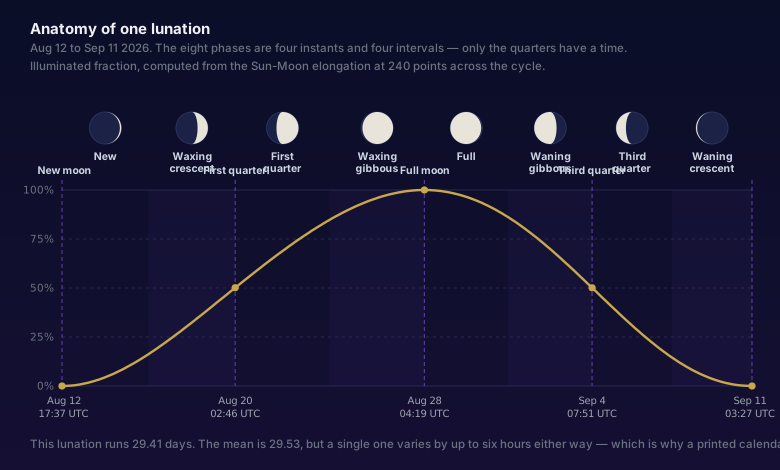
Check it yourself
Here is a claim you can check. The full moon of 28 August 2026 computes here to 04:19 UTC. The Farmers' Almanac publishes it as 12:19 a.m. EDT — the same instant, in a different zone. The partial lunar eclipse on that full moon computes to 96.6% of the disc inside the umbra, which matches the published figure.
Why the Moon has phases
Common misconception
Half the Moon is always lit, exactly as half the Earth is always in daylight. What changes is our viewing angle. When the Moon is on the far side of us from the Sun we see the whole lit half and call it full; when it is between us and the Sun we see the unlit half and call it new. Everything in between is a partial view of a hemisphere that never changes.
This is why the terminator on a quarter moon is a straight line. You are looking at the day-night boundary circle of a sphere edge-on, and a circle seen edge-on is a line. At any other phase you see that circle at an angle, so it projects as half an ellipse — which is exactly how the disc at the top of this page is drawn, rather than being selected from a set of pre-made images.
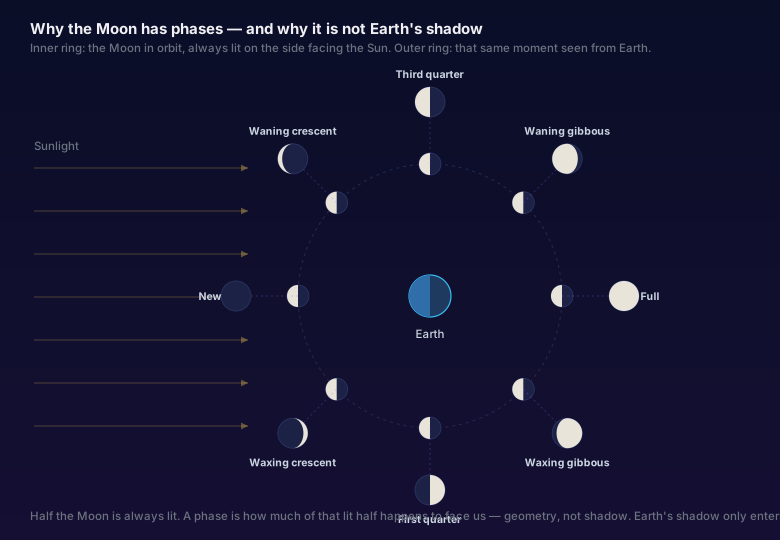
It also explains why the moon phase today is the same for everyone on Earth at the same instant. Your longitude changes what time it is and whether the Moon is above your horizon at all, but not the geometry. Two observers on opposite sides of the planet see the same phase — one of them may have to wait until their own night to see it.
If the Moon's orbit were not tilted about 5° to the Earth's, we would get an eclipse every single month: a solar one at every new moon and a lunar one at every full. The tilt is why we do not, and why eclipses come in seasons roughly six months apart instead.
What sign is the Moon in today?
The Moon's zodiac sign is the piece that no astronomy page reporting the moon phase today carries and the reason a lot of people are here. It is a straightforward measurement: the Moon's position along the ecliptic, divided into twelve 30° signs. The readout at the top gives the current sign and — more usefully — the exact instant the Moon leaves it.
The Moon is the fastest-moving body in a chart. It covers about 13.2° a day, which means a new sign every two and a bit days and thirteen or fourteen sign changes in a single lunation. Compare that with the Sun's one sign a month, and it is clear why the Moon is read as mood and immediate circumstance rather than as anything settled.
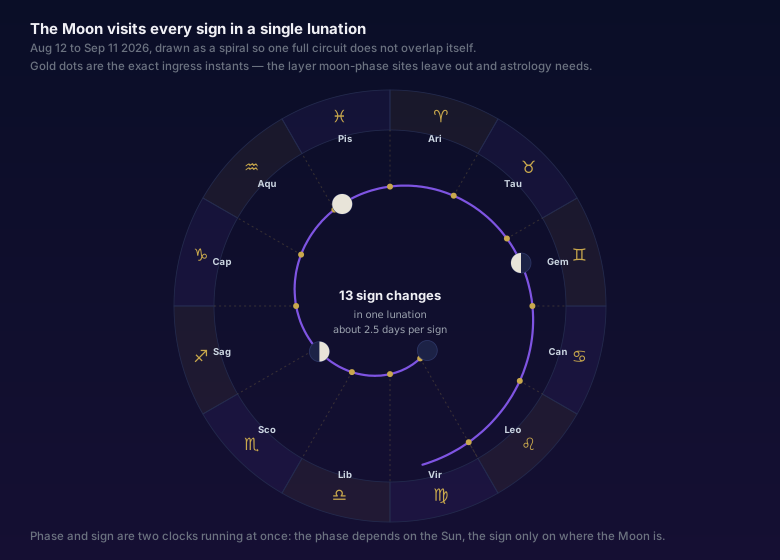
Because it moves that fast, the Moon's sign is also the placement most sensitive to birth time. Someone born at breakfast and someone born the same evening can have the Moon in different signs. That is a different question from this page's — for your own birth Moon, use the moon sign calculator; for the Moon's sign right now, the number above is it.
The sign also changes on its own schedule, unrelated to the phase. The Moon can enter Scorpio at breakfast and be full by midnight, or reach full moon halfway through Aries and finish the sign three days later. Two independent cycles running at once is the reason a table of phases and a table of ingresses are genuinely different documents, and why this page shows both.
When is the next full moon?
The next full moon is September 26, 2026, at 3.6° Aries. Its traditional name is the Harvest Moon.
Full moons arrive every 29.53 days on average, so the date walks backwards through the calendar by about a day each month. That drift is the whole reason a lunar calendar and a solar one cannot be reconciled without patching — and the reason some years get thirteen full moons instead of twelve.
The folk names come from North American and European agricultural tradition, and two of them are rules rather than months: the Harvest Moon is the full moon nearest the September equinox, and the Hunter's Moon is the one after it. Assign them by month and you will get them wrong in the years the equinox falls awkwardly — which is a mistake almanac readers spot immediately.
It is worth knowing why the full moon looks full for several nights. Illumination changes slowest at the extremes: the Moon is above 99% lit for roughly a day either side of the exact instant, and the eye cannot resolve the last fraction of a percent of a curved limb. So the exact time matters for an eclipse or a calculation and not at all for looking at it.
Harvest Moon
September 26, 2026
3.6° Aries
How the moon phase today is calculated
The moon phase today, and every instant below it, comes from astronomy-engine — the same ephemeris that produces every chart on this site. Nothing is read out of a stored table of dates, and nothing is copied from another calendar.
The quarter instants are found by search rather than by formula. The code brackets the moment the Moon's elongation from the Sun crosses 0°, 90°, 180° or 270°, then bisects inside that bracket until the answer is stable to well under a minute. That is slower than an approximation and it is the reason the times can be published to the minute.
The page itself is prerendered and rebuilt daily, which is why the moon phase today shown above is resolved in your browser rather than baked into the HTML. A page built in August that told an October reader the Moon was waxing gibbous would be confidently wrong, and no amount of accuracy in the ephemeris would fix it.
Being checkable is the point. Anyone can compare these dates against timeanddate, an almanac or their own software, and if we disagree with all of them we are wrong. That is a stronger position than asking to be trusted.
What tonight's moon means for your chart
The moon phase today is the same for everyone alive. So is the Moon's sign. What differs from person to person is which part of your own chart the Moon is crossing — and that cannot be known from a date, only from a birth chart.
In astrological practice the phase suggests the shape of the timing rather than the content of it. The waxing half — new moon through full — is read as the part of the cycle for starting and building; the waning half for finishing, editing and letting go. A new moon in your tenth house and a new moon in your fourth are the same sky and different assignments.
This is timing for your own actions, not a forecast of events. Nothing on this page can tell you what will happen, and any page that claims otherwise is selling something other than astronomy. What a chart adds is the house — the area of life the Moon is currently lighting up — and that is worth knowing before you decide when to do something you were going to do anyway.
The practical use is narrow and real. If you already intend to launch something, ask for something, or end something, the phase offers a defensible way to pick the week — and knowing which of your houses the Moon is crossing narrows it further. What it does not offer is a reason to do the thing, and that distinction is the whole of the difference between timing and prediction.
Frequently asked questions
What moon phase is it today?
The block at the top of this page answers it for the moment you are reading, with the illumination percentage, the Moon's age in days and its zodiac sign. It updates on the minute and uses your own timezone, so it does not need to be refreshed to stay right.
What will the moon phase be tonight?
The same as the block above shows, give or take a percent — the Moon's illumination moves by about 5 percentage points a day near the quarters and much less near new and full. If you are reading this in the morning, tonight's moon will look essentially identical to the disc at the top of the page.
Is this free? Do I need an account?
Free, with no signup and no email gate, and there is no limit on how often you can check. These are public astronomical facts. What this site charges for is the AI interpretation of your own birth chart, which is a different thing entirely.
How accurate is the moon phase today shown here?
The quarter instants are located by search over the ephemeris and are stable to well under a minute. As a published cross-check, the 28 August 2026 full moon computes here to 04:19 UTC, which is the Farmers' Almanac's 12:19 a.m. EDT. Sub-minute differences against other sources come from rounding, not from disagreement.
Why does the moon phase today here differ from another site?
Almost always timezone rather than disagreement. This page renders every instant in your own zone; moongiant, timeanddate and most almanacs publish UTC. A full moon at 04:19 UTC is the 28th in Berlin and the 27th in Los Angeles — the same instant, two calendar dates. Switch the toggle to UTC and the numbers should line up.
What is the difference between the moon phase and the moon sign?
Two different clocks. The phase depends on the angle between the Moon and the Sun, and repeats every 29.53 days. The sign depends only on where the Moon is against the zodiac, and repeats every 27.32 days. The two-day gap is why the full moon lands in a different sign each month instead of repeating.
How often does the moon phase change during the day?
Continuously. The eight named phases are four exact instants — new, first quarter, full, last quarter — and four intervals of about 3.7 days each between them. Nothing switches over at midnight; the names are conventions laid over a curve that never stops moving.
Does the moon phase today look different in the southern hemisphere?
The phase is identical, but it appears upside down. A waxing crescent lit on the right in London is lit on the left in Sydney, because observers in the two hemispheres are oriented differently relative to the Moon. The illumination percentage, the age and the sign are all the same number.
How is this different from a horoscope app?
Everything here is computed and identical for every reader: the same phase, the same illumination, the same sign. A horoscope assigns you a meaning. What actually differs between people is which house of their own chart the Moon is crossing, and that needs birth data rather than a sun sign.
What should I do during this phase?
The tradition offers timing for your own actions, not predictions about events. The waxing half of the cycle is read as the time for starting and building, the waning half for finishing and clearing. That is a scheduling suggestion you can accept or ignore, and it is the most any moon phase page can honestly offer.
Related moon tools
The moon phase today is one reading of a cycle that runs all year. These pages cover the rest of it: the full calendar month by month, each full and new moon with its folk name and sign, and the phase you were born under.
Calculated live from the ephemeris. Page rebuilt daily.