Full moon calendar
Every full moon from 2020 to 2035, computed to the minute and shown in your own timezone — with its traditional name, its zodiac sign and degree, and a flag on the ones the Earth's shadow catches.
The next full moon
2.8° Taurus · Hunter's Moon
Every full moon in 2026
| Date | Phase | Name | Sign | Note |
|---|---|---|---|---|
| Full moon | Wolf Moon | 20.0° Cancer | ||
| Full moon | Snow Moon | 20.0° Leo | ||
| Full moon | Worm Moon | 19.6° Virgo | ||
| Full moon | Pink Moon | 18.7° Libra | ||
| Full moon | Flower Moon | 17.3° Scorpio | ||
| Full moon | Strawberry Moon | 15.6° Sagittarius | ||
| Full moon | Buck Moon | 13.6° Capricorn | ||
| Full moon | Sturgeon Moon | 11.8° Aquarius | ||
| Full moon | Corn Moon | 10.2° Pisces | ||
| Full moon | Harvest Moon | 9.1° Aries | ||
| Full moon | Hunter's Moon | 8.6° Taurus | Blue Moon | |
| Full moon | Beaver Moon | 8.6° Gemini | ||
| Full moon | Cold Moon | 8.9° Cancer | ||
| Full moon | Wolf Moon | 9.1° Leo | ||
| Full moon | Snow Moon | 9.0° Virgo | ||
| Full moon | Worm Moon | 8.3° Libra | ||
| Full moon | Pink Moon | 7.1° Scorpio | ||
| Full moon | Flower Moon | 5.4° Sagittarius | Total lunar eclipse (100%) | |
| Full moon | Strawberry Moon | 3.5° Capricorn | ||
| Full moon | Buck Moon | 1.4° Aquarius | ||
| Full moon | Sturgeon Moon | 29.6° Aquarius | ||
| Full moon | Harvest Moon | 28.2° Pisces | ||
| Full moon | Hunter's Moon | 27.4° Aries | ||
| Full moon | Beaver Moon | 27.2° Taurus | Partial lunar eclipse (99%) | |
| Full moon | Cold Moon | 27.5° Gemini | ||
| Full moon | Wolf Moon | 27.9° Cancer | ||
| Full moon | Snow Moon | 28.0° Leo | ||
| Full moon | Worm Moon | 27.7° Virgo | ||
| Full moon | Pink Moon | 26.8° Libra | ||
| Full moon | Flower Moon | 25.3° Scorpio | Total lunar eclipse (100%) | |
| Full moon | Strawberry Moon | 23.4° Sagittarius | ||
| Full moon | Buck Moon | 21.4° Capricorn | ||
| Full moon | Sturgeon Moon | 19.4° Aquarius | ||
| Full moon | Harvest Moon | 17.7° Pisces | ||
| Full moon | Hunter's Moon | 16.5° Aries | ||
| Full moon | Beaver Moon | 16.0° Taurus | Total lunar eclipse (100%) | |
| Full moon | Cold Moon | 16.0° Gemini | ||
| Full moon | Wolf Moon | 16.4° Cancer | ||
| Full moon | Snow Moon | 16.7° Leo | ||
| Full moon | Worm Moon | 16.7° Virgo | ||
| Full moon | Pink Moon | 16.1° Libra | ||
| Full moon | Flower Moon | 15.0° Scorpio | ||
| Full moon | Strawberry Moon | 13.3° Sagittarius | ||
| Full moon | Buck Moon | 11.3° Capricorn | ||
| Full moon | Sturgeon Moon | 9.3° Aquarius | ||
| Full moon | Blue Moon | 7.4° Pisces | Blue Moon | |
| Full moon | Harvest Moon | 6.0° Aries | ||
| Full moon | Hunter's Moon | 5.2° Taurus | Partial lunar eclipse (6%) | |
| Full moon | Beaver Moon | 4.9° Gemini | ||
| Full moon | Cold Moon | 5.0° Cancer | ||
| Full moon | Wolf Moon | 5.3° Leo | ||
| Full moon | Snow Moon | 5.4° Virgo | ||
| Full moon | Worm Moon | 5.1° Libra | ||
| Full moon | Pink Moon | 4.3° Scorpio | ||
| Full moon | Flower Moon | 2.9° Sagittarius | ||
| Full moon | Strawberry Moon | 1.1° Capricorn | ||
| Full moon | Buck Moon | 29.2° Capricorn | ||
| Full moon | Sturgeon Moon | 27.3° Aquarius | ||
| Full moon | Harvest Moon | 25.7° Pisces | Partial lunar eclipse (4%) | |
| Full moon | Hunter's Moon | 24.6° Aries | ||
| Full moon | Beaver Moon | 24.0° Taurus | ||
| Full moon | Cold Moon | 23.9° Gemini | ||
| Full moon | Wolf Moon | 24.0° Cancer | ||
| Full moon | Snow Moon | 24.1° Leo | ||
| Full moon | Worm Moon | 23.9° Virgo | Total lunar eclipse (100%) | |
| Full moon | Pink Moon | 23.3° Libra | ||
| Full moon | Flower Moon | 22.2° Scorpio | ||
| Full moon | Strawberry Moon | 20.7° Sagittarius | ||
| Full moon | Buck Moon | 18.8° Capricorn | ||
| Full moon | Sturgeon Moon | 17.0° Aquarius | ||
| Full moon | Corn Moon | 15.4° Pisces | Total lunar eclipse (100%) | |
| Full moon | Harvest Moon | 14.1° Aries | ||
| Full moon | Hunter's Moon | 13.4° Taurus | ||
| Full moon | Cold Moon | 13.1° Gemini | ||
| Full moon | Wolf Moon | 13.0° Cancer | ||
| Full moon | Snow Moon | 13.1° Leo | ||
| Full moon | Worm Moon | 12.9° Virgo | Total lunar eclipse (100%) | |
| Full moon | Pink Moon | 12.4° Libra | ||
| Full moon | Flower Moon | 11.4° Scorpio | ||
| Full moon | Blue Moon | 9.9° Sagittarius | Blue Moon | |
| Full moon | Strawberry Moon | 8.3° Capricorn | ||
| Full moon | Buck Moon | 6.5° Aquarius | ||
| Full moon | Sturgeon Moon | 4.9° Pisces | Partial lunar eclipse (97%) | |
| Full moon | Harvest Moon | 3.6° Aries | ||
| Full moon | Hunter's Moon | 2.8° Taurus | ||
| Full moon | Beaver Moon | 2.3° Gemini | ||
| Full moon | Cold Moon | 2.2° Cancer | ||
| Full moon | Wolf Moon | 2.2° Leo | ||
| Full moon | Snow Moon | 2.1° Virgo | ||
| Full moon | Worm Moon | 1.6° Libra | ||
| Full moon | Pink Moon | 0.6° Scorpio | ||
| Full moon | Flower Moon | 29.2° Scorpio | ||
| Full moon | Strawberry Moon | 27.6° Sagittarius | ||
| Full moon | Buck Moon | 25.8° Capricorn | ||
| Full moon | Sturgeon Moon | 24.2° Aquarius | ||
| Full moon | Harvest Moon | 22.9° Pisces | ||
| Full moon | Hunter's Moon | 22.0° Aries | ||
| Full moon | Beaver Moon | 21.5° Taurus | ||
| Full moon | Cold Moon | 21.4° Gemini | ||
| Full moon | Wolf Moon | 21.5° Cancer | Partial lunar eclipse (3%) | |
| Full moon | Snow Moon | 21.4° Leo | ||
| Full moon | Worm Moon | 21.0° Virgo | ||
| Full moon | Pink Moon | 20.1° Libra | ||
| Full moon | Flower Moon | 18.7° Scorpio | ||
| Full moon | Strawberry Moon | 17.0° Sagittarius | ||
| Full moon | Buck Moon | 15.2° Capricorn | Partial lunar eclipse (33%) | |
| Full moon | Sturgeon Moon | 13.4° Aquarius | ||
| Full moon | Corn Moon | 12.0° Pisces | ||
| Full moon | Harvest Moon | 11.0° Aries | ||
| Full moon | Hunter's Moon | 10.5° Taurus | ||
| Full moon | Cold Moon | 10.4° Gemini | ||
| Full moon | Blue Moon | 10.6° Cancer | Total lunar eclipse (100%) | |
| Full moon | Wolf Moon | 10.6° Leo | ||
| Full moon | Snow Moon | 10.4° Virgo | ||
| Full moon | Worm Moon | 9.7° Libra | ||
| Full moon | Pink Moon | 8.4° Scorpio | ||
| Full moon | Flower Moon | 6.8° Sagittarius | ||
| Full moon | Strawberry Moon | 4.8° Capricorn | Total lunar eclipse (100%) | |
| Full moon | Buck Moon | 2.9° Aquarius | ||
| Full moon | Sturgeon Moon | 1.2° Pisces | ||
| Full moon | Harvest Moon | 30.0° Pisces | ||
| Full moon | Hunter's Moon | 29.3° Aries | ||
| Full moon | Beaver Moon | 29.1° Taurus | ||
| Full moon | Cold Moon | 29.4° Gemini | Total lunar eclipse (100%) | |
| Full moon | Wolf Moon | 29.6° Cancer | ||
| Full moon | Snow Moon | 29.6° Leo | ||
| Full moon | Worm Moon | 29.2° Virgo | ||
| Full moon | Pink Moon | 28.2° Libra | ||
| Full moon | Flower Moon | 26.6° Scorpio | ||
| Full moon | Strawberry Moon | 24.7° Sagittarius | Partial lunar eclipse (47%) | |
| Full moon | Buck Moon | 22.7° Capricorn | ||
| Full moon | Sturgeon Moon | 20.8° Aquarius | ||
| Full moon | Harvest Moon | 19.2° Pisces | ||
| Full moon | Hunter's Moon | 18.2° Aries | ||
| Full moon | Beaver Moon | 17.8° Taurus | ||
| Full moon | Cold Moon | 17.9° Gemini | ||
| Full moon | Wolf Moon | 18.3° Cancer | ||
| Full moon | Snow Moon | 18.5° Leo | ||
| Full moon | Worm Moon | 18.4° Virgo | ||
| Full moon | Pink Moon | 17.7° Libra | ||
| Full moon | Flower Moon | 16.4° Scorpio | ||
| Full moon | Strawberry Moon | 14.7° Sagittarius | ||
| Full moon | Buck Moon | 12.6° Capricorn | ||
| Full moon | Sturgeon Moon | 10.6° Aquarius | ||
| Full moon | Corn Moon | 8.8° Pisces | ||
| Full moon | Harvest Moon | 7.4° Aries | Blue Moon | |
| Full moon | Hunter's Moon | 6.7° Taurus | ||
| Full moon | Beaver Moon | 6.5° Gemini | ||
| Full moon | Cold Moon | 6.8° Cancer | ||
| Full moon | Wolf Moon | 7.1° Leo | ||
| Full moon | Snow Moon | 7.3° Virgo | ||
| Full moon | Worm Moon | 6.9° Libra | ||
| Full moon | Pink Moon | 6.0° Scorpio | Total lunar eclipse (100%) | |
| Full moon | Flower Moon | 4.5° Sagittarius | ||
| Full moon | Strawberry Moon | 2.6° Capricorn | ||
| Full moon | Buck Moon | 0.5° Aquarius | ||
| Full moon | Sturgeon Moon | 28.6° Aquarius | ||
| Full moon | Harvest Moon | 27.0° Pisces | ||
| Full moon | Hunter's Moon | 26.0° Aries | Total lunar eclipse (100%) | |
| Full moon | Beaver Moon | 25.5° Taurus | ||
| Full moon | Cold Moon | 25.5° Gemini | ||
| Full moon | Wolf Moon | 25.7° Cancer | ||
| Full moon | Snow Moon | 25.9° Leo | ||
| Full moon | Worm Moon | 25.8° Virgo | ||
| Full moon | Pink Moon | 25.2° Libra | Total lunar eclipse (100%) | |
| Full moon | Flower Moon | 24.0° Scorpio | ||
| Full moon | Strawberry Moon | 22.3° Sagittarius | ||
| Full moon | Buck Moon | 20.4° Capricorn | ||
| Full moon | Sturgeon Moon | 18.4° Aquarius | ||
| Full moon | Harvest Moon | 16.7° Pisces | ||
| Full moon | Hunter's Moon | 15.5° Aries | Total lunar eclipse (100%) | |
| Full moon | Beaver Moon | 14.7° Taurus | ||
| Full moon | Cold Moon | 14.5° Gemini | ||
| Full moon | Wolf Moon | 14.5° Cancer | ||
| Full moon | Snow Moon | 14.6° Leo | ||
| Full moon | Worm Moon | 14.6° Virgo | ||
| Full moon | Pink Moon | 14.1° Libra | ||
| Full moon | Flower Moon | 13.2° Scorpio | ||
| Full moon | Strawberry Moon | 11.7° Sagittarius | ||
| Full moon | Buck Moon | 10.0° Capricorn | ||
| Full moon | Blue Moon | 8.1° Aquarius | Blue Moon | |
| Full moon | Sturgeon Moon | 6.4° Pisces | ||
| Full moon | Harvest Moon | 5.1° Aries | Partial lunar eclipse (0%) | |
| Full moon | Hunter's Moon | 4.2° Taurus | ||
| Full moon | Beaver Moon | 3.7° Gemini | ||
| Full moon | Cold Moon | 3.6° Cancer | ||
| Full moon | Wolf Moon | 3.7° Leo | ||
| Full moon | Snow Moon | 3.6° Virgo | ||
| Full moon | Worm Moon | 3.1° Libra | ||
| Full moon | Pink Moon | 2.3° Scorpio | ||
| Full moon | Flower Moon | 1.0° Sagittarius | ||
| Full moon | Strawberry Moon | 29.3° Sagittarius | ||
| Full moon | Buck Moon | 27.6° Capricorn | ||
| Full moon | Sturgeon Moon | 25.9° Aquarius | Partial lunar eclipse (5%) | |
| Full moon | Harvest Moon | 24.5° Pisces | ||
| Full moon | Hunter's Moon | 23.6° Aries | ||
| Full moon | Beaver Moon | 23.0° Taurus | ||
| Full moon | Cold Moon | 22.8° Gemini |
Times shown in UTC
What a full moon actually is
Common misconception
The instant, and the two or three nights around it
A full moon is the instant the Moon reaches 180° from the Sun — directly opposite it, seen from Earth, with its entire lit hemisphere turned toward us. It is a moment rather than a night, which is the single most useful thing to know when reading any full moon calendar.
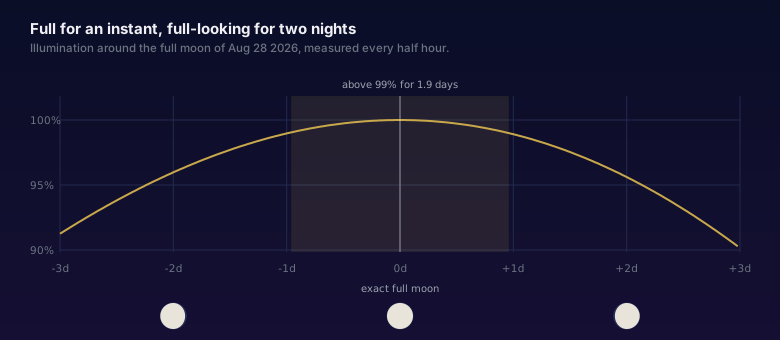
It looks full for two or three nights either side, because illumination changes slowest at the extremes: the Moon is above 99% lit for roughly a day on each side of the exact instant, and the eye cannot resolve the last fraction of a percent along a curved limb. So the precise time matters for a calculation or an eclipse and not at all for looking at it.
Why it rises as the Sun sets
Because it is opposite the Sun, a full moon rises as the Sun sets and sets as the Sun rises. It is the only phase visible for the whole night, and the only one that can be eclipsed — the Moon has to be behind us relative to the Sun for the Earth's shadow to reach it.
Where the full moon calendar's traditional names come from
Check it yourself
Where the names came from
The names on this full moon calendar — Wolf, Snow, Worm, Pink, Flower, Strawberry, Buck, Sturgeon, Corn, Harvest, Hunter's, Beaver, Cold — come mostly from North American colonial and Algonquian usage, collected and popularised in twentieth-century almanacs. They describe what was happening on the ground in that month rather than anything about the Moon.
Two of them are not month names at all, and this is where most published tables go wrong. The Harvest Moon is the full moon falling nearest the September equinox, and the Hunter's Moon is the one after it. In most years that puts Harvest in September — but not all years, and a table that assigns it by month will be wrong in the others.
The Harvest Moon, and whose names these are
The Harvest Moon earned its name from a real effect rather than a poetic one. Around the September equinox the Moon's orbit meets the horizon at a shallow angle, so successive moonrises come only 20 to 30 minutes later each night instead of the usual 50. The result is several evenings of bright moonlight arriving right after sunset — genuinely useful if you are bringing in a crop by hand.
The names are also not universal, and it is worth saying so. These are one regional tradition among many; Chinese, Hindu, Māori and countless other calendars name their lunar months differently and start them at different points in the cycle. What this full moon calendar publishes is the set that English-language almanacs standardised on, because that is the set a reader comparing pages will be comparing against.
Blue moons, and the year with thirteen full moons
The definition, and the mistake that stuck
A Blue Moon is the second full moon in a single calendar month. It happens because the lunar cycle is 29.53 days and most months are longer: a full moon in the first day or two of a 31-day month leaves just enough room for another before it ends.
This is the modern definition, and it is a mistake that stuck. An older seasonal usage — the third full moon in a season containing four — was misread in a 1946 Sky & Telescope article, and the simpler month-based version took over completely. This calendar uses the month-based one, because it is what every calendar a reader might compare against uses.
The same arithmetic produces the thirteen-full-moon year. Twelve lunations take 354 days, eleven short of a solar year, so the shortfall accumulates and roughly every two or three years a thirteenth full moon fits. Within the range this full moon calendar covers, 2026 is one: two full moons in May, the second on the 31st.
What the diagram shows, and the colour question
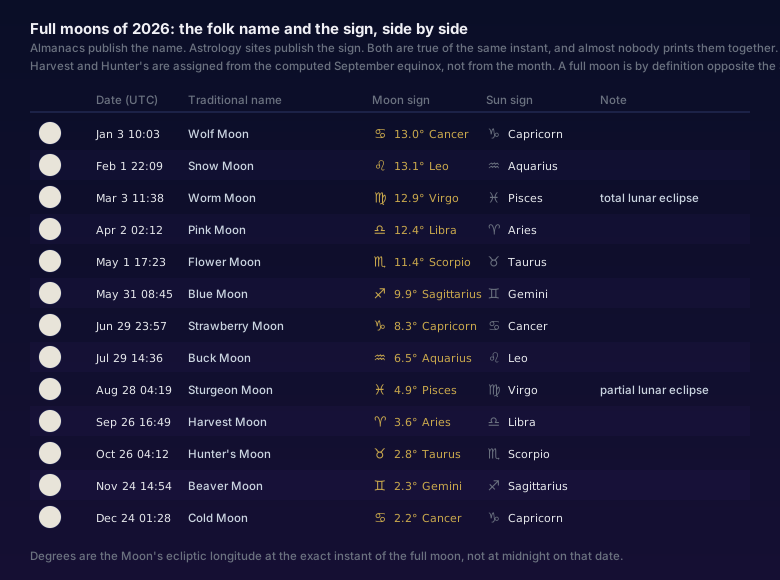
There is a consequence in the diagram above that no competing page prints. Because thirteen lunations are being squeezed into twelve months, each full moon of 2026 falls at a slightly earlier degree than the one before it — from 13.0° Cancer in January down to 2.2° Cancer in December. The full moons walk backwards through the zodiac across the year.
Blue moons are also not blue. The colour name appears to be unrelated to any visual effect — although a moon genuinely can look blue after a large volcanic eruption or a major forest fire, when particles of a particular size scatter red light preferentially. Those events are far rarer than the calendrical Blue Moon and have nothing to do with which month the full moon falls in.
The full moon's zodiac sign, and why it changes
Always opposite the Sun, so always predictable
Every entry in this full moon calendar carries the sign and degree the Moon occupies at that instant. Because a full moon is by definition opposite the Sun, the Moon's sign is always the sign opposite the Sun's — a full moon while the Sun is in Leo is a full moon in Aquarius, every time.
That makes the sign predictable to anyone who knows the date, and it is exactly why the degree is the interesting number rather than the sign. A full moon at 2° of a sign and one at 28° are nearly a month apart in the cycle they belong to, and only one of them will be within orb of anything in a given birth chart.
Read as a culmination, and the sequence retreats
In astrological practice the full moon is read as a culmination rather than a beginning: something reaching the point where it has to be dealt with. Which part of your life that touches depends on which house of your own chart the degree falls in, and a date alone cannot tell you that.
Because the full moon is always opposite the Sun, the sequence of signs across a year is fixed and marches forward one place a month. What is not fixed is the degree, and in a thirteen-full-moon year it runs backwards — which is the pattern the diagram above makes visible and the reason two consecutive Januarys can put the full moon at very different points in the same sign.
Which full moons are eclipsed
Two or three a year, and what is left out
Two or three full moons a year fall close enough to the lunar nodes for the Earth's shadow to reach the Moon. Those are flagged in the table, with the fraction of the disc inside the umbra at maximum.
Penumbral eclipses are left out of this full moon calendar even though they are real events. The Moon dims slightly and almost nobody can see the difference; flagging one trains a reader to distrust the flag on the eclipses they actually can see. The eclipse calendar on this site lists them, clearly labelled, because that page's job is completeness rather than usefulness at a glance.
Copper red, and how much the depth varies
A totally eclipsed full moon turns deep copper red rather than going dark, lit by sunlight refracted around the Earth through our atmosphere and stripped of its blue wavelengths on the way. It is the light of every sunrise and sunset on Earth at once, landing on the Moon.
The depth of a total lunar eclipse varies more than most people expect, and it is measured on the Danjon scale from L=0 for one so dark the Moon nearly disappears to L=4 for a bright coppery orange. What decides it is the state of our own atmosphere along the day-night line, since that is the air the light passes through. Years with significant volcanic dust in the stratosphere produce the darkest eclipses on record.
Frequently asked questions
When is the next full moon?
The block at the top of this page gives the exact instant in your own timezone, along with the Moon's sign and degree and the full moon's traditional name.
How often is there a full moon?
Every 29.53 days on average, so twelve or thirteen times a year. The date walks backwards through the calendar by about a day each month, which is why no fixed rule about full moons and dates stays true for long.
How long does a full moon last?
The full moon itself is an instant — the moment the Moon is exactly 180° from the Sun. It looks full to the eye for two or three nights, because illumination changes very slowly near the extremes of the cycle.
Why does each full moon have a name?
The names come from North American colonial and Algonquian tradition, describing the season rather than the Moon. Two are rules rather than months: the Harvest Moon is the full moon nearest the September equinox and the Hunter's Moon is the next one, which is why this calendar computes them instead of looking them up.
When is the next Blue Moon?
The table flags them. A Blue Moon is the second full moon in one calendar month, which happens roughly every two and a half years — within this span, 31 May 2026.
Does this full moon calendar show supermoons?
Not as a separate flag. A supermoon is a full moon near perigee, and the definition is a popular one rather than an astronomical one — different sources use different distance thresholds, which is why published supermoon counts disagree. The apparent size difference is about 14% at the extremes and hard to judge without a side-by-side comparison.
What zodiac sign is the full moon in?
Always the sign opposite the Sun's, because a full moon is by definition opposite the Sun. The table gives the exact degree as well, which is the number that decides whether it touches anything in a particular birth chart.
Why does another site give a different date?
Timezone, almost always. A full moon at 04:19 UTC is the 28th in Berlin and the 27th in Los Angeles — the same instant, two calendar dates. Switch this page to UTC and the numbers should match.
How accurate are these times?
Located by search over the ephemeris and stable to well under a minute. As a published cross-check, the 28 August 2026 full moon computes here to 04:19 UTC, which is the Farmers' Almanac's 12:19 a.m. EDT.
Related pages
Calculated live from the ephemeris. Page rebuilt daily.