Moon phase calendar
Every full moon, new moon and quarter from 2020 to 2035, computed to the minute and shown in your own timezone — with the folk name, the zodiac sign and any eclipse on the same row.
The next three events
- New Moon17.4° Libra
- First Quarter25.3° Capricorn
- Full Moon2.8° Taurus
Moon phases in October 2026
Every day of the month, with the Moon’s sign, the exact instant it changes sign, and how much of the disc is lit. The four quarter instants are marked on the day they fall.
| Date | Phase | Sign | Illumination | Notes | |
|---|---|---|---|---|---|
| Thu 1 | Waning Gibbous | Gemini | 73% | ||
| Fri 2 | Waning Gibbous | Gemini→Cancer | 62% | ||
| Sat 3 | Last Quarter | Cancer | 51% | ||
| Sun 4 | Waning Crescent | Cancer→Leo | 39% | ||
| Mon 5 | Waning Crescent | Leo | 29% | ||
| Tue 6 | Waning Crescent | Leo | 19% | ||
| Wed 7 | Waning Crescent | Leo→Virgo | 11% | ||
| Thu 8 | Waning Crescent | Virgo | 5% | ||
| Fri 9 | Waning Crescent | Virgo→Libra | 2% | ||
| Sat 10 | New Moon | Libra | 0% | ||
| Sun 11 | Waxing Crescent | Libra→Scorpio | 1% | ||
| Mon 12 | Waxing Crescent | Scorpio | 4% | ||
| Tue 13 | Waxing Crescent | Scorpio | 8% | ||
| Wed 14 | Waxing Crescent | Scorpio→Sagittarius | 14% | ||
| Thu 15 | Waxing Crescent | Sagittarius | 22% | ||
| Fri 16 | Waxing Crescent | Sagittarius→Capricorn | 30% | ||
| Sat 17 | Waxing Crescent | Capricorn | 39% | ||
| Sun 18 | First Quarter | Capricorn | 48% | ||
| Mon 19 | Waxing Gibbous | Capricorn→Aquarius | 58% | ||
| Tue 20 | Waxing Gibbous | Aquarius | 67% | ||
| Wed 21 | Waxing Gibbous | Aquarius→Pisces | 76% | ||
| Thu 22 | Waxing Gibbous | Pisces | 84% | ||
| Fri 23 | Waxing Gibbous | Pisces→Aries | 91% | ||
| Sat 24 | Waxing Gibbous | Aries | 96% | ||
| Sun 25 | Waxing Gibbous | Aries→Taurus | 99% | ||
| Mon 26 | Full Moon | Taurus | 100% | ||
| Tue 27 | Waning Gibbous | Taurus | 98% | ||
| Wed 28 | Waning Gibbous | Taurus→Gemini | 93% | ||
| Thu 29 | Waning Gibbous | Gemini | 85% | ||
| Fri 30 | Waning Gibbous | Gemini→Cancer | 76% | ||
| Sat 31 | Waning Gibbous | Cancer | 65% | ||
Rows are UTC calendar days. The exact times follow the timezone setting above, so a time close to midnight can belong to the neighbouring day in your own zone.
What a moon phase calendar actually contains
A moon phase calendar is a list of the instants the Moon reaches each of its four defining positions relative to the Sun: new moon at 0°, first quarter at 90°, full moon at 180° and last quarter at 270°. Everything else on a lunar calendar — the names, the illumination percentages, the pretty icons — is derived from those four numbers.
That is why a good moon phase calendar is short on opinion and precise about times. There are about 49 or 50 of these instants in a year, arriving every 7.4 days or so, and each one is a fact that can be checked against any almanac in the world.
What this moon phase calendar adds is the column the astronomy sites leave out and the precision the astrology sites leave out. Each full and new moon carries its zodiac sign and exact degree alongside its traditional name and its time. Neither half of that is expensive to compute — both fall out of the same ephemeris call — and nobody publishes them together.
The four events are not evenly spaced through the year either. Because 12.37 lunations fit into 365 days, the pattern shifts against the calendar continuously and never repeats exactly — which is why a moon phase calendar has to be computed for each year rather than copied forward with the dates nudged.
Why the Moon does not fit the calendar
Common misconception
- 29.53days
- Back to the same phase
- 354days
- Twelve lunations
- 365days
- A solar year
- 12.37
- Lunations in a year
The mismatch between the lunar cycle and the calendar month is the source of nearly every confusing thing about a moon phase calendar, so it is worth stating once, plainly.
The Moon takes 29.53 days to return to the same phase. Our months are 30 or 31 days, except one that is 28. That surplus each month means every full moon falls about a day earlier in the month than the last one, walking backwards through the calendar until it laps.
Twelve lunations add up to 354 days — eleven days short of a solar year. So a year contains not twelve lunar cycles but roughly 12.37 of them, and every two or three years the leftovers accumulate into a whole extra one. That is the entire explanation for the thirteen-full-moon year and the Blue Moon.
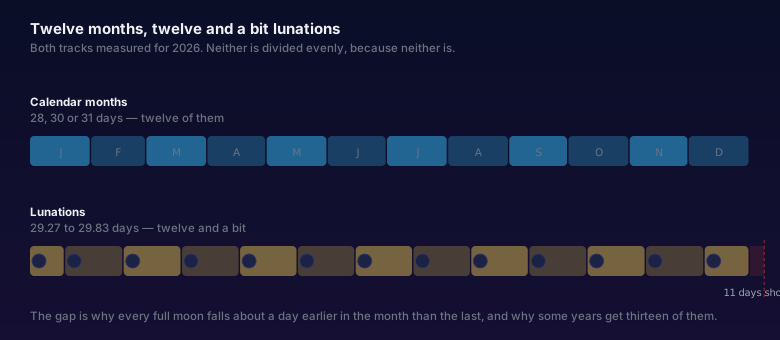
This is also why every calendar reform in history has had to choose. The Islamic calendar keeps the lunar month and lets the year drift through the seasons. The Gregorian calendar keeps the seasons and abandons the Moon entirely. The Hebrew and traditional Chinese calendars split the difference and insert a leap month. Nobody has found a fourth option, because the two cycles are not commensurable.
The four events every moon phase calendar is built from
Four instants define the cycle, and everything else on the page is interpolation between them. Each is the moment the Moon reaches an exact angle from the Sun, so each has a time rather than a date — and each of the four means something different, both to an observer and to the traditions that track them.
New Moon
The new moon is the Moon and Sun at the same ecliptic longitude. The Moon is invisible: it rises and sets with the Sun and its lit face is turned away from us. This is the darkest sky of the month, which is why observers plan deep-sky nights around it, and it is where most lunar traditions place the start of the cycle.
First Quarter
First quarter is the Moon 90° ahead of the Sun, half its disc lit, rising around midday and setting near midnight. It is the best moon for looking at through anything: the low sunlight along the terminator throws crater shadows that a full moon flattens out completely.
Full Moon
Full moon is the Moon opposite the Sun, rising as the Sun sets and visible all night. It is the only one of the four that can be eclipsed, because it is the only one where the Moon passes behind us relative to the Sun — and it does so about twice a year, when the alignment is close enough to the lunar nodes.
Last Quarter
Last quarter is the mirror of first quarter, 270° from the Sun, rising around midnight and highest at dawn. It is the phase most people have seen without noticing: the pale half-moon still hanging in a blue morning sky on the way to work.
The gaps between them are not equal. A quarter-to-quarter interval runs anywhere from about 6.6 to 8.2 days, because the Moon's orbit is an ellipse and it travels faster when it is closer to us. A calendar that spaces them evenly is drawing the idea of a lunation rather than the real one.
2026 at a glance
Every instant is shown in your own timezone by default, with a toggle to UTC if you want to compare against a published almanac. This is not a cosmetic setting. A full moon at 04:19 UTC is the 28th in Berlin and the 27th in Los Angeles — the same moment, two calendar dates — and a calendar that publishes one zone for everyone is simply wrong for most of its readers.
January
- Wolf Moon
- New moon
February
- Snow Moon
- New moon
March
- Worm Moon
- New moon
April
- Pink Moon
- New moon
May
- Flower Moon
- New moon
- Blue Moon
June
- New moon
- Strawberry Moon
July
- New moon
- Buck Moon
August
- New moon
- Sturgeon Moon
September
- New moon
- Harvest Moon
October
- New moon
- Hunter's Moon
November
- New moon
- Beaver Moon
December
- New moon
- Cold Moon
How to read this moon phase calendar
The sign and degree give the Moon's position along the zodiac at that instant. Because the Moon covers about 13.2° a day, the degree is meaningful: a full moon at 2° of a sign and one at 28° are nearly a month apart in the cycle they belong to.
The name column applies to full moons only. New moons have never carried folk names in the traditions these come from, and inventing some to fill the column would be padding. An em dash is the honest entry.
Eclipses are flagged on the full moon that carries them rather than kept in a separate list, so a row and its eclipse can never disagree about a date. Penumbral eclipses are omitted here — they are real, and the eclipse calendar lists them for that reason, but a flag on a full moon nobody can see any difference in teaches you to distrust the flag on the ones you can.
One column deliberately absent is moonrise and moonset. Those depend on your latitude and longitude rather than only on the instant, so publishing a single pair of times would be wrong for almost everyone reading. Every number on these pages is either the same for the whole planet or explicitly localised, and there is no third category.
| Date | Phase | Name | Sign | Note | |
|---|---|---|---|---|---|
| Full moon | Wolf Moon | 13.0° Cancer | |||
| New moon | — | 28.7° Capricorn | |||
| Full moon | Snow Moon | 13.1° Leo | |||
| New moon | — | 28.8° Aquarius | |||
| Full moon | Worm Moon | 12.9° Virgo | Total lunar eclipse (100%) | ||
| New moon | — | 28.5° Pisces | |||
| Full moon | Pink Moon | 12.4° Libra | |||
| New moon | — | 27.5° Aries | |||
| Full moon | Flower Moon | 11.4° Scorpio | |||
| New moon | — | 26.0° Taurus | |||
| Full moon | Blue Moon | 9.9° Sagittarius | Blue Moon | ||
| New moon | — | 24.1° Gemini | |||
| Full moon | Strawberry Moon | 8.3° Capricorn | |||
| New moon | — | 22.0° Cancer | |||
| Full moon | Buck Moon | 6.5° Aquarius | |||
| New moon | — | 20.0° Leo | |||
| Full moon | Sturgeon Moon | 4.9° Pisces | Partial lunar eclipse (97%) | ||
| New moon | — | 18.4° Virgo | |||
| Full moon | Harvest Moon | 3.6° Aries | |||
| New moon | — | 17.4° Libra | |||
| Full moon | Hunter's Moon | 2.8° Taurus | |||
| New moon | — | 16.9° Scorpio | |||
| Full moon | Beaver Moon | 2.3° Gemini | |||
| New moon | — | 17.0° Sagittarius | |||
| Full moon | Cold Moon | 2.2° Cancer |
Times shown in UTC
The rest of the moon pages
This hub is the top of a small cluster. If you want tonight's phase rather than a schedule, the today page answers it live. If you only care about one kind of event, the full moon and new moon calendars are the same data filtered down, with more room for what makes each one interesting.
Three other moon tools on this site sit on the same topic and are worth knowing about: the moon sign calculator for your own birth Moon, the lunar return chart for the Moon's monthly return to its birth position, and the moon phase compatibility test.
The division between them is intentional. A page that tried to be tonight's phase, a full year's schedule and a birth-data calculator at once would do all three badly and rank for none of them. Each page here answers one question completely and links to the others rather than absorbing them.
Frequently asked questions
Is this moon phase calendar free?
Yes — no signup, no email gate and no limit. These are public astronomical facts computed from an open ephemeris. What this site charges for is the AI interpretation of a birth chart, which is a different product.
How many full moons are there in a year?
Twelve in most years and thirteen in some, because 12 lunations take 354 days and a year is 365. The extra one accumulates every two or three years. When two full moons fall in the same calendar month, the second is called a Blue Moon.
Which years have thirteen full moons?
It depends on where the first full moon of the year falls. If one lands in the first days of January, there is room for a thirteenth by December. Within the span this calendar covers, 2026 is such a year — with two full moons in May, the second of them a Blue Moon.
Which timezone does this moon phase calendar use?
Yours, resolved in your browser. There is a toggle for UTC if you want to compare against an almanac that publishes it. The underlying instants are identical either way — only the label changes.
What is a Blue Moon?
The second full moon in a calendar month, under the modern definition. An older seasonal definition — the third full moon in a season containing four — gives different dates. This calendar uses the month-based one, because it is what every calendar you might compare against uses.
How accurate are these dates?
The quarter instants are located by search over the ephemeris and are stable to well under a minute. As a cross-check, the 28 August 2026 full moon computes here to 04:19 UTC, which is the Farmers' Almanac's 12:19 a.m. EDT.
Why does this moon phase calendar show zodiac signs?
Because the Moon's position along the ecliptic is the same measurement either way, and dividing it into twelve signs costs nothing extra. Astronomy calendars omit it by convention and astrology calendars usually round the date to a day; there is no reason a reader should have to choose.
Why does this calendar disagree with my printed almanac?
Check the timezone first — that accounts for nearly all differences, and a date can shift by a full day between zones. After that, check whether the almanac assigns folk names by month; Harvest and Hunter's Moon are defined by the September equinox rather than by a month, so month-based tables get them wrong in some years.
Why does the calendar only run from 2020 to 2035?
A fixed published span rather than a rolling window, so that the pages that exist and the URLs that resolve can never disagree. Extending it is a deliberate change rather than a side effect of the date.
Related pages
Calculated live from the ephemeris. Page rebuilt daily.