Fire
Destruction and clearing at once, which is why it reads well and badly at the same time.
What dreaming about Fire usually means
Fire is the symbol with the most genuinely double reading on this list, and unusually the traditions agree about the doubleness rather than splitting over it: it destroys and it clears, and which one a given dream is about is not decidable from the image. That makes it one of the few symbols where the accompanying detail is not optional — what was burning, whether it was spreading, and whether anyone was trying to stop it. A controlled fire and a spreading one are reported as different dreams with different attachments, and a dictionary entry that reads "fire means transformation" is technically defensible and practically useless, because it applies equally to both. The detail people most often remember and most often fail to record is heat: whether the fire was felt or only seen. A detail the traditions rarely mention and the accounts return to constantly: fire dreams are disproportionately reported as silent. People describe watching flames with no sound at all, which is not how fire behaves, and the silence is frequently the thing they remember most clearly. It tends to accompany the watching versions rather than the ones with heat in them, and it is worth recording, because it marks the difference between a situation observed and a situation inhabited.
Common variations
A house on fire
Combines the two most structurally loaded symbols here, and the combination is the reading: the house is consistently read as the self or the household, so fire in it lands differently from fire outdoors. What people remember is whether anyone was inside.
Being burned
The most physical version and the one with the sharpest waking. The readings attach to a cost already incurred rather than to a threat approaching, and the accounts frequently locate the burn on a specific part of the body, which is the detail worth keeping.
Watching it spread
The version with no agency and the one reported as most distressing over time. It attaches to situations getting worse in a way you can see and cannot affect. Whether you raised the alarm is the detail that separates the accounts.
Putting it out
Agency restored, and one of the few actively favourable dream events in this vocabulary. The readings attach to something contained in time, and people who keep records sometimes find this version arriving after a run of the spreading one.
Smoke with no fire visible
A distinct and common version, and the one that separates a warning from an event. Something is burning and cannot be located, which attaches to situations where the evidence of a problem is clear and its source is not. The accounts frequently involve searching, and the tone is closer to unease than to fear.
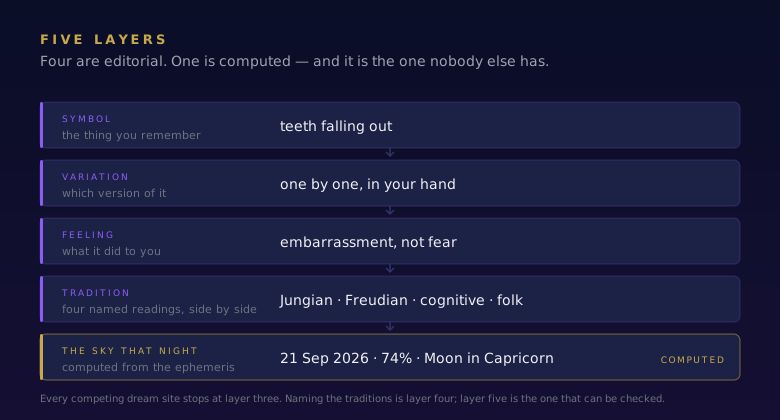
Four ways this is read
The Jungian reading
Treats the image as belonging to a shared vocabulary rather than a personal one, and asks what the image does rather than what it reminds you of. On this account the figures in a dream are closer to characters in a story everybody already knows than to coded references to your own week.
Reads fire as the transforming element in the strict sense: it does not remove a thing, it changes its state. The tradition points at the frequency with which fire appears at turning points in myth and ritual rather than at moments of loss, and reads a burning dream as the end of a form rather than of a substance.
The Freudian reading
Treats the image as a disguise and asks what it is standing in for. It is the most parodied of the four and it produced one durable observation worth keeping: the feeling in a dream is often attached to something other than the thing the dream appears to be about.
Attached fire to particular impulses and to childhood in ways that were specific to the period and have not lasted well. The remaining general point is that fire in a dream is often accompanied by a bodily sensation, and sensations during sleep get written into the narrative rather than the other way round.
The cognitive or continuity reading
The one closest to current sleep science. It holds that dreams continue waking concerns rather than encoding messages, so the useful question is never "what does it mean" but "what in my week does this resemble". It is also the reading that explains recurrence most simply: an unresolved situation keeps producing similar material.
Notes the dream rises after anything that made fire salient — a news event, an alarm, a genuine scare — and otherwise asks what in the current situation is both destroying and clearing, which is a narrower question than it sounds and usually has an answer.
The folk tradition
The oldest layer, and the one with the least explanation attached. Its readings vary sharply between cultures, which is itself informative — a symbol read the same way everywhere is behaving differently from one that is not.
Split down the middle, and in a way that is easy to reconstruct. Where fire was the hearth it reads as home, warmth and continuity; where it was the thing that took the village it reads as disaster. Both readings are recorded in the same regions, sometimes in the same source, which is the clearest illustration on this list of a symbol whose meaning depends on which aspect of the thing the reader had in mind.
How this one is usually misread
The standard entry is "fire means transformation", which is true, applies to every instance, and therefore identifies none of them. It is the flattest reading available and it obscures the fact that the traditions agree fire is double rather than singular — destroying and clearing at once — so that the useful question is always which of the two this dream was about. The second habit worth breaking is reading a burning dream as a warning about fire. It is the same predictive error as the car crash, kept alive the same way, and no tradition that has thought about the symbol makes the claim.
The feeling matters more than the image
Fire produces the widest split in reported tone of any symbol here: terror and a kind of fascination are both extremely common, and a meaningful number of accounts describe both in the same dream. That combination is itself informative and attaches to situations the dreamer has mixed feelings about ending. The detail most worth recording is whether the heat was felt. A fire that was only seen is reported as a different experience from one that was felt on the skin, and the second attaches far more often to something the dreamer is actually inside rather than watching.
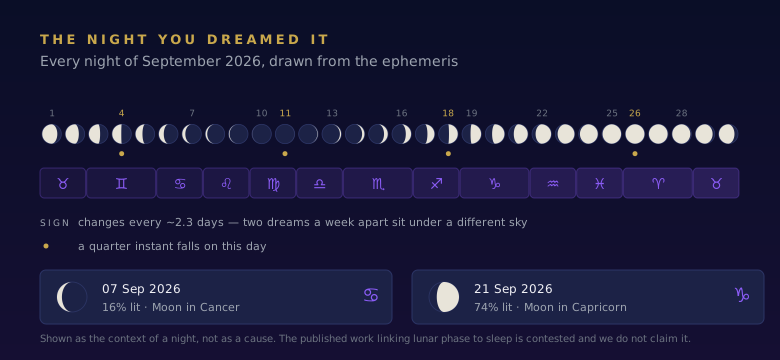
The Moon on the night you dreamed it
The one thing on this page that can be verified. Enter the night you went to sleep and you get the phase, the illuminated fraction and the sign the Moon held in the small hours, computed rather than asserted. It is context, not a cause — the published research on the Moon and sleep is contested, and the page on it says so.
Related symbols
These are descriptions of how a symbol is commonly read, never statements about you, and nothing here is medical or psychological advice.