Free Transit Chart Calculator
See exactly which planets are moving through your birth chart right now — with the precise dates each transit starts, peaks and ends.
Why Timing Matters More Than Your Birth Chart
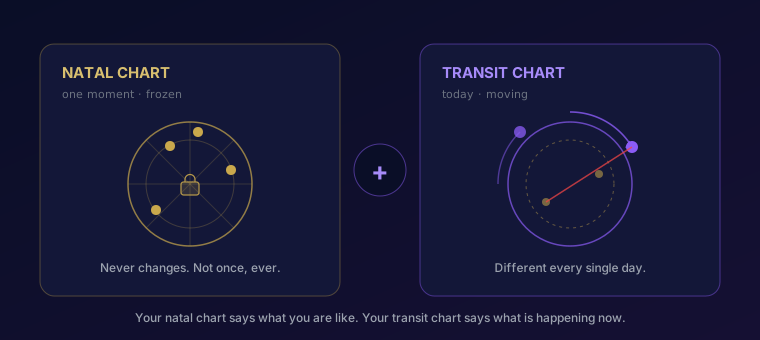
Your natal chart tells you what you are like. Your transit chart tells you what is happening to you now — and unlike the natal chart, it is different every single day.
Most people who get into astrology stop at the static half. They learn their Sun, Moon and rising, read a few descriptions that feel accurate, and never go further. That is understandable, because the natal chart is the foundation of everything else. But it also means they are reading a map and ignoring the weather.
Transits are the weather. A transit is simply a planet, moving right now through the actual sky, forming a geometric relationship with a planet that was frozen in place at the moment you were born. Nothing mystical is required to accept the mechanics: the positions are astronomy, computed from an ephemeris, and any two calculators that are working correctly will agree on them to within a fraction of a degree.
The problem is volume. We measured it: one birth chart, over one year, produces 327 distinct transit windows. If a tool hands you all 327 — and most of them do, in the form of an endless aspect list — you have not been given information. You have been given a wall of dates.
Worse, most of those 327 are meaningless. The Sun travels the whole zodiac every year, so it necessarily forms every possible aspect to every planet in your chart, every year, without exception. A Sun transit tells you almost nothing you could plan around. Saturn conjunct your natal Sun, by contrast, happens once or twice in an entire lifetime. Both appear in the same undifferentiated list on most sites. That is the actual problem this calculator is built to solve.
What Is a Transit Chart?
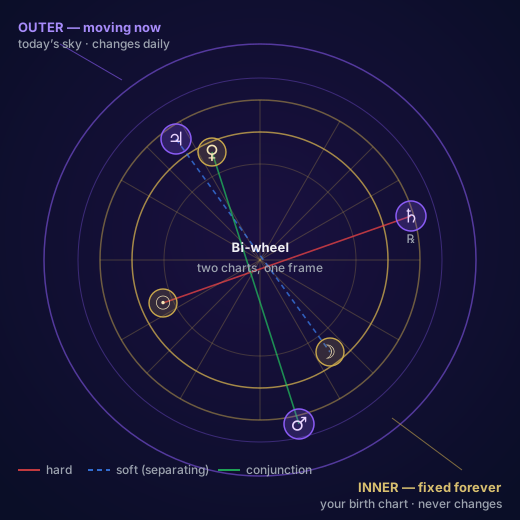
A transit chart is a two-ring chart that places the planets' current positions around the outside of your fixed birth chart, showing which parts of your natal chart the moving sky is touching right now.
The inner ring is your natal chart. It was set at the moment of your birth and it will never change — not with age, not with a house move, not ever. Every planet in it stays at the exact degree it occupied when you were born.
The outer ring is today. It holds the same planets, but at the positions they occupy in the sky at the moment you are looking. Come back tomorrow and the outer ring will have moved; the inner ring will not have. Drag the time ribbon on this page and you can watch exactly that happen.
What you are reading, then, is the relationship between the two rings. When an astrologer says "transiting Saturn is square your natal Sun", they mean: Saturn, in the sky today, is sitting 90 degrees away from the spot where the Sun was when you were born. That is the whole sentence. The lines drawn across the middle of the wheel are those relationships, and they are the only lines on this chart that describe you — which is why this calculator draws transit-to-natal aspects and deliberately suppresses transit-to-transit ones. Those describe the sky in general, not your chart, and on a page about you they are noise.
How to Read Your Transit Chart in 5 Steps
You do not need to interpret all 327. You need a reading order, and this is the one working astrologers use.
- 1
Find the outer ring — that is today's sky
Start by orienting yourself. The violet glyphs on the outside are transiting planets. The gold glyphs inside are yours. If you only ever remember one thing about bi-wheels, make it this: outside moves, inside does not.
- 2
Read the slow planets first
Go straight to Saturn, Uranus, Neptune and Pluto. These take years to cross a single sign, so when one of them contacts a natal planet the effect is measured in months or years, and it defines the period. Jupiter is next at roughly a year per sign. Only after those should you look at Mars, Venus, Mercury, the Sun and the Moon — they colour a week, not a year.
- 3
Note which natal house each transiting planet is in
The house tells you the area of life the transit is operating in: work, home, relationships, money, and so on. This is why an accurate birth time matters. If yours is unknown, this calculator hides house placements entirely rather than deriving them from a noon guess — a house pinned to an arbitrary cusp would date a real event to the wrong part of your life.
- 4
Read aspects between the rings, not within them
A square between two transiting planets is happening to everybody alive today. A square from a transiting planet to one of your natal planets is happening to you. Only the second kind is on this chart, and every one of them is listed with the exact orb.
- 5
Check the orb, and whether it is applying
The orb is how far the aspect is from exact. Under about one degree, a transit is at full strength. An applying aspect is still tightening and the theme is building; a separating one has already peaked and is fading. Two transits with the same name can mean opposite things depending on which side of exact they sit.
Pro tip: if you do not know your birth time, you can still use this tool. Everything driven by longitude — every aspect on the page — stays accurate. Only houses are affected, and we hide those rather than fake them.
What You Can Do With Your Transit Chart
Four things people actually use this for, as opposed to four things that sound good in marketing copy.
Choose when to act, not whether to
The most practical use is picking a month. If you are going to renegotiate a salary, launch something, or have a difficult conversation, the transit chart tells you when the relevant part of your chart is active and when it is quiet. It does not tell you what will happen — nobody can — but timing your own move is a decision you control.
Understand a period that already felt hard
Set the date backwards. A stretch that made no sense at the time often turns out to line up with a slow outer-planet transit you were not aware of. This is the single most convincing use of transits for a sceptic, because it can be checked against something that already happened rather than something predicted.
Find out whether Mercury retrograde touches you at all
Mercury goes retrograde three or four times a year for everyone. Whether it means anything for you depends on which degrees it crosses and what you have sitting there. Frequently the answer is that it does not touch your chart at all, which is worth knowing before you postpone anything.
See a once-in-a-lifetime transit coming
Outer-planet contacts to your natal Sun, Moon or angles happen a handful of times in a life. They are also the only transits far enough out to actually plan around. Push the time ribbon forward and they are visible months before they arrive.
Transit Chart vs Natal Chart vs Solar Return
These three answer the same underlying question — what is going on with me — at three different resolutions. They are complements, not competitors.
| What it is | Natal chart | Transit chart | Solar return |
|---|---|---|---|
| What it shows | Who you are | What is happening now | The theme of one year |
| How often it changes | Never | Every day | Once a year, on your birthday |
| Time horizon | A lifetime | Days to years | Birthday to birthday |
| Needs exact birth time | For houses | For houses only | Yes |
| Best for | Understanding yourself | Deciding when to act | Planning a year |
A transit chart is meaningless on its own. It is measured against your natal chart, so if you have not looked at your birth chart yet, start there — the transit chart is a second layer on top of it, not a replacement for it.
The solar return sits between the two: it is a chart cast for the moment the Sun returns to its natal position each year, and it describes the year as a whole. Many people find the natural workflow is to read the solar return once a year for the shape of it, then use transits through the year for timing.
How to Turn Transits Into Dates You Can Plan Around
This is where a transit chart stops being a diagram and starts being useful, and it is the part almost no calculator does.
Ranking by rarity
327 windows in a year is not a decision aid. The fix is not to show fewer transits at random — it is to order them by how rare they are, which is essentially orbital period. A transit you will see again next year is not worth rearranging your life around. One that recurs every 29 years is. Ranked that way, roughly twenty windows a year are worth your attention, and the rest is background.
A triple pass is one event, not three
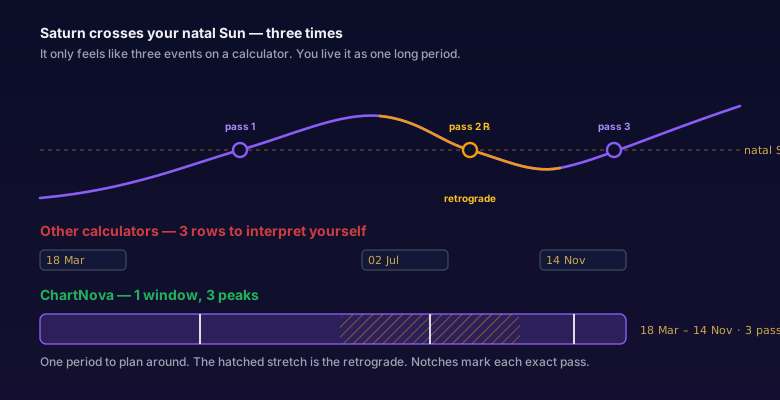
When a slow planet stations retrograde it can cross the same degree three times over several months — forward, back, then forward again. Technically these are three separate crossings, and most tools list them as three separate events on three separate dates. Nobody experiences it that way. It is one long period with three intensity peaks, and it should be presented as one.
Advice that names its source
Every window we show is labelled with the placement that produced it — "Saturn square your natal Sun", not "a challenging period". That is not decoration. It means you can check the claim against the data table on the same page, and checkability is the entire argument for using a calculator over asking a chatbot. We follow two rules on the wording: we describe the timing of your own actions and never predict events, and we write nothing that cannot be traced back to the placement shown next to it. Where we do not yet have a rule for a window, it shows its dates and its source and nothing else. A blank is better than filler.
Free transit chart with interpretation
The complete transit chart on this page is free, permanently, including every position, every aspect and every orb. A Pro subscription adds the full ranked list of dated windows for the year ahead and an AI reading written against those computed dates — never dates the model invented.
See what Pro includesWhat to Do Next
Start with the slowest transiting planet on your list — that is the one shaping this period of your life. Then read your solar return chart for the year-level picture, since transits and the solar return answer the same question at different resolutions.
See what your year actually looks like
Your transit chart is free and always will be. Pro adds the ranked list of dated windows and a reading written against real computed dates.