Hair falling out
Exposure and ageing; the loss is public in a way tooth loss is not.
2,300 searches a month in United Kingdom, per Google Trends UK, Sep 2026.
What dreaming about Hair falling out usually means
Hair loss sits close to tooth loss in the readings — both are the body shedding something that was supposed to stay — but it separates on one point that runs through every account: hair is public. Teeth can be hidden by not smiling; hair cannot, and the dreams reflect it. Reports of this dream are far more likely than tooth dreams to involve other people noticing, and the readings attach to exposure and to being seen ageing rather than to loss of control. It is also a symbol with a real physical counterpart that matters for how you read it: people experiencing actual hair loss report the dream more often, and in that case the dream is continuing a waking concern in the plainest possible way and needs no further reading. Where there is no waking counterpart, the accounts cluster around situations involving visibility — a new role, a return to something after an absence, a period of being assessed by others.
Common variations
Hair coming out in handfuls
The most reported version and the most physical: the detail people remember is the weight of it in the hand. Readings attach to something being lost faster than it can be accounted for, and the accounts often mention trying to hide it, which is the part worth noting.
Hair turning grey or white
Not loss but change, and read differently. The accounts attach to time passing visibly rather than to anything being taken, and a meaningful share describe it as neutral or even welcome, which separates it from the rest of this symbol.
Someone else cutting your hair
Agency changes it entirely, as with being pushed rather than slipping. This version has an old and consistent reading around loss of strength imposed by another, and the accounts follow whoever held the scissors more than the hair.
Finding bald patches
Discovery rather than event: the loss has already happened and is being found. The accounts attach to situations noticed late, and the detail people remember is usually whether anyone else had seen it first.
Four ways this is read
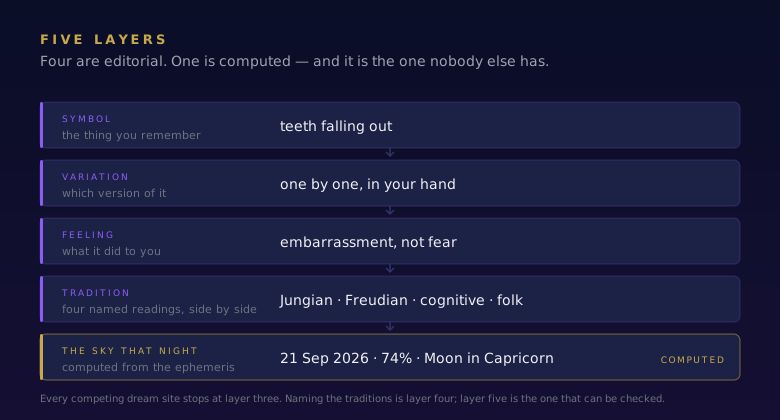
The Jungian reading
Treats the image as belonging to a shared vocabulary rather than a personal one, and asks what the image does rather than what it reminds you of. On this account the figures in a dream are closer to characters in a story everybody already knows than to coded references to your own week.
Reads hair as an attribute rather than a part — something displayed rather than used — and its loss as a change in how one is presented to the world rather than in what one can do. The tradition points at the length of the recorded association between hair and strength across unrelated cultures as the reason the image carries more weight than its practical importance would suggest.
The Freudian reading
Treats the image as a disguise and asks what it is standing in for. It is the most parodied of the four and it produced one durable observation worth keeping: the feeling in a dream is often attached to something other than the thing the dream appears to be about.
Read hair loss in the same family as other loss-of-potency images and attached specific readings that have not held up. What remains useful is the general point it shares with the tooth dream: the distress is genuine and its object in the dream is usually not its object in life.
The cognitive or continuity reading
The one closest to current sleep science. It holds that dreams continue waking concerns rather than encoding messages, so the useful question is never "what does it mean" but "what in my week does this resemble". It is also the reading that explains recurrence most simply: an unresolved situation keeps producing similar material.
Has the most direct account here. The dream is substantially more common among people actually losing hair, among those under sustained pressure, and during periods of being looked at — and in each case it continues a waking concern rather than encoding one. Where none of those applies, the useful question is what in the past week involved being seen.
The folk tradition
The oldest layer, and the one with the least explanation attached. Its readings vary sharply between cultures, which is itself informative — a symbol read the same way everywhere is behaving differently from one that is not.
Widely recorded and mostly unfavourable: loss of strength, loss of standing, or in some traditions the loss of a relative. The Samson story is the best-known instance of the strength association and is old enough to show that the connection predates any of the analytic traditions by a long way.
How this one is usually misread
Because this symbol sits so close to tooth loss, it tends to inherit tooth loss’s entries, and that flattens the one thing that separates them. Hair is public and teeth are not, and the accounts differ accordingly — shame rather than alarm, other people noticing rather than a private discovery. A dictionary that gives both the same reading has merged two symbols that behave differently. The other thing routinely left out is the obvious one: people actually losing hair report this dream far more often, and in that case it is continuing a waking concern in the plainest way available and there is nothing further to interpret.
The feeling matters more than the image
Shame is the tone reported far more often for this symbol than for tooth loss, and that difference is the most informative thing about it. Where the dream is frightening it tends to attach to a change arriving; where it is shameful it attaches to being seen, and the two point at quite different circumstances. The second detail worth recording is whether anyone else was present. A private discovery and a public one are reported as different dreams, and since this is the symbol whose whole character turns on visibility, the presence or absence of an audience carries more of the reading than the hair does.
This one is felt, not only seen
People report this dream partly as a bodily sensation rather than an image — which is why it is remembered vividly and why it is hard to describe afterwards. The sensation is worth noting alongside the content when you write it down, because it is usually the part that changes between one instance and the next.
The Moon on the night you dreamed it
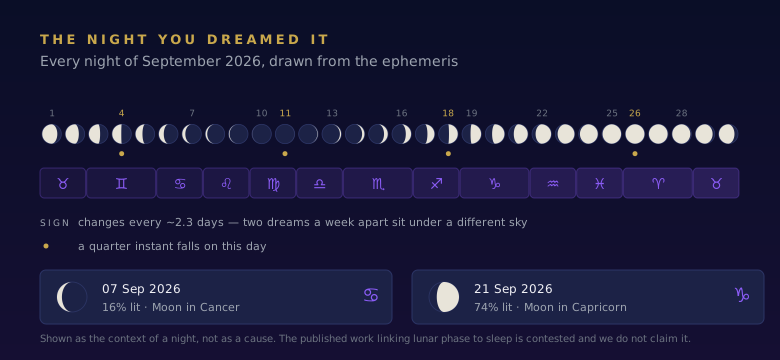
The one thing on this page that can be verified. Enter the night you went to sleep and you get the phase, the illuminated fraction and the sign the Moon held in the small hours, computed rather than asserted. It is context, not a cause — the published research on the Moon and sleep is contested, and the page on it says so.
Related symbols
These are descriptions of how a symbol is commonly read, never statements about you, and nothing here is medical or psychological advice.