Falling
Support giving way, and the moment before impact rather than the impact.
What dreaming about Falling usually means
Falling is reported nearly as often as being chased, and it is unusual in that a large share of instances have a physical explanation that does not require the image to mean anything. The hypnic jerk — the sudden whole-body twitch as sleep begins — is extremely common, and the sensation of falling is frequently the narrative the mind attaches to it a moment later. That accounts for a substantial number of falling dreams, particularly the short ones that occur just after lying down. The rest are harder to dismiss, and the readings around them are consistent: support giving way. What is almost never reported is the landing. The dream tends to end before impact, and the accounts people give emphasise the interval rather than the conclusion — which is the feature most worth attending to, because it describes a situation rather than an outcome.
Common variations
Waking the moment you land
The common version, and most often the hypnic jerk arriving with a story attached. If it happens shortly after going to bed rather than in the small hours, that is the likeliest account and it needs no interpretation.
Falling from a specific height
When the place is identified — a building, a cliff, a staircase — the reports attach to it more than to the fall. The detail that recurs is whether you were standing somewhere you had a right to be, which is the part that tends to map onto a situation.
Falling with no ground below
A distinct version and the one people describe as the worst. Without a destination the dream has no structure, which is exactly how it is reported: not frightening in a sharp way, but unending. The accounts attach to circumstances without a visible end rather than to threats.
Being pushed rather than slipping
Agency changes the dream completely. A slip is about footing; a push is about a person, and the readings follow whoever did it. This version is reported far less often than the others and is much more likely to be remembered in detail.
Four ways this is read
The Jungian reading
Treats the image as belonging to a shared vocabulary rather than a personal one, and asks what the image does rather than what it reminds you of. On this account the figures in a dream are closer to characters in a story everybody already knows than to coded references to your own week.
Reads the fall as a descent image, which in the shared repertoire is not primarily about failure — descent is the shape of a great many myths in which something is retrieved from below. The tradition tends to read a falling dream as a movement away from a position that had become too fixed, which is a friendlier reading than the symbol usually gets.
The Freudian reading
Treats the image as a disguise and asks what it is standing in for. It is the most parodied of the four and it produced one durable observation worth keeping: the feeling in a dream is often attached to something other than the thing the dream appears to be about.
Connected falling dreams to a loss of control over something being held in, and read the sensation as the body reporting on a state of mind rather than the other way round. The tradition is on firmer ground here than usual, because the physical component of this dream is genuinely large.
The cognitive or continuity reading
The one closest to current sleep science. It holds that dreams continue waking concerns rather than encoding messages, so the useful question is never "what does it mean" but "what in my week does this resemble". It is also the reading that explains recurrence most simply: an unresolved situation keeps producing similar material.
The strongest account for this particular symbol. The hypnic jerk is well documented, it occurs at sleep onset, and it produces exactly the sensation the dream describes; the narrative arrives afterwards as an explanation. For falling dreams in the small hours the continuity reading applies as usual, and it asks what support has been withdrawn rather than what the fall represents.
The folk tradition
The oldest layer, and the one with the least explanation attached. Its readings vary sharply between cultures, which is itself informative — a symbol read the same way everywhere is behaving differently from one that is not.
Carries the most widely repeated and most clearly false claim in the whole category: that dying in a fall in a dream means dying in life. People do reach the ground and wake up, and they report it. The belief is worth naming because it is encountered and it frightens people, not because it deserves any weight.
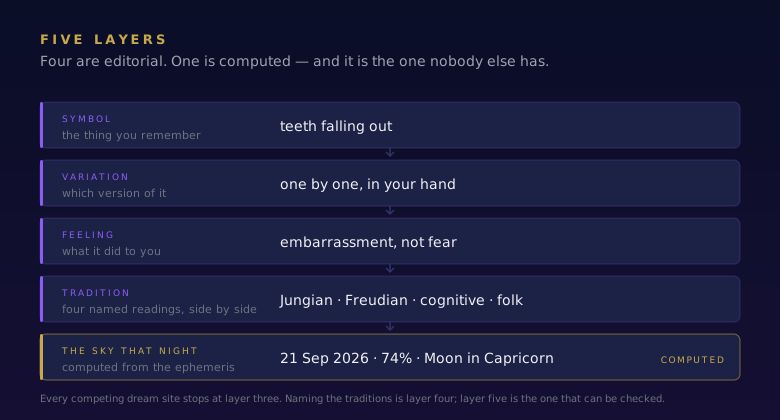
How this one is usually misread
The misreading in widest circulation is that hitting the ground in a falling dream means dying in your sleep. It is false in the simplest possible way: people land, wake up, and report it, which is how anyone knows the dream continues past impact at all. It survives because the dream usually ends before the landing, so the absence of accounts gets read as evidence rather than as a feature of when people wake. The subtler error is treating every falling dream as meaningful. A large share are hypnic jerks — a whole-body twitch at sleep onset, with a story attached a second later — and those carry no more information than a sneeze.
The feeling matters more than the image
The distinction that separates two genuinely different dreams is whether the fall was frightening or, as a minority consistently report, exhilarating. The second reads much closer to flying and attaches to quite different situations — often to something being let go of deliberately. Also worth recording is when in the night it happened, which is not a feature of any other symbol on this list. A fall in the first few minutes of sleep is most likely a hypnic jerk with a story attached and carries no information; the same dream at four in the morning, in the middle of a REM period, is a different event and is the one worth writing down.
This one is felt, not only seen
People report this dream partly as a bodily sensation rather than an image — which is why it is remembered vividly and why it is hard to describe afterwards. The sensation is worth noting alongside the content when you write it down, because it is usually the part that changes between one instance and the next.
If it keeps coming back
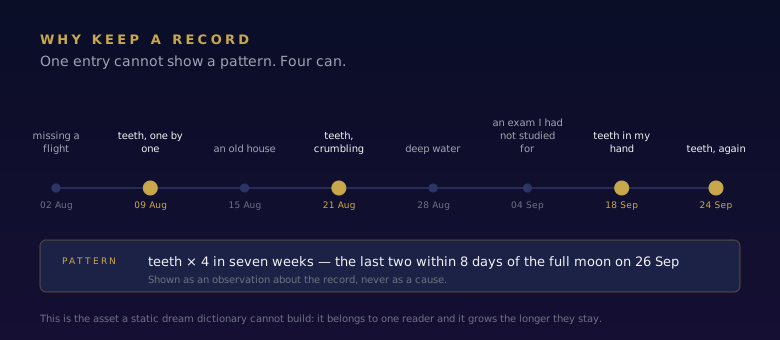
This is one of the symbols most often reported as recurring. The recurrence is more informative than the content: a single instance is an image, and eleven over two years is a pattern that can be checked against your life. The continuity account predicts something testable — recurring dreams tend to stop or change when the circumstances around them change — and people who keep records report exactly that.
The Moon on the night you dreamed it
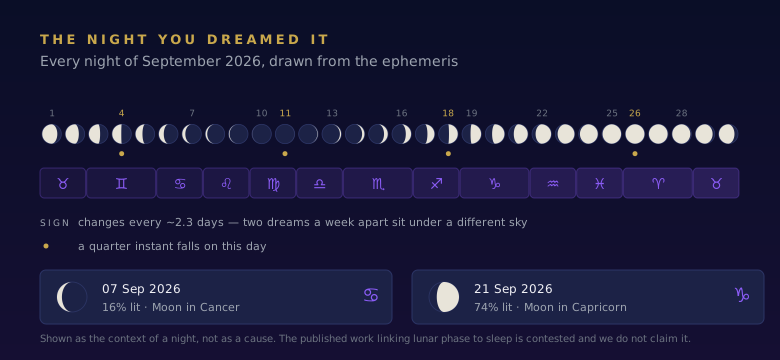
The one thing on this page that can be verified. Enter the night you went to sleep and you get the phase, the illuminated fraction and the sign the Moon held in the small hours, computed rather than asserted. It is context, not a cause — the published research on the Moon and sleep is contested, and the page on it says so.
Related symbols
These are descriptions of how a symbol is commonly read, never statements about you, and nothing here is medical or psychological advice.