Solar Eclipse Calendar
Every solar eclipse from 2024 to 2030, computed to the minute and shown in your own timezone, with the zodiac degree each one falls on and how much of the Sun is covered at greatest eclipse.
The next solar eclipse
Annular · 17.6° Aquarius
Every solar eclipse from 2024 to 2030
16 solar eclipses across the span: 5 total, 5 annular and 6 partial.
| Instant | Type | Degree | Node gap | Covered |
|---|---|---|---|---|
| Solar · Total | 19.4° Aries | 3.8° | 100% | |
| Solar · Annular | 10.1° Libra | 3.8° | 87% | |
| Solar · Partial | 9.0° Aries | 12.1° | — | |
| Solar · Partial | 29.1° Virgo | 11.6° | — | |
| Solar · Annular | 28.8° Aquarius | 10.8° | 93% | |
| Solar · Total | 20.0° Leo | 10.3° | 100% | |
| Solar · Annular | 17.6° Aquarius | 3.3° | 86% | |
| Solar · Total | 9.9° Leo | 1.6° | 100% | |
| Solar · Annular | 6.2° Aquarius | 4.0° | 85% | |
| Solar · Total | 29.8° Cancer | 7.1° | 100% | |
| Solar · Partial | 24.8° Capricorn | 11.4° | — | |
| Solar · Partial | 21.5° Gemini | 14.0° | — | |
| Solar · Partial | 19.6° Cancer | 15.6° | — | |
| Solar · Partial | 13.8° Sagittarius | 12.4° | — | |
| Solar · Annular | 10.8° Gemini | 6.0° | 89% | |
| Solar · Total | 3.0° Sagittarius | 4.4° | 100% |
Solar · Total
- Degree
- 19.4° Aries
- Node gap
- 3.8°
Solar · Annular
- Degree
- 10.1° Libra
- Node gap
- 3.8°
Solar · Partial
- Degree
- 9.0° Aries
- Node gap
- 12.1°
Solar · Partial
- Degree
- 29.1° Virgo
- Node gap
- 11.6°
Solar · Annular
- Degree
- 28.8° Aquarius
- Node gap
- 10.8°
Solar · Total
- Degree
- 20.0° Leo
- Node gap
- 10.3°
Solar · Annular
- Degree
- 17.6° Aquarius
- Node gap
- 3.3°
Solar · Total
- Degree
- 9.9° Leo
- Node gap
- 1.6°
Solar · Annular
- Degree
- 6.2° Aquarius
- Node gap
- 4.0°
Solar · Total
- Degree
- 29.8° Cancer
- Node gap
- 7.1°
Solar · Partial
- Degree
- 24.8° Capricorn
- Node gap
- 11.4°
Solar · Partial
- Degree
- 21.5° Gemini
- Node gap
- 14.0°
Solar · Partial
- Degree
- 19.6° Cancer
- Node gap
- 15.6°
Solar · Partial
- Degree
- 13.8° Sagittarius
- Node gap
- 12.4°
Solar · Annular
- Degree
- 10.8° Gemini
- Node gap
- 6.0°
Solar · Total
- Degree
- 3.0° Sagittarius
- Node gap
- 4.4°
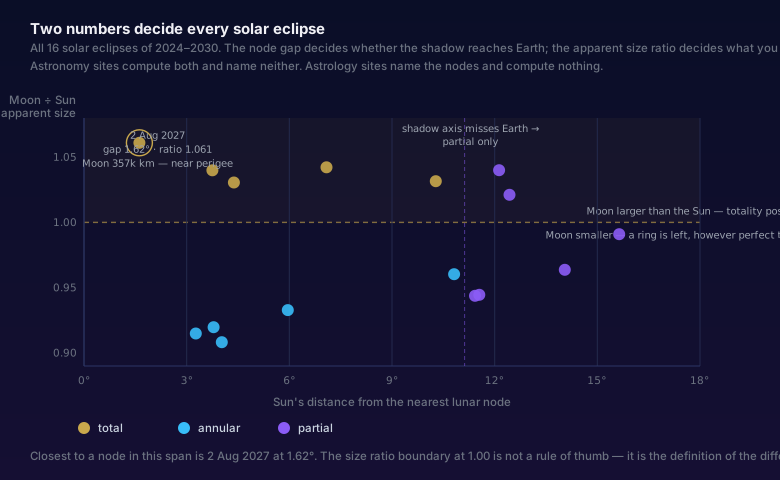
A solar eclipse comes in three kinds, and the difference is not subtle
Every solar eclipse is the Moon passing between the Earth and the Sun. What varies is whether the Moon looks big enough to cover the Sun, and whether the shadow axis actually reaches us.
In a total solar eclipse the Moon covers the disc completely. The sky darkens to something like deep twilight, the corona becomes visible, the temperature drops and bright stars appear. It lasts minutes, and only inside a band roughly a hundred kilometres wide.
In an annular solar eclipse the alignment is just as good but the Moon is further from Earth and looks slightly too small. A ring of sunlight is left around it. The sky does not darken, the corona never appears, and there is no moment when it is safe to look without a filter.
In a partial solar eclipse the shadow axis misses the Earth entirely and only the outer shadow touches us. The Sun looks bitten into. This is what most of the world sees during any solar eclipse, including the ones that are total somewhere else.
Why a total solar eclipse is rare where you live but common on Earth
There are two or three solar eclipses in a typical year, which does not sound rare at all. What is rare is standing in the right place.
The shadow is small
The Moon's shadow is small. Where it touches the Earth it makes a spot at most a couple of hundred kilometres across, and that spot sweeps a track a few thousand kilometres long before the geometry runs out. A track that size covers a tiny fraction of the surface, and most of it is ocean.
Roughly once every three or four centuries
The result is that any given place sees a total solar eclipse roughly once every three or four hundred years on average, while the Earth as a whole gets one every eighteen months. The scarcity is a fact about you, not about the phenomenon.
Why partial eclipses feel common
That asymmetry is also why partial eclipses feel so much more common. You do not have to be under the shadow axis to see one, only somewhere on the daylit side within reach of the outer shadow, and that is a large piece of the planet each time.
Where the shadow actually goes
The track of a total eclipse is drawn on maps as a smooth band, which makes it look like a road. It is closer to the mark left by a spotlight swept across a globe.
The shadow crosses faster than a jet
The shadow spot moves at over a thousand miles an hour near the middle of a track and much faster near its ends, where it strikes the Earth at a shallow angle and stretches. That is why totality lasts longest near the middle of the path and why the band widens and thins along the way.
Why so many tracks land on water
It is also why so many tracks land on water. Oceans cover most of the surface, and the shadow does not care: a great many total eclipses are seen properly only by people who put themselves on a ship or a plane, and a few are seen by nobody at all.
Distance from the centre line is what counts
Distance from the centre line matters more than distance along it. Fifty kilometres to the side costs a large fraction of the totality; a thousand kilometres further along the same line costs almost nothing. Anyone travelling aims at the line, not at the shaded band.
What actually happens during totality
The partial phases take about an hour and are, frankly, undramatic. You need a filter to see anything at all, and the light does not obviously change until the Sun is more than three quarters covered.
The last minute, when it goes fast
In the last minute the change becomes very fast. Shadows sharpen, because the light source is shrinking towards a line. Colours flatten. If the ground is pale you may see shadow bands — faint rippling stripes cast by turbulence high in the atmosphere, visible for only a few seconds and still not fully explained.
Beads of light along the Moon's edge
Then the last of the photosphere breaks into beads of light along the Moon's edge, shining through valleys on its limb. The final bead alongside the emerging corona is the diamond ring. That is the moment the filters come off, and not a second before.
Totality does not look like the photographs
Totality itself does not look like the photographs. The corona is fainter and more structured than long exposures suggest, stars come out, the horizon glows in every direction at once because you are looking at daylight beyond the shadow, and animals go quiet. Then the diamond ring appears on the other side, and the filters go straight back on.
Watching a solar eclipse safely
This is the one section on this site where getting it wrong has physical consequences, so it is stated plainly rather than in passing.
A partly eclipsed Sun is as dangerous as any other
A partially eclipsed Sun is exactly as dangerous as an ordinary one. It does not feel bright enough to warn you, because most of the disc is covered and your eyes relax, but the part still showing is unfiltered sunlight and the retina has no pain receptors. Damage is painless and can be permanent.
What you actually need: ISO 12312-2
Use eclipse glasses certified to ISO 12312-2, or a solar filter mounted on the front of any camera, phone or telescope. Sunglasses are not a filter, however dark. Exposed film, smoked glass and CDs are not filters. A filter over the eyepiece rather than the front of a telescope will crack under the concentrated heat.
The single exception, and only inside the band
The single exception is totality itself, inside the narrow band where the Sun is completely covered, and only for as long as it lasts. Look away the instant the first bead of sunlight returns. During an annular solar eclipse there is no such moment: a ring of photosphere is showing the whole time.
A solar eclipse in your own chart
Astrologically a solar eclipse is a new moon on the nodal axis, so it is read as a beginning with the volume turned up. The degree is the same for everyone; whether it touches your chart is not.
Reading the degree column against your own
The table above gives the degree of every solar eclipse in the span. Anything within a few degrees of one of your placements — or opposite it, or square to it — is a contact worth knowing about. Everything else is a spectacular astronomical event you can watch without it meaning anything in particular for you.
Check the degrees above against your own chart in one step.
Find my eclipse contactsFrequently asked questions
- When is the next solar eclipse?
- The block at the top of this page answers that for the moment you are reading it, with the exact instant in your own timezone and the degree it falls on.
- How often is there a solar eclipse?
- Two to five a year, most commonly two. They cluster into eclipse seasons about six months apart, because a solar eclipse needs the Sun to be near a lunar node and the Sun passes each node once a year.
- What decides whether a solar eclipse is total or annular?
- The Moon's apparent size. Its distance from Earth varies by about ten per cent over a month, so sometimes its disc is fractionally larger than the Sun's and sometimes fractionally smaller. Larger gives a totality; smaller leaves a ring.
- Why can I only see some of them?
- Because the Moon's shadow is small and the Earth is large. A total solar eclipse is visible from a band a hundred kilometres wide; a partial phase reaches much further, but you still have to be on the daylit side at the right moment.
- Is it ever safe to look at a solar eclipse without a filter?
- Only during totality, inside the band where the Sun is fully covered, and only while that lasts. At every other moment, and throughout an annular eclipse, you need ISO 12312-2 glasses or a certified solar filter.
- How accurate are these times?
- They are computed from the ephemeris rather than copied from another calendar, and the degrees agree to the arcminute with astrology publishers who list the same eclipses independently.
- What does a solar eclipse mean in astrology?
- It is read as an intensified new moon falling on the nodal axis, carrying a sense of beginning and of direction. What varies from person to person is whether the degree touches their own chart, which is a question a birth chart answers and a horoscope cannot.
- Is this free?
- Yes, with no signup and no limit. These are public astronomical facts. What is paid on this site is the interpretation of your own chart.
Related pages
Eclipse calendar
Solar and lunar eclipses together, with the seasons they arrive in.
Lunar eclipse calendar
The other half of every eclipse season, and safe to watch.
Solar eclipse of 2027
The 2 August 2027 totality — the longest for 87 years.
Eclipse birth chart calculator
Which of these degrees land on your own chart.