Eclipse Calendar 2026
Every solar and lunar eclipse of 2026, computed from the ephemeris to the minute and shown in your own timezone — with the degree each one falls on, which is the part most calendars leave out.
Next solar eclipse
Annular · 17.6° Aquarius
Next lunar eclipse
Penumbral · 2.0° Virgo
Every eclipse of 2026
2026 brings 2 solar and 2 lunar eclipses.
| Instant | Type | Degree | Node gap | Covered |
|---|---|---|---|---|
| Solar · Annular | 28.8° Aquarius | 10.8° | 93% | |
| Lunar · Total | 12.9° Virgo | 4.0° | 100% | |
| Solar · Total | 20.0° Leo | 10.3° | 100% | |
| Lunar · Partial | 4.9° Pisces | 5.4° | 97% |
Solar · Annular
- Degree
- 28.8° Aquarius
- Node gap
- 10.8°
Lunar · Total
- Degree
- 12.9° Virgo
- Node gap
- 4.0°
Solar · Total
- Degree
- 20.0° Leo
- Node gap
- 10.3°
Lunar · Partial
- Degree
- 4.9° Pisces
- Node gap
- 5.4°
Every eclipse of the year on one axis, with the zodiac sign each one falls in. Solar eclipses happen at a new moon, lunar ones at a full moon, and the node gap in the last column is what decides how deep each goes.
How to read this eclipse calendar
Four columns, and two of them are unusual enough to be worth a sentence each.
The instant
The instant is the moment of greatest eclipse, converted to your own timezone. It is a single moment worldwide, not a local one — what changes from place to place is what you can see from there, not when it happens.
The degree
The degree is where the eclipsed body sits in the zodiac at that instant. For a solar eclipse this is the Sun's position; for a lunar eclipse it is the Moon's, which is always exactly opposite the Sun. This is the number to compare against your own chart, and it is the column that turns an astronomy table into an astrology one.
The node gap
The node gap is how far the Sun is from the nearest lunar node. Small numbers mean a deep, central eclipse; numbers above about fifteen degrees mean no eclipse at all, which is why the column never shows one. It is the quantity astronomy sites compute without naming and astrology sites name without computing.
Covered is the fraction of the disc in shadow at maximum, for someone ideally placed. For a total eclipse it reads 100%; for a partial one it is the best anyone on Earth gets, not what you will see from your own garden.
The five things an eclipse calendar has to distinguish
Not all eclipses are the same event with a different date, and a calendar that prints only "solar" and "lunar" is hiding most of what varies between them.
- Total solar
- The Moon covers the Sun completely. Only visible from a band roughly a hundred kilometres wide, and only for a few minutes, but inside that band the sky goes dark and the corona appears.
- Annular solar
- The alignment is just as good, but the Moon is further from Earth and looks slightly too small to cover the Sun. A ring of sunlight is left around it. Never safe to look at without a filter, at any moment.
- Partial solar
- The shadow axis misses the Earth and only the outer shadow touches us, so the Sun is bitten into rather than covered. This is what most of the world sees during any solar eclipse.
- Total lunar
- The Moon passes fully into the Earth's dark shadow and usually turns a deep copper red, lit only by sunlight bent through our atmosphere. Visible from the entire night side of the planet.
- Penumbral lunar
- The Moon passes only through the faint outer shadow and dims a little. Real, listed in this eclipse calendar, and almost impossible to notice without a photograph taken before and after.
Solar and lunar eclipses are two halves of one thing
A solar eclipse is a new moon that happens to line up: the Moon passes between the Earth and the Sun and its shadow lands on us. A lunar eclipse is a full moon that lines up the other way: the Earth passes between the Sun and the Moon, and the Moon slides into our shadow.
Why a calendar never separates them
That is why an eclipse calendar never lists them separately in practice. They arrive within about a fortnight of each other, because both need the same alignment and the Sun spends roughly a month near each crossing point.
What the difference looks like
The visible difference is stark. A total solar eclipse is confined to a band a hundred kilometres wide and lasts minutes; a total lunar eclipse is visible from the entire night side of the Earth and lasts an hour or more. Solar eclipses are rarer to witness even though they are not rarer to occur.
Why eclipses come in pairs, twice a year
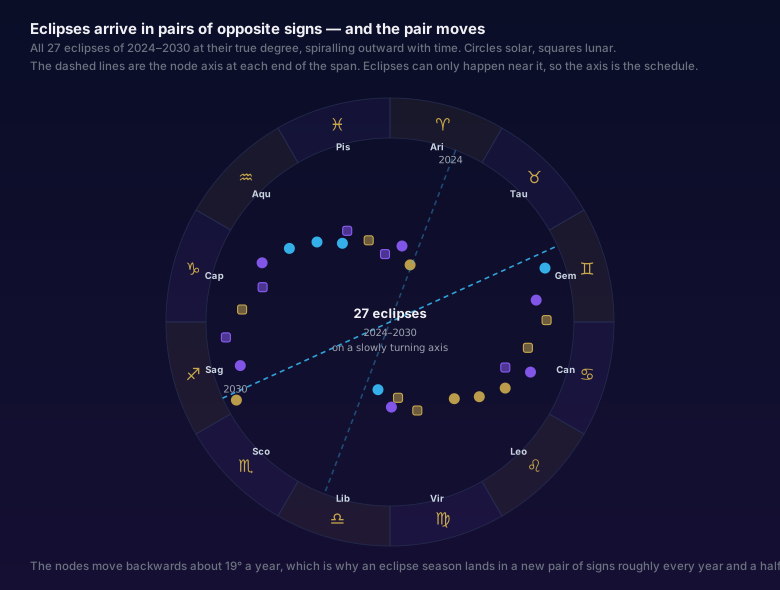
Eclipses are not scattered through the year, which is the first thing an eclipse calendar makes obvious. They cluster into eclipse seasons, roughly two per year, each about a month long, and inside a season you get a solar and a lunar eclipse a fortnight apart. Occasionally three.
The geometry behind the pairing
The reason is the same geometry that governs everything else on this eclipse calendar. The Moon's orbit is tilted about 5.1° to the plane of the Earth's orbit, and it crosses that plane at two points called the nodes. An eclipse can only happen when the Sun is near one of them, and the Sun passes each node once a year.
How long each window stays open
So the eclipse windows open twice a year and last as long as the Sun takes to move through the zone where an alignment is possible. That is why a year holds four to seven eclipses rather than twenty-four, and why they arrive in clumps rather than evenly.
How this eclipse calendar is calculated
Every instant in this eclipse calendar is computed when the page is built, using the astronomy-engine library, from the same ephemeris that produces the chart tables everywhere else on this site. No dates are copied from another calendar.
The two columns nobody else prints
Two columns are worth explaining because almost nobody prints them. The degree is the ecliptic longitude of whatever is being eclipsed — the Sun for a solar eclipse, the Moon for a lunar one — at the exact instant of maximum, not at midnight on that date. The node gap is how far the Sun sits from the nearest lunar node, and it is the single number that decides whether an alignment produces an eclipse at all.
Why times are rendered in your own zone
Times are rendered in your own timezone in your browser. The underlying instant is always the same one, which is why our dates sometimes differ by a day from a site that publishes only UTC. If you ever want to compare, switch the toggle to UTC.
What an eclipse in your chart actually means
Every date in this eclipse calendar is the same for everyone alive. The degree is public, the instant is public, and no part of it is personal. What differs from person to person is whether that degree touches anything in your own chart.
What counts as a contact
An eclipse within a few degrees of one of your natal placements, or opposite it, or square to it, is doing something quite different from one that lands in empty sky. That distinction is the reason this eclipse calendar prints degrees at all, and it is not something a sun-sign column can resolve.
Which node it sits nearest
The traditional reading turns on which node the eclipse sits nearest. Eclipses near the north node are read as bringing something in; near the south node, as bringing something to a conclusion. Both are ways of timing your own attention rather than predictions of what will happen to you.
Generate your birth chart free and see which of these degrees you actually have something at.
Calculate my birth chartFrequently asked questions
- When is the next eclipse?
- The block at the top of this eclipse calendar answers that for the moment you are reading it, and gives the next solar and the next lunar eclipse separately, because they rarely fall together.
- How many eclipses are there in a year?
- Between four and seven. Four is the common case: two solar and two lunar, one pair in each eclipse season. Seven happens only when the seasons fall in a way that squeezes an extra one in at either end of the year.
- Is this eclipse calendar free?
- Yes. No signup, no email gate, no limit. These are public astronomical facts. What is paid on this site is the interpretation of your own chart, not access to the sky.
- How accurate are these dates?
- They are computed from the ephemeris rather than copied, and the degrees agree to the arcminute with astrology publishers who list the same eclipses independently. Times are converted to your timezone in the browser, so the underlying instant never changes.
- Why does your date differ from another site by a day?
- Timezone, not disagreement. This eclipse calendar renders instants in your own zone; most sites publish UTC. An eclipse at 23:40 UTC is already the next day in Berlin and still the previous one in Los Angeles.
- What is a penumbral eclipse, and why is it in the list?
- It is a lunar eclipse where the Moon passes only through the Earth's faint outer shadow, so it dims slightly instead of turning dark or red. It is a real eclipse, most people cannot see it happening, and leaving it out of an eclipse calendar without explanation is how readers end up thinking a calendar is wrong.
- Will an eclipse affect me?
- Only if it lands on something in your chart. The eclipse degree is identical for everyone; whether you have a planet or an angle near it is not. That is the question a birth chart answers and a horoscope cannot.
- Is it safe to watch an eclipse?
- A lunar eclipse is completely safe to watch with the naked eye. A solar eclipse is not: you need ISO 12312-2 eclipse glasses or a certified solar filter, and the only exception is totality itself, inside the narrow band where the Sun is fully covered.