Moon sign today — what sign is the Moon in right now?
The moon sign today with its exact degree, the instant it changes, and every sign change of the current lunar cycle — computed from the ephemeris and shown in your own timezone.
The sign changes of the current cycle are listed below. The live answer for right now appears once the page loads.
What sign is the Moon in today?
Definition
The block above gives the moon sign today for the moment you are reading, with the exact degree and the instant the Moon leaves that sign. Every time on this page is in your own timezone, which matters here more than on most pages: an ingress at 23:40 UTC is one calendar day in London and the previous one across the Americas.
There is no degree shown for the live position, deliberately. The instants are exact, but interpolating a degree between two of them would be out by up to a degree and a half — the Moon's speed varies by about 12% over an orbit — and a page whose whole claim is exactness should not print a number it cannot stand behind. The sign and the change time are both exact; the degree in between is not worth faking.
If you are looking for your own birth Moon rather than the Moon's sign right now, that is a different question with a different answer, and the moon sign calculator handles it. This page is about the sky; that one is about you.
Every sign change this cycle
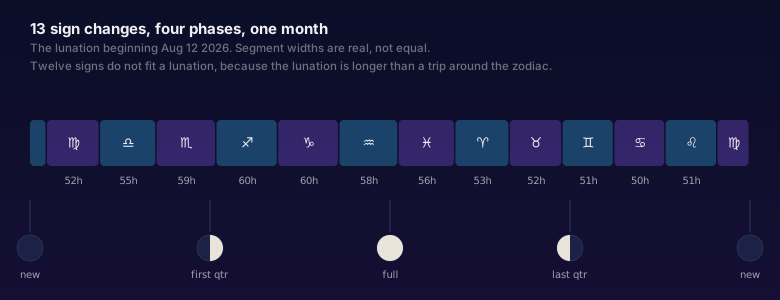
The list below is computed for the current lunar cycle and rebuilt daily. Nothing about the live position is baked into the page a crawler reads — the schedule is what gets published, because it stays true for the whole cycle, and the answer for right now is resolved in your browser.
The ingress instants are found by search rather than by formula: the code samples the longitude coarsely to bracket each boundary crossing, then bisects inside the bracket until the answer is stable to well under a minute. A single root-find would be faster and unsafe, because the Moon can sit within a degree of a cusp on either side of a coarse sample.
- Libra
- Scorpio
- Sagittarius
- Capricorn
- Aquarius
- Pisces
- Aries
- Taurus
- Gemini
- Cancer
- Leo
- Virgo
- Libra
- Scorpio
- Sagittarius
Why the moon sign today will not be the moon sign tomorrow
- 13.2°
- The Moon's daily motion
- 27.32days
- Back to the same sign
- 29.53days
- Back to the same phase
The Moon is by far the fastest-moving body in a chart. It completes the full circuit of the zodiac in 27.32 days, against the Sun's year, Jupiter's twelve years and Pluto's two and a half centuries. That works out to about 13.2° a day, or roughly half a degree an hour.
The rate is not constant. The Moon's orbit is an ellipse, so it moves fastest near perigee and slowest near apogee — between about 11.8° and 15.4° a day. A sign takes as little as 47 hours at the fast end and as much as 61 at the slow end, which is why the intervals in the timeline below are visibly uneven.
This speed is the whole reason the Moon is read the way it is. A placement that changes every couple of days cannot describe anything settled, so the tradition assigns it to mood, immediate circumstance and the texture of a particular day rather than to character. The Sun stays in a sign a month; the Moon has moved on before most people notice it arrived.
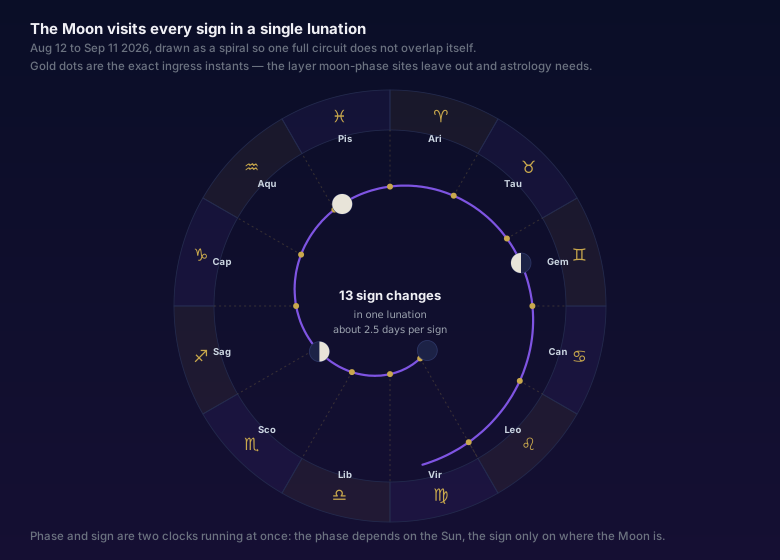
The moon sign and the moon phase run on different clocks
This is the single most useful thing to understand about the Moon, and it explains a great many apparent contradictions between calendars.
The moon sign today repeats every 27.32 days — the sidereal month, measured against the fixed stars. It returns to the same phase every 29.53 days — the synodic month, measured against the Sun. The gap exists because the Earth moves too: after one sidereal month the Moon is back at the same star, but the Sun has advanced about 27°, so it takes another 2.2 days to catch the same angle and repeat the phase.
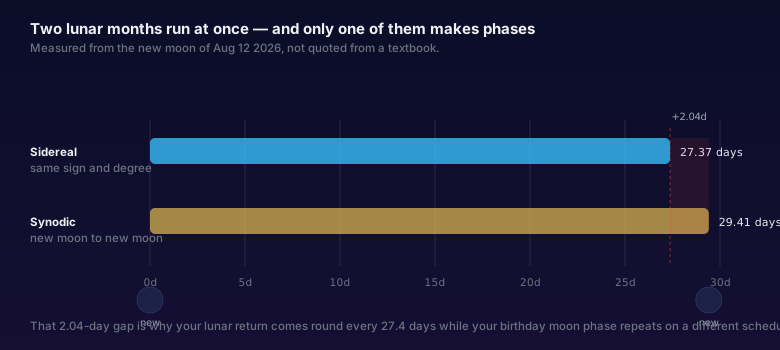
Two consequences follow, and both are things people notice and find confusing. The full moon lands in a different sign each month rather than repeating, because the two cycles slide against each other. And a lunation contains thirteen or fourteen sign changes rather than twelve, because it is longer than a full trip around the zodiac.
It also means a lunar return — the Moon coming back to its birth position — and a moon phase anniversary are different events that only rarely coincide. The lunar return runs on the sidereal clock; the phase runs on the synodic one. Lunar return chart →
What the Moon in each sign is read as
The Moon is read as the reactive, instinctive layer — how a moment feels rather than what it means. Passing through a sign, it is traditionally taken to colour the day's mood with that sign's temperament, which is why moon-sign timing is used for choosing when to do something rather than for deciding what to do.
The fire signs — Aries, Leo, Sagittarius — are read as quick, outward and impatient with detail. The earth signs — Taurus, Virgo, Capricorn — as steady, practical and slow to be moved. The air signs — Gemini, Libra, Aquarius — as talkative, comparative and easily distracted. The water signs — Cancer, Scorpio, Pisces — as receptive, unhurried and hard to argue with.
None of that is a prediction, and it is not the same as a horoscope. The moon sign today is identical for everyone on the planet at this instant, so nothing about it distinguishes one person from another. What differs is which house of your own chart the Moon is crossing, and that needs a birth chart rather than a date.
The body parts each moon sign traditionally rules
This is melothesia — the "zodiac man" — and it is the oldest surviving use of the Moon’s sign. The scheme runs head to foot in zodiacal order: Aries at the crown, Pisces at the feet, with every sign in between taking the next region down. Ptolemy set it out in the *Tetrabiblos* in the second century and it has not changed since.
Medieval and early modern physicians read it as a timing rule and avoided operating on the part the Moon was passing over. We publish the correspondences because you will meet the claim elsewhere and it is worth being able to look up what it actually says. We do not publish a day-by-day verdict on whether to have surgery, and you should not read one into the table: that is a question for a doctor and nothing in the sky bears on it.
| Moon sign | Traditionally associated with |
|---|---|
| Aries | Head, face, brain, eyes |
| Taurus | Neck, throat, vocal cords, thyroid |
| Gemini | Shoulders, arms, hands, lungs, airways |
| Cancer | Chest, breasts, stomach, digestion |
| Leo | Heart, spine, upper back, circulation |
| Virgo | Abdomen, intestines, pancreas, gut |
| Libra | Kidneys, lower back, bladder, skin |
| Scorpio | Pelvis, reproductive organs, bowel |
| Sagittarius | Hips, thighs, liver, sciatic nerve |
| Capricorn | Knees, joints, bones, teeth |
| Aquarius | Calves, ankles, shins, circulation |
| Pisces | Feet, toes, lymphatic system |
Void-of-course, and why it is not on this page
A term worth knowing if you encounter it elsewhere: the Moon is said to be void-of-course between its last major aspect in a sign and the moment it enters the next one. In traditional practice that window is read as a poor time to start something that needs to go somewhere.
This page does not calculate it, and the reason is worth stating rather than hiding. Void-of-course needs the Moon's aspects to every other body, not just its position — a different and heavier computation than the ingress list below, with genuine disagreement between traditions about which aspects count. Publishing it as a by-the-way column would mean picking one convention silently.
What this moon sign today page publishes is unambiguous: where the Moon is, and exactly when it moves. Those are facts every tradition agrees on.
How the moon sign today is calculated
The Moon's ecliptic longitude comes from astronomy-engine, the same ephemeris behind every chart on this site, and the sign is that longitude divided into twelve 30° segments starting at 0° Aries. This is the tropical zodiac, which is what Western astrology uses and what every calculator you are likely to compare against uses.
The ingress instants are found by search rather than by formula: the code samples the longitude coarsely to bracket each boundary crossing, then bisects inside the bracket until the answer is stable to well under a minute. A single root-find would be faster and unsafe, because the Moon can sit within a degree of a cusp on either side of a coarse sample.
Frequently asked questions
What sign is the Moon in today?
The block at the top of this page gives the moon sign today for the moment you are reading it, along with the exact instant the Moon leaves that sign. It updates on the minute and uses your own timezone.
How often does the Moon change sign?
Every two and a quarter days on average — between about 47 and 61 hours depending on where the Moon is in its elliptical orbit. That works out to thirteen or fourteen sign changes in one lunar cycle.
Is this my moon sign?
No. This is the Moon's sign right now, which is the same for everyone alive. Your moon sign is where the Moon was at your birth, and it does not change. The moon sign calculator works that one out from your birth date, time and place.
Why is there no degree for the current position?
Because it would be an interpolation rather than a measurement. The Moon's speed varies by about 12% over an orbit, so a degree derived by interpolating between two ingress instants could be out by a degree and a half. The sign and the change times are exact; the degree in between is not worth printing badly.
What is the difference between the moon sign and the moon phase?
Two different clocks. The sign depends only on where the Moon is against the zodiac and repeats every 27.32 days. The phase depends on the angle between the Moon and the Sun and repeats every 29.53 days. The two-day gap is why the full moon falls in a different sign each month.
Is the Moon void-of-course right now?
This page does not calculate it. Void-of-course needs the Moon's aspects to every other body, not just its position, and traditions disagree about which aspects count — publishing it as an extra column would mean picking one convention silently. The ingress times here are unambiguous.
Why does another site show a different sign?
Timezone, almost always — an ingress near midnight falls on different calendar days in different places. Failing that, check whether the other site uses the sidereal zodiac; Vedic astrology's signs sit about 24° behind the tropical ones, which is nearly a whole sign.
Is this free?
Yes, with no signup and no limit. The Moon's position is a public astronomical fact. What this site charges for is the AI interpretation of your own birth chart.
Related pages
Calculated live from the ephemeris. Page rebuilt daily.