Being chased
Avoidance given a shape: the thing pursuing is usually the thing not faced.
What dreaming about Being chased usually means
Being chased is among the most commonly reported dreams anywhere and one of the few where the traditions broadly agree. The readings converge on avoidance: something is being kept at a distance in waking life, and the dream gives it a body and a direction. What makes the symbol useful is not the chase but the pursuer, and that is the detail most people do not record. Accounts where the pursuer is identified map onto specific situations far more often than accounts where it is a shape. The other consistently reported feature is the physical one — legs that will not work, ground that has become deep — which is reported so frequently that it has become the shorthand for the whole dream. It is also the feature most often explained without reference to symbolism at all: the body is genuinely immobilised during REM sleep, and an attempt to run inside a dream is an instruction the sleeping body does not carry out.
Common variations
Running but not moving
The near-universal version, and the one with a plain physical explanation alongside the symbolic one: muscle tone is suppressed during REM, so the effort is real and the movement is not. That does not make the reading wrong, but it does mean the paralysis is a fact about sleep rather than a message.
Chased by someone with no face
The unidentified pursuer is the commonest form and the least specific. Accounts of it attach more often to a diffuse pressure than to a particular person or problem. Where a face does appear, later, people often describe the dream as changing character entirely.
Chased by an animal
The animal usually matters more than the chase. Readings attach to what the animal is taken to represent, and the reports divide sharply between predators, which read as threat, and domestic animals, which more often read as something familiar turned unpredictable.
Hiding rather than running
A distinct version with its own body of accounts. Hiding involves a decision that running does not, and reports of it attach more often to situations being actively concealed than to ones being fled. The quality people remember is the holding still.
Turning to face what is chasing you
Uncommon, and the one version people almost always remember as significant. It is frequently reported as the point at which a recurring chase dream stops recurring. Whatever the mechanism, the pattern in the accounts is consistent enough to be worth knowing about.
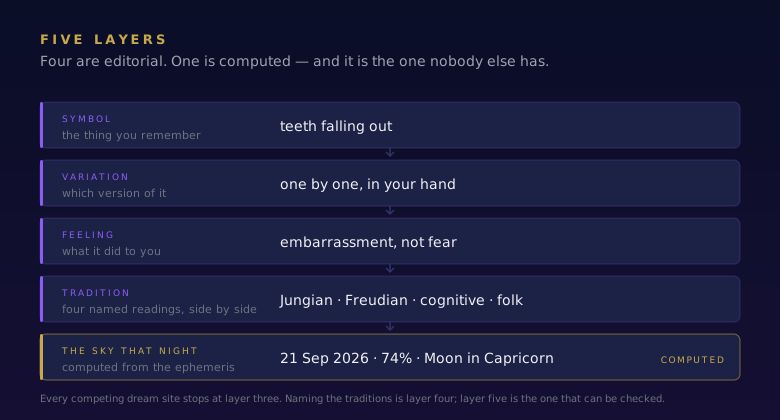
Four ways this is read
The Jungian reading
Treats the image as belonging to a shared vocabulary rather than a personal one, and asks what the image does rather than what it reminds you of. On this account the figures in a dream are closer to characters in a story everybody already knows than to coded references to your own week.
Reads the pursuer as a disowned part of the self rather than an external threat — the material that has been pushed out of the picture and continues to operate anyway. On this account the reason turning to face it changes the dream is that the confrontation is the point, and the pursuit only continues as long as it is refused.
The Freudian reading
Treats the image as a disguise and asks what it is standing in for. It is the most parodied of the four and it produced one durable observation worth keeping: the feeling in a dream is often attached to something other than the thing the dream appears to be about.
Read it as an impulse being kept out of awareness, with the chase as the shape the keeping-out takes. The specific content varied; the structural claim, that the dream dramatises something being held off rather than something approaching from outside, is the part the later traditions kept.
The cognitive or continuity reading
The one closest to current sleep science. It holds that dreams continue waking concerns rather than encoding messages, so the useful question is never "what does it mean" but "what in my week does this resemble". It is also the reading that explains recurrence most simply: an unresolved situation keeps producing similar material.
Has the most to say here, and it is not symbolic. Chase dreams are more frequent in people under sustained pressure, they involve genuine motor activity in the brain, and REM muscle suppression accounts for the specific sensation of not being able to run. The continuity reading then asks the useful question: what in the current week is being postponed rather than handled.
The folk tradition
The oldest layer, and the one with the least explanation attached. Its readings vary sharply between cultures, which is itself informative — a symbol read the same way everywhere is behaving differently from one that is not.
Less developed than for animal or body symbols, because the chase is a situation rather than an object and folk dream-books are organised around objects. Where it appears, it is read as a warning about an enemy or a debt — a reading that points outward, where all three of the other traditions point inward.
How this one is usually misread
The common error is treating the chase as the content and the pursuer as background, which is backwards. Dictionary entries describe the running, the fear and the paralysis because those are the parts every instance shares — and therefore the parts that carry no information about yours. What differs between one chase dream and the next is who or what was behind you, whether it was gaining, and whether you ever turned. A second and more specific misreading is that the paralysis means something. It is a fact about REM sleep, it happens to everyone, and reading it as a message about helplessness is interpreting a physiological constraint as a symbol.
The feeling matters more than the image
Terror is the expected report and it is not the only one. A meaningful share of accounts describe the chase as exhausting rather than frightening, or as tediously familiar in the way a recurring dream becomes, and those attach to different situations — long-running obligations rather than acute threats. The other thing worth recording is whether the pursuer was gaining. People who keep dream records often find that the distance changes over months while the rest of the dream does not, and that the distance tracks the circumstance more closely than any other feature of it.
This one is felt, not only seen
People report this dream partly as a bodily sensation rather than an image — which is why it is remembered vividly and why it is hard to describe afterwards. The sensation is worth noting alongside the content when you write it down, because it is usually the part that changes between one instance and the next.
If it keeps coming back
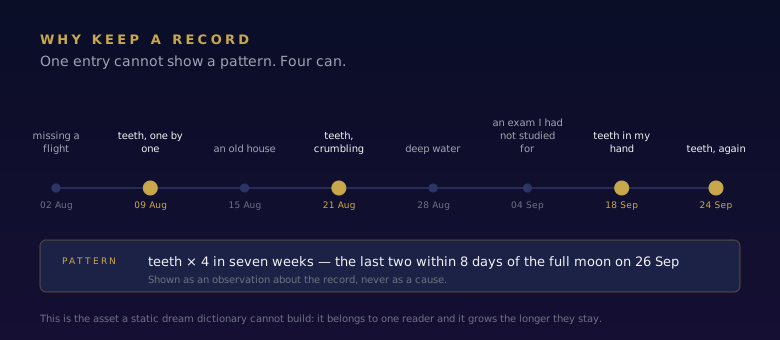
This is one of the symbols most often reported as recurring. The recurrence is more informative than the content: a single instance is an image, and eleven over two years is a pattern that can be checked against your life. The continuity account predicts something testable — recurring dreams tend to stop or change when the circumstances around them change — and people who keep records report exactly that.
The Moon on the night you dreamed it
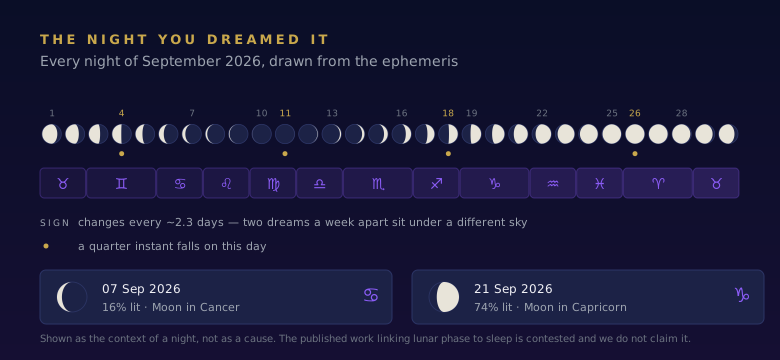
The one thing on this page that can be verified. Enter the night you went to sleep and you get the phase, the illuminated fraction and the sign the Moon held in the small hours, computed rather than asserted. It is context, not a cause — the published research on the Moon and sleep is contested, and the page on it says so.
Related symbols
These are descriptions of how a symbol is commonly read, never statements about you, and nothing here is medical or psychological advice.