An ex-partner
Unfinished business, more often with a version of yourself than with them.
What dreaming about An ex-partner usually means
Dreaming about a former partner is among the most searched dreams and among the most consistently misunderstood, because the obvious reading of an ex-partner dream is almost never the useful one. The accounts do not support the idea that the dream is about wanting the ex back; people report it during settled relationships, years after the fact, about partners they have no wish to see. What it attaches to far more often is a version of yourself that belonged to that period — the person you were then, the things that mattered then, the way that relationship organised your time. The recurring detail that carries information is whether the dream was set in the past or in the present. A dream of an ex-partner in a place you never went together reads quite differently from a dream that replays a room you both knew. This is also a symbol with no folk tradition behind it, which the page says rather than inventing one.
Common variations
Getting back together
The version people find hardest to dismiss and the one that most often prompts a search. The accounts attach less to the ex than to what was unresolved when it ended. Worth noting whether the reconciliation in the dream felt like relief or like resignation, because those go to different places.
Seeing them with someone else
Reported with a sharpness that surprises people who thought the matter closed. It attaches more often to being replaced in general than to jealousy about that person specifically, and it is common during periods of change at work or in friendships.
Arguing with them
The version that most often replays an actual exchange, sometimes years later and sometimes with the things you did not say at the time. The unsaid part is usually the content; what people remember is finally getting to it.
Them ignoring you
Distinct from conflict and reported as worse. Being unacknowledged by an ex rather than opposed attaches to situations where you have no standing to object, which is a specific and often recognisable circumstance once named.
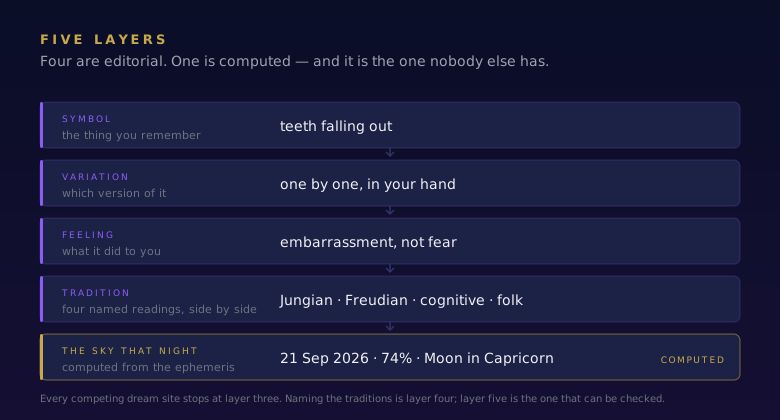
Four ways this is read
The Jungian reading
Treats the image as belonging to a shared vocabulary rather than a personal one, and asks what the image does rather than what it reminds you of. On this account the figures in a dream are closer to characters in a story everybody already knows than to coded references to your own week.
Would read the figure less as the person than as a carrier for something the dreamer has not integrated — which, applied here, lands on the version of yourself from that period rather than on them. The tradition is generally uninterested in the literal relationship, which in this case turns out to match what the accounts describe.
The Freudian reading
Treats the image as a disguise and asks what it is standing in for. It is the most parodied of the four and it produced one durable observation worth keeping: the feeling in a dream is often attached to something other than the thing the dream appears to be about.
Read figures from the past as standing in for earlier attachments still operating, and the specific readings have not aged well. The durable half is the observation this symbol demonstrates better than most: the strength of feeling in the dream is frequently out of proportion to any current feeling about the person, which means it is attached to something else.
The cognitive or continuity reading
The one closest to current sleep science. It holds that dreams continue waking concerns rather than encoding messages, so the useful question is never "what does it mean" but "what in my week does this resemble". It is also the reading that explains recurrence most simply: an unresolved situation keeps producing similar material.
Has the most direct account. The dream is more frequent after any reminder of that period — a photograph, a place, a song, a conversation — and more frequent during transitions of any kind, because a transition makes the previous configuration of your life salient. On this reading an ex-partner is not a message but the most available image of a former self.
There is no folk tradition for this one
The thing in this dream did not exist before the twentieth century, so no pre-modern dream literature has anything to say about it. That is worth stating plainly rather than filling the gap: a dictionary that offers you an ancient reading of a missed flight is inventing one. The other three framings above still apply, and the continuity reading applies especially well, because a modern anxiety is exactly what it is built to describe.
How this one is usually misread
Two misreadings, and the first is nearly universal: that the dream means you want your ex back, or that they are thinking of you. Neither survives contact with the accounts — people report this dream from inside happy relationships, decades later, about partners they actively dislike. The belief persists because the dream is emotionally loud and because a loud dream invites a literal reading. The second error is structural and belongs to the dictionaries: many of them give this symbol a folk tradition. There is not one. The category of "ex-partner" in the modern sense is recent enough that no pre-modern dream literature addresses it, and an entry offering you an ancient reading of it has made the ancient part up.
The feeling matters more than the image
The tone is the most informative thing about this symbol and the most often discarded. Longing, relief, irritation and flat indifference are all commonly reported, and they attach to completely different circumstances — indifference in particular is worth noticing, because a dream about an ex that leaves you unmoved is telling you the dream was not about them. The second detail is the setting. Past settings tend to attach to a period of your life; present or unfamiliar ones tend to attach to something current that the person has become a stand-in for. Both are worth one line in a record, and neither is recoverable an hour later.
If it keeps coming back
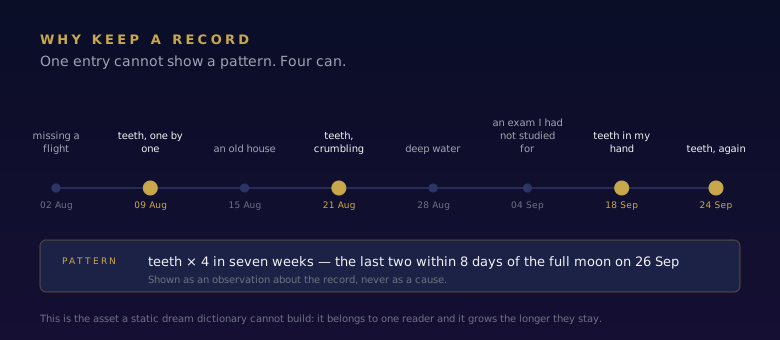
This is one of the symbols most often reported as recurring. The recurrence is more informative than the content: a single instance is an image, and eleven over two years is a pattern that can be checked against your life. The continuity account predicts something testable — recurring dreams tend to stop or change when the circumstances around them change — and people who keep records report exactly that.
The Moon on the night you dreamed it
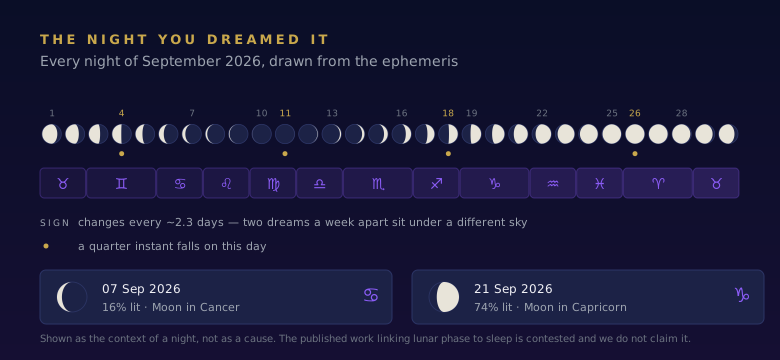
The one thing on this page that can be verified. Enter the night you went to sleep and you get the phase, the illuminated fraction and the sign the Moon held in the small hours, computed rather than asserted. It is context, not a cause — the published research on the Moon and sleep is contested, and the page on it says so.
Related symbols
These are descriptions of how a symbol is commonly read, never statements about you, and nothing here is medical or psychological advice.