Snakes
Something hidden, dangerous or transforming — read very differently across cultures.
3,500 searches a month in United Kingdom, per Google Trends UK, Sep 2026.
What dreaming about Snakes usually means
Snakes are the most Googled dream in the world, and the single symbol where the traditions disagree most sharply — which makes it a good test of how to use a page like this. In much of Europe and North America the snake is read as threat, deceit or something concealed. In parts of India it is read as a form of the divine and the dream is auspicious. In Chinese tradition it can indicate wealth arriving. These are not variations on a theme; they are different answers, and no amount of averaging produces a true one. What survives across them is narrower and more useful: the snake is an image of something that moves without warning and changes state. It sheds, it appears from cover, it is unreadable. Dreams of snakes are commonly reported around situations that are in flux and not fully visible — which is a description broad enough to be worth testing against your own circumstances, and specific enough to be wrong sometimes.
Common variations
Being bitten by a snake
The most reported version and the one people wake from. The bite localises the dream: readings attach to the place it lands, and the detail people remember is usually whether it happened suddenly or after a stretch of being watched. The waiting, where there is any, tends to be the part that maps onto a situation.
Many snakes at once
Volume changes the character. One snake is a thing to face; a floor of them is a situation to get out of, and accounts of this version attach less to a specific threat than to being overwhelmed by a number of small ones. Read against circumstances with several unresolved strands rather than one large problem.
A snake in the house
Combines two symbols, and the combination is the reading. The house is consistently read as the self or the settled part of life, so something unpredictable inside it lands differently from the same thing outdoors. Which room it was in is the detail worth noting.
Killing a snake
One of the few dream actions with a fairly consistent folk reading across traditions, generally positive — a threat resolved. Modern accounts more often emphasise how it felt to do it, which frequently is not triumph. Both are worth holding.
A snake in water
Water is read as feeling and the snake as something unseen, so the pair is often read as something unacknowledged in an emotional situation. Whether the water was clear or murky does more to shape this version than the snake does.
Four ways this is read
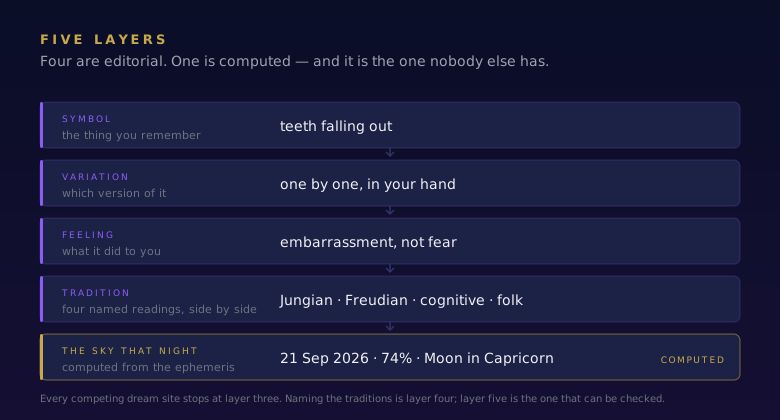
The Jungian reading
Treats the image as belonging to a shared vocabulary rather than a personal one, and asks what the image does rather than what it reminds you of. On this account the figures in a dream are closer to characters in a story everybody already knows than to coded references to your own week.
Treats the snake as one of the oldest images in the shared repertoire — it appears in creation stories, medicine and kingship across cultures with no contact, which is the observation the whole tradition is built on. The reading emphasises transformation, because the snake is the animal that visibly discards a former self, and it is generally not read as an enemy.
The Freudian reading
Treats the image as a disguise and asks what it is standing in for. It is the most parodied of the four and it produced one durable observation worth keeping: the feeling in a dream is often attached to something other than the thing the dream appears to be about.
Read the snake as a sexual image, an interpretation so widely repeated that it has become the joke version of the whole tradition. It is worth stating plainly rather than skipping: it is a single fixed reading applied regardless of context, which is the weakness the later traditions were reacting against.
The cognitive or continuity reading
The one closest to current sleep science. It holds that dreams continue waking concerns rather than encoding messages, so the useful question is never "what does it mean" but "what in my week does this resemble". It is also the reading that explains recurrence most simply: an unresolved situation keeps producing similar material.
Notes something the symbolic readings do not explain: snakes are among a small set of animals that humans detect unusually fast in visual tests, including people who have never seen one. On this account the snake appears in dreams often because it is salient to the visual system, and its frequency needs no symbolic explanation at all.
The folk tradition
The oldest layer, and the one with the least explanation attached. Its readings vary sharply between cultures, which is itself informative — a symbol read the same way everywhere is behaving differently from one that is not.
The layer where the disagreement lives, and the one worth reading comparatively. European traditions lean toward betrayal and hidden enemies; several South Asian traditions read the same dream as blessing or as an ancestor; some East Asian readings connect it to money. A symbol that is read in opposite directions by different cultures is telling you that the reading is cultural, which is itself the most useful thing to know about it.
How this one is usually misread
The misreading here is not a claim but a habit: taking one culture’s reading as the reading. Someone who looks this symbol up in an English-language dictionary is told about betrayal and hidden enemies, and that is a specific tradition’s answer presented as a general one. A reader in India would be handed a substantially more favourable reading of exactly the same dream, and a reader in parts of East Asia a third. None of them is wrong within its own frame and none is the answer. The practical consequence is worth stating: if a snake dream has left you suspicious of someone, check whether that suspicion came from the dream or from a dictionary entry written inside a tradition you did not choose.
The feeling matters more than the image
More than with most symbols, the tone here separates two genuinely different dreams. Fear is the common report, but a substantial minority describe the snake as calm, watchful or even companionable, and those accounts attach to quite different situations — more often to something changing than to something threatening. The distinction that seems to matter most in the reports is whether the snake was approaching or simply present. A snake that does nothing is a different dream from a snake that moves toward you, and the dictionaries that give one entry for both are flattening the thing that carries the information.
If it keeps coming back
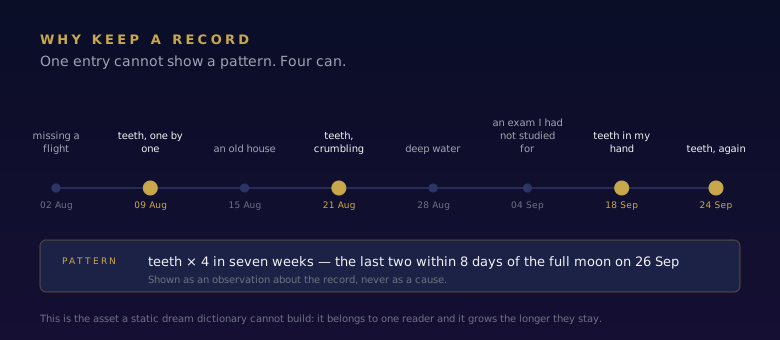
This is one of the symbols most often reported as recurring. The recurrence is more informative than the content: a single instance is an image, and eleven over two years is a pattern that can be checked against your life. The continuity account predicts something testable — recurring dreams tend to stop or change when the circumstances around them change — and people who keep records report exactly that.
The Moon on the night you dreamed it
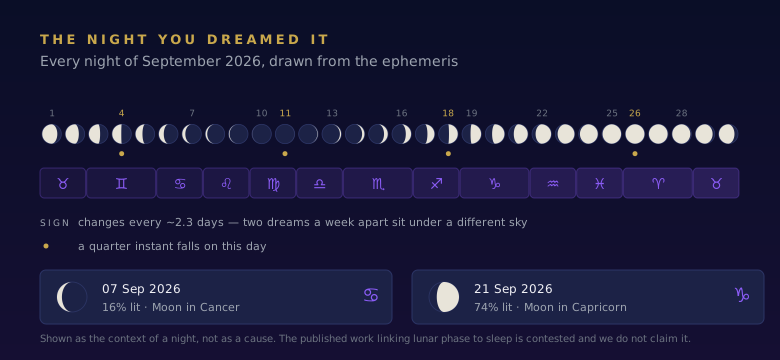
The one thing on this page that can be verified. Enter the night you went to sleep and you get the phase, the illuminated fraction and the sign the Moon held in the small hours, computed rather than asserted. It is context, not a cause — the published research on the Moon and sleep is contested, and the page on it says so.
Related symbols
These are descriptions of how a symbol is commonly read, never statements about you, and nothing here is medical or psychological advice.