Minor Arcana · Wands · fire
Two of Wands
Dates are for 2026 and shift by up to a day between years, because the tropical year is not a whole number of days.
The Book T title
Book T calls this card Dominion, and the word is doing more work than it looks. Dominion is not victory and not achievement; it is the state of having authority over something. The Two of Wands sits at the very start of the fire suit, in the first decan of Aries, which is the first decan of the zodiac — the earliest possible position in the whole circle. So the authority it describes is not earned by a track record. It is the authority of someone who has the means and has not yet spent them, which is a specific and slightly uncomfortable kind of power.
Upright meaning
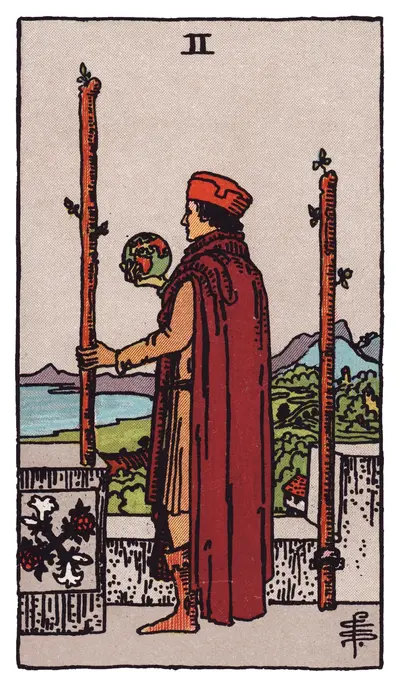
The Two of Wands is the card of holding everything you need and not having moved yet. On the Rider-Waite-Smith card the figure stands on his own battlement with a globe in his hand, and the detail that matters is that he is looking away from it — out past the wall, at somewhere he is not. That is the whole card. Nothing about the position is bad. The holdings are real, the vantage point is high, and the discomfort is entirely about the gap between what could be done and what has been. When it arrives in a reading the useful question is almost never whether to act but what specifically is being deferred, because the answer is usually available and usually being avoided. It is worth separating this from indecision, which is a different state and belongs to other cards. The figure here is not weighing two options; he has one and has not started. Two is the number of the suit where the initial spark of the Ace has taken a form but has not yet been put to use, and the card is honest about how long that condition can persist.
Reversed meaning
Reversed, the gap between capability and action becomes the subject rather than the tension. That usually reads one of two ways and the surrounding cards decide which. The first is a plan that has been held so long it has stopped being a plan and become a comfort — the surveying itself has become the activity. The second is the opposite failure: moving without the survey, leaving the battlement before deciding where to go, which the upright card was specifically not doing. There is also a narrower reading worth knowing: reversed, the Two of Wands sometimes describes authority that turns out to be smaller than it looked from inside. The globe is held, but the territory beyond the wall was never yours to plan for.
What Mars in Aries contributes
Mars in Aries is the only decan in the deck where a planet sits in the sign it rules, in the first ten degrees of the zodiac — the most undiluted placement available. Mars does not deliberate, and Aries does not wait, so the pairing should produce a card about charging forward. It conspicuously does not. That mismatch is the most interesting thing about the Two of Wands and it is what the Book T title resolves: Mars in its own sign at the start of everything is not someone being driven anywhere, it is someone who has the drive entirely under their own command. Dominion is Mars owning itself. The card is still about force; it is about force at rest, which is why the figure is standing still and why the stillness reads as power rather than hesitation.
What is on the card
The figure stands between two staves, and only one is fixed to the wall — the other he holds, which is the composition telling you that half of this is his and half is still being decided. The globe in his right hand is the card’s most quoted detail and the least ambiguous: the world, small enough to hold, and he is not looking at it. The crossed roses and lilies on the wall behind him are desire and thought, the same pairing that appears on the Magician’s table. His back is to the viewer and to his own castle, and the sea in front of him is open. Everything in the frame is arranged so that the wealth is behind and the attention is ahead.
In a love reading
In a relationship question the Two of Wands describes something with real potential that has not been acted on — and the person holding the globe is usually the querent. It reads well on questions about whether something could work and badly on questions about why nothing is happening, because the card’s answer to the second is that nobody has started. Where a relationship already exists it more often points at a shared plan that keeps being discussed: moving, committing, changing the shape of the thing. The resources are there. The conversation has replaced the decision.
In a career reading
Strong on questions about whether you have what a move requires, and the answer it gives is yes. The Two of Wands is the card of the person with the skills, the standing and the option, who has not exercised any of it — which makes it useful on questions about hesitation and unhelpful on questions about how to compete, since nobody in this card is competing. It reads particularly clearly on decisions about leaving: the battlement is yours, and the card is not telling you to stay on it.
How this one is usually misread
The usual error is reading this as a decision between two options, which the imagery does not support and the number invites. Two in the pips is not a fork; it is the first form the suit takes, and the figure on the battlement is holding one globe and looking at one horizon. There is no second path in the card. Where a reading treats it as a choice, the querent is usually being handed a comfort — deliberating feels like progress and a card about deliberation would license more of it, which is precisely what the Two of Wands does not do. The second and more common misreading is optimistic: taking Dominion to mean the thing has been achieved. It means the means to achieve it are in hand, which is a different and much earlier position, and the gap between the two is what the card exists to describe.
How it behaves beside other cards
Next to the Three of Wands it forms a sequence rather than a repetition — Two is the plan, Three is the ships already out — and drawing both suggests the movement has started more than the querent thinks. Beside the Eight of Wands, which is pure velocity, it reads as a delay about to end. Its most informative pairing is with any of the Swords: an air card next to this one usually means the deferral is being defended with reasoning, which the Two of Wands does not do on its own. With the Four of Pentacles it hardens into holding for its own sake.
Why this card has a zodiac sign attached
The thirty-six numbered cards from Two to Ten are mapped one-to-one onto the thirty-six decans — the ten-degree slices the zodiac divides into. Two of Wands holds 0° to 10° of Aries, ruled by Mars in the Chaldean order. That is a lookup from a position on the ecliptic, not an association someone chose, which is why this page can print a degree range and a date range next to it.
Correspondences follow the Golden Dawn attributions set out in Book T. Degrees are computed from each card’s position in the decan sequence rather than transcribed, so they cannot drift from the spread tool on the rest of this site.
Cards next to this one
The rest of Aries
See this card come up in your own chart
The spread on our tarot astrology page reads your chart positions as cards — no shuffle, the same answer every time. The daily card does the same for the Moon’s decan right now.