Minor Arcana · Pentacles · earth
Ace of Pentacles
The Book T title
The Root of the Powers of Earth, and of the four titles this is the one whose meaning is least metaphorical. The root of earth is the capacity of a thing to exist materially — to be made, held, spent or built on. The Ace has no decan and no degrees because it is the source rather than a location, which is the same structural point the other three Aces make and is easiest to see here: every other Pentacles card is a stage of something, and this is the substance those stages are working with.
Upright meaning
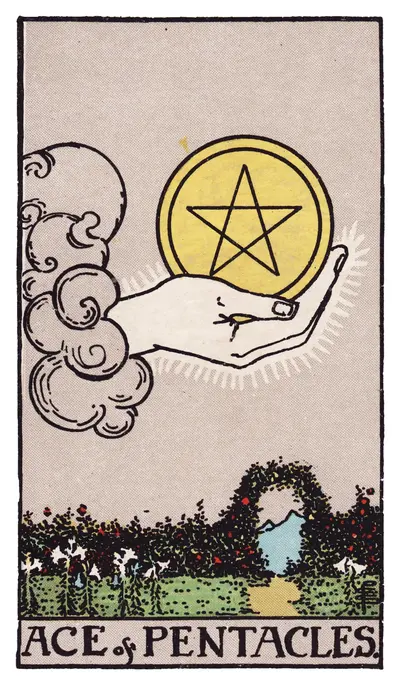
A hand emerges from a cloud holding a single large pentacle, above a walled garden in full bloom with lilies, and an archway in a hedge leading out to mountains. It is the most restful of the four Aces and the most concrete. The Ace of Pentacles is a material opportunity — money, work, a resource, a tangible offer — and what distinguishes it from the abstraction of the other three is that it can be counted. When it arrives, something real has become available and has not yet been accepted. The garden below is the card’s underrated half: it is already cultivated, already in flower, which means the offer is arriving into a life that has something in it rather than into emptiness. The archway leading out is the only route in the image, and it leads away from the garden toward mountains. The four Aces are the only cards in the deck sharing one composition: a hand out of a cloud, a single emblem, and no figure in the frame at all. That is the tradition making a structural point — an Ace is what is available, not what anybody does about it. This one differs from the other three in having a landscape that matters. The Ace of Wands shows empty desert, the Ace of Swords bare mountains, the Ace of Cups still water; here there is a walled garden in flower with an archway leading out. Of the four offers, only this one arrives somewhere specific, and only this one shows what accepting it would mean leaving.
Reversed meaning
Reversed, the offer is compromised in some way. The commonest reading is an opportunity lost or withdrawn, which the surrounding cards usually attribute. A second concerns value: something material arriving that is worth less than it appears, or costs more than it is worth. A third and more useful one is misplaced priority — the pentacle taken and the garden neglected, where the material gain is real and something else pays for it. Reversed, this Ace is more often a qualification than a refusal.
The root of Earth
Earth is the element of substance, endurance and consequence, and the Ace is that before it has been shaped into anything. It is why the emblem is a coin: a coin is pure potential in material form, because it is the one object whose only property is that it can become something else. In the Golden Dawn scheme each Ace rules a quadrant of the heavens rather than a sign, which is the technical reason a chart position never resolves to one — a placement is at a degree, and the root of earth is wherever earth is.
What is on the card
The garden below is walled and planted with lilies, already tended before the offer arrives — the card is quite specific that this lands in an existing life. The archway in the hedge is the only exit and it frames distant mountains, so taking the pentacle implies leaving the garden. The hand holds the coin flat and open rather than gripping it. The pentacle itself is the largest in the deck. There is no figure anywhere in the image, which the Aces share: nobody has accepted anything yet.
In a love reading
Less common than the other Aces on relationship questions and usually literal when it appears — something being built together that has a material dimension: living together, money, a shared undertaking. It reads as steady rather than exciting. On questions about whether a relationship has a future it is one of the more reassuring cards, because it speaks to foundation rather than to feeling, and foundations are what questions about the future are actually about.
In a career reading
The clearest card in the deck for a concrete offer — a job, a contract, a sum, a commission. On questions about whether something will materialise it is among the strongest affirmatives, and unlike the Ace of Wands it indicates something with substance rather than energy. On money questions it is favourable and specific: the amount is real and is not yet in hand. Its practical caution is the archway: accepting the offer means leaving the garden, and the card is unusually clear that a material gain has a location attached.
How this one is usually misread
The frequent error is reading this as wealth arriving, which the Nine and Ten of Pentacles actually depict. An Ace is a seed: one coin, offered, unaccepted, with everything the suit does still ahead of it. Delivered as prosperity it promises an outcome from a card about a starting point. The second misreading is ignoring the garden. Almost every popular reading describes only the hand and the coin, and the walled garden in flower beneath it is half the image — it says the offer is arriving into a life that already exists, and the archway says taking it will mean leaving something. A third habit is reading the archway as an invitation. It is an exit, framing mountains rather than a destination, and the card is noting a cost rather than extending a further offer. What lies through it is not shown.
How it behaves beside other cards
With the Eight of Pentacles the offer becomes work and the work becomes skill, which is the suit’s natural opening sequence. Beside the Seven of Cups it is the one solid option among several imagined ones. With the Five of Pentacles it is help arriving in a period of real shortage. Next to the Two of Pentacles the new resource has to be balanced against an existing one. Its most complete neighbour is the Ten of Pentacles, which is where a single offered coin ends up after three generations. Beside the Page of Pentacles the offer meets somebody willing to learn what it requires. With the Nine of Cups the material and the satisfied arrive together and the card is unusually literal. Next to the Six of Pentacles the coin is being handed over by somebody rather than simply appearing, which changes what accepting it means. Next to the Hermit the offer arrives during a period of deliberate withdrawal and the archway leads back rather than onward. With the Wheel of Fortune the opportunity is timing rather than merit, which changes what declining it would cost. Beside the Knight of Pentacles the offer is accepted and worked at the same steady pace for years.
Why this card has no degrees
The four Aces are the root of their element rather than a place in the zodiac. Ace of Pentacles is the root of Earth. A card with no span cannot be drawn from a chart position, which is exactly why the spread tool never returns one.
Correspondences follow the Golden Dawn attributions set out in Book T. Degrees are computed from each card’s position in the decan sequence rather than transcribed, so they cannot drift from the spread tool on the rest of this site.
Cards next to this one
See this card come up in your own chart
The spread on our tarot astrology page reads your chart positions as cards — no shuffle, the same answer every time. The daily card does the same for the Moon’s decan right now.