Minor Arcana · Wands · fire
Four of Wands
Dates are for 2026 and shift by up to a day between years, because the tropical year is not a whole number of days.
The Book T title
Perfected Work is a title that surprises people who know this card only as the wedding card, and the surprise is instructive. Book T is not describing a celebration but a completion — something brought to the state it was aiming at. The celebration in the imagery is what follows completion rather than what the card is about. Placed in the third and final decan of Aries, it closes the zodiac’s opening sign, which is why the card reads as an arrival rather than a beginning despite sitting so early in the deck.
Upright meaning
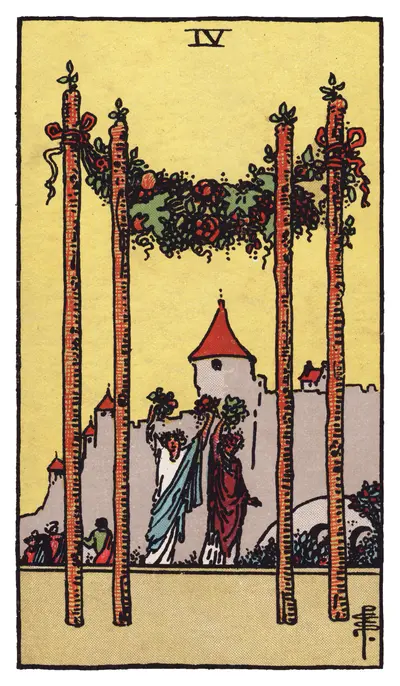
The Four of Wands is the most straightforwardly happy card in the suit and one of the few in the deck with no ambiguity in it at all. Four staves stand garlanded, two figures raise bouquets, a walled town sits behind them in full light. What it describes is a threshold that has been reached and is being marked — a homecoming, a settling, a piece of work finished well enough to stop. The reason it is worth resisting the shorthand reading of "wedding" is that the card is considerably more general than that and more useful for being so. Any structure that now stands where there was none satisfies it. When it arrives, the thing being asked about has reached a stable configuration, and the card’s advice, to the extent it gives any, is to recognise that rather than immediately asking what is next. Four is the number of stability throughout the deck, and in fire it produces the only kind of stability fire can have: not permanence, but a structure solid enough to celebrate inside.
Reversed meaning
Reversed, the Four of Wands rarely turns unpleasant — it is one of the cards that degrades rather than inverts. The commonest reading is a celebration that is internal rather than shared: the completion is real and nobody is marking it, which people report recognising immediately. A second reading concerns the structure rather than the party: the four staves are up but the ground under them is not settled, so the arrangement is being treated as more permanent than it is. Where the surrounding cards are difficult it can describe a homecoming that is not comfortable, and the specific discomfort is usually that the home has stayed the same while the person did not.
What Venus in Aries contributes
Venus in Aries is the card’s odd note and worth sitting with, because Venus is in detriment here — the planet of harmony placed in the sign least interested in it. The standard reading of that placement is friction, and the Four of Wands is not frictional at all. What the pairing actually produces is Venus’s pleasure applied to Aries’s output: not a harmonious process but a harmonious result, arrived at by force and then enjoyed. That is exactly what Perfected Work names. It also explains the card’s slightly temporary feel. Venus is not at home here and cannot settle in; the garland is hung on staves that are still, fundamentally, weapons.
What is on the card
The four staves carry a garland of flowers and fruit slung between their tops, which is the card’s whole structure in one image: something built, then decorated. The two figures in the foreground raise bouquets rather than cups, and they are outside the walls rather than inside them — the celebration is at the threshold, not in the hall. Behind them a crowd and a castle sit in unusually even light, with no shadow anywhere in the frame, which is rare in the deck. The staves are rooted in the ground rather than held by anyone, so unlike most Wands cards nobody in this one is carrying anything.
In a love reading
The most favourable relationship card in the suit and frequently literal — engagement, moving in, a commitment being formalised. Where it is not literal it describes a relationship that has reached a shape both people recognise, which is a real event and worth naming even when nothing external changes. It reads well on questions about stability and poorly on questions about passion, since the card has settled into something and fire that has settled is warm rather than hot.
In a career reading
Completion and the recognition that follows it: a project delivered, a role confirmed, a team that has come together. It is one of the better cards for questions about workplace culture rather than individual advancement, because the Four of Wands is fundamentally collective — nobody in the image is celebrating alone. On questions about whether to take a position it reads as yes and specifically as a place you would belong, which is a narrower claim than the position being good.
How this one is usually misread
Almost every popular source reduces this to the wedding card, and the reduction is worth resisting on two counts. First, it is wrong about scope: Book T calls it Perfected Work, and any structure that now stands where none did satisfies the card — a project finished, a home settled, a group that has become one. Second, it makes the card predictive in a way nothing in it supports, so that people draw it in relationship questions and read an engagement into a card about completion. The other habit worth breaking is treating the celebration as permanence. Four is stability, but this is fire’s version of stability: the garland is hung on staves that remain, fundamentally, weapons, and the figures are outside the walls rather than in the hall. A third and quieter error is reading the card as the end of something. Four is a resting point in the pips, not a conclusion — the Five follows immediately, and what the Five does to any structure is test it. Drawing the Four as an ending rather than a plateau is what makes its sequel feel like a reversal of fortune when it is simply the next number.
How it behaves beside other cards
With the Ten of Cups it becomes almost redundantly favourable and usually points at family rather than work. Beside the Five of Wands, which follows it numerically, the pair reads as a settled structure about to be tested — a useful sequence, because the Five is what happens next to anything built. Next to the Eight of Cups it sharpens into leaving somewhere good, which is one of the harder readings available and one the two cards make together rather than separately. With the Hierophant it leans firmly toward the formal and the ceremonial. With the Ace of Cups the completion turns out to be the start of something rather than the close of it.
Why this card has a zodiac sign attached
The thirty-six numbered cards from Two to Ten are mapped one-to-one onto the thirty-six decans — the ten-degree slices the zodiac divides into. Four of Wands holds 20° to 30° of Aries, ruled by Venus in the Chaldean order. That is a lookup from a position on the ecliptic, not an association someone chose, which is why this page can print a degree range and a date range next to it.
Correspondences follow the Golden Dawn attributions set out in Book T. Degrees are computed from each card’s position in the decan sequence rather than transcribed, so they cannot drift from the spread tool on the rest of this site.
Cards next to this one
The rest of Aries
See this card come up in your own chart
The spread on our tarot astrology page reads your chart positions as cards — no shuffle, the same answer every time. The daily card does the same for the Moon’s decan right now.